What Happens to My Crypto If an Exchange Gets Hacked?
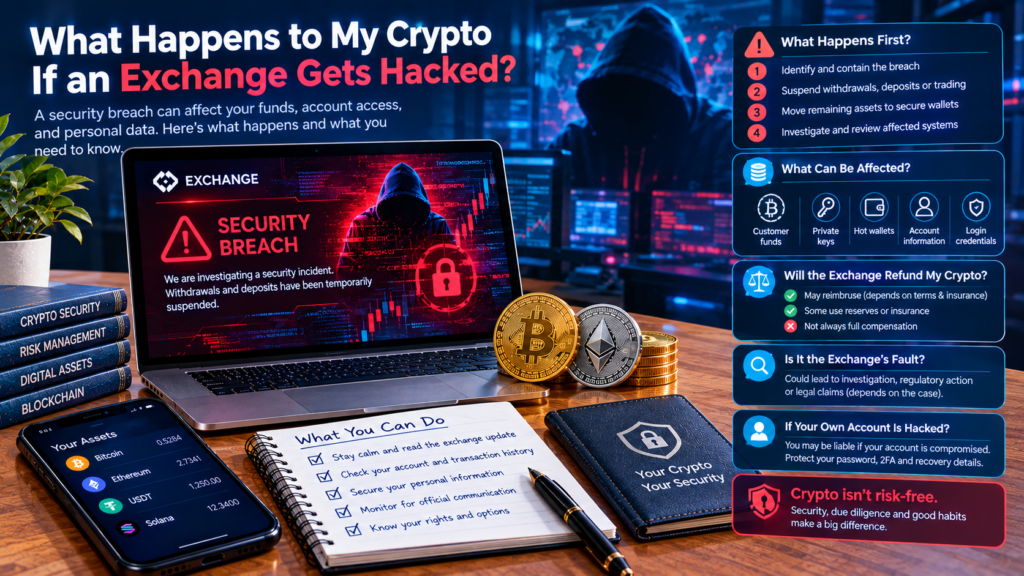
What happens to your crypto if an exchange gets hacked?
This is an important question for anyone who keeps digital assets on a centralized exchange. A successful hack can affect customer funds, account access, personal data, and the exchange’s ability to process withdrawals.
The risk is not theoretical. In February 2025, hackers stole approximately $1.5 billion in ether from Bybit in one of the largest crypto exchange thefts on record. Bybit said its reserves remained sufficient to cover customer assets, but the incident showed how a security breach at an exchange can create serious risks for users.
However, a hacked exchange does not automatically mean that every customer loses their crypto.
So, what actually happens after an exchange hack? And who is responsible for the loss?
What Happens When a Crypto Exchange Gets Hacked?
The first step usually involves identifying and containing the security breach.
An exchange may temporarily suspend withdrawals, deposits, or trading while its security team investigates the incident. The platform may also move remaining assets to secure wallets and review which systems or accounts were affected.
The impact depends on what the attacker accessed.
For example, a breach could involve:
- Customer crypto assets
- Private keys
- Exchange hot wallets
- Customer account information
- Login credentials
- Internal systems
- Third-party custody providers
A security breach can therefore affect customers in different ways.
Some users may experience temporary withdrawal restrictions. Others may face account security issues. In the most serious cases, customers could lose access to some or all of their crypto.
Can I Lose My Crypto If an Exchange Gets Hacked?
Yes, it is possible.
However, the outcome depends on the exchange’s security controls, custody structure, insurance, reserves, contractual obligations, and the circumstances of the hack.
A recent SEC filing discussing digital asset custody risks notes that a hack or compromise of wallets holding customer assets can lead to losses. It also explains that insurance may not cover every type or amount of loss.
Therefore, users should not assume that an exchange hack automatically means the exchange will fully reimburse every customer.
The exact recovery process depends on the specific incident.
Will the Exchange Refund My Crypto?
Not always.
Some exchanges may choose to reimburse affected customers. Others may use company reserves or insurance to cover certain losses. However, coverage can depend on the exchange’s terms and the type of incident.
For example, an exchange may have insurance for certain types of theft or operational losses. Yet insurance policies can contain exclusions, limits, and conditions.
A 2026 SEC filing from a digital asset custody business also noted that insurance coverage may be insufficient to protect customers against all possible losses.
This is why the phrase “the exchange was hacked, so the exchange must pay me back” is too simple.
The legal and contractual position can vary.
What If the Hack Was the Exchange’s Fault?
This is where personal liability and exchange responsibility become important.
If an exchange failed to follow its legal, contractual, or security obligations, affected customers may have potential claims depending on the jurisdiction and the terms of their agreement.
However, customers should not assume that every hack automatically creates a right to full compensation.
The investigation may examine:
- How the attacker gained access
- Whether private keys were compromised
- Whether employees or contractors were involved
- Whether the exchange followed its security procedures
- Whether customer assets were properly safeguarded
- What the exchange’s terms and custody agreement say
- Whether insurance applies
- Whether regulators or courts become involved
In some cases, an exchange may face regulatory action or litigation after a security incident. SEC filings from crypto businesses warn that security incidents can result in regulatory investigations, fines, lawsuits, and significant financial losses.
What If My Own Account Was Hacked?
This situation can be different from an exchang wide hack.
If an attacker compromises your personal account through phishing, a stolen password, malware, or another form of account takeover, the exchange may investigate the incident under its own policies.
Your responsibility can depend on how the account was compromised and what security requirements you agreed to when using the platform.
For example, users should protect:
- Passwords
- Two-factor authentication codes
- Recovery methods
- Email accounts
- Devices used to access the exchange
- API keys
- Withdrawal settings
A strong exchange security system cannot protect an account if a user voluntarily gives an attacker their login credentials or authentication codes.
Exchange Hack vs Personal Account Hack
These two situations should not be confused.
| Situation | What May Happen |
|---|---|
| Exchange hot wallet is hacked | Customer assets may be affected |
| Exchange private keys are compromised | Crypto may be stolen |
| Exchange database is breached | Customer information may be exposed |
| Your exchange account is hacked | Your individual funds may be at risk |
| You send crypto to a scammer | Recovery may be extremely difficult |
| Exchange becomes insolvent | Access to assets may depend on legal and bankruptcy proceedings |
The responsibility can be different in each case.
Therefore, understanding where the security failure happened is important.
Is Crypto on an Exchange Insured?
Do not assume that crypto held on an exchange has the same protection as money in a traditional bank account.
The US Federal Trade Commission says cryptocurrency held in an account is not insured by the government in the same way as US dollars held in an FDIC-insured bank account. If a crypto company goes out of business or is hacked, the government does not have an obligation to reimburse the user.
Some exchanges or custodians may have private insurance policies.
However, private insurance is different from government-backed deposit insurance. Coverage can also have limits and exclusions.
Therefore, check the exchange’s custody and insurance terms before assuming your crypto has full protection.
What Happens to My Crypto During an Investigation?
An exchange may temporarily restrict certain services after a major security incident.
For example, the platform could pause withdrawals while investigators determine which wallets or systems were affected.
This can be frustrating for customers because the crypto may still appear in their account while withdrawals remain unavailable.
The exchange may then announce additional information about the incident, recovery efforts, compensation plans, or changes to its security systems.
In larger cases, regulators, law enforcement agencies, auditors, insurers, or courts may also become involved.
The process can take time.
Can an Exchange Recover Stolen Crypto?
Sometimes, but recovery is not guaranteed.
Blockchain transactions are generally difficult to reverse once confirmed. If stolen assets move through multiple wallets, exchanges, bridges, or other services, tracing and recovering them can become more complicated.
A crypto company may work with blockchain analytics firms, other exchanges, law enforcement, and security researchers to identify stolen funds.
However, identifying stolen crypto does not automatically mean that the assets can be recovered.
This is one reason exchange security and custody controls remain important.
What Can I Do If My Exchange Gets Hacked?
If an exchange announces a security breach, avoid making rushed decisions.
First, follow the exchange’s official security instructions. Use the official website or app rather than links sent through social media or private messages.
Next, secure your account if the exchange recommends changing your password or authentication settings.
You should also watch for phishing scams.
Hackers and scammers may use a major exchange hack as an opportunity to impersonate the platform. They may claim that you need to verify your wallet, pay a recovery fee, or provide your recovery phrase.
Never share your private keys or wallet recovery phrase with someone claiming to recover your stolen crypto.
The FTC warns that cryptocurrency transactions and wallet compromises can be difficult to recover, and users should be cautious about scams involving crypto payments.
How Can I Reduce Exchange Security Risks?
You cannot eliminate exchange risk completely, but you can reduce your exposure.
Use Strong Account Security
Enable two-factor authentication and use a unique password for your exchange account.
Also, protect the email account connected to the exchange because attackers may target it to reset your account.
Keep Only What You Need for Trading
If you actively trade, you may need funds on an exchange.
However, you do not necessarily need to keep every crypto asset you own on a trading platform.
Some users keep trading funds on an exchange and store longer-term holdings in self-custody.
Check Withdrawal Controls
Use available withdrawal protections, address allowlists, and other security features when appropriate.
These tools can make unauthorized withdrawals more difficult.
Watch for Phishing
Never click suspicious links claiming to come from an exchange.
Instead, open the official exchange website or app directly.
Understand the Custody Terms
Before depositing significant funds, read how the platform handles customer assets.
Look for information about custody, asset segregation, insurance, withdrawal restrictions, and what happens if the company becomes insolvent.
Does Self-Custody Eliminate Hack Risk?
No.
Self-custody changes the type of risk rather than eliminating it.
With an exchange, you depend on the platform to protect assets held in its custody.
With self-custody, you control the wallet and private keys. Therefore, you become responsible for protecting them.
The UK’s FCA recently clarified that genuine self-custody involves the customer having control over the crypto and the firm having no means to transfer the asset itself.
However, self-custody can expose users to different risks, including lost recovery phrases, phishing attacks, malicious transactions, and device compromise.
What Does the Latest Crypto Custody Regulation Mean?
Crypto custody is also receiving more attention from regulators.
On October 1, 2026, the US SEC proposed new rules covering how registered investment advisers and regulated funds can custody crypto assets. The proposal includes specific conditions for certain self-custody arrangements.
The proposal is not a final rule, and it does not mean that retail users must move their crypto away from exchanges.
Instead, it shows that regulators are paying closer attention to how digital assets are stored, controlled, and protected.
This makes exchange security and custody an increasingly important issue for the crypto market.
The Bottom Line
So, what happens to your crypto if an exchange gets hacked?
You may not automatically lose your funds, but you also should not assume that every loss will be fully reimbursed.
The outcome depends on the nature of the hack, the exchange’s custody structure, its contractual obligations, insurance coverage, security practices, and the laws that apply.
A major exchange hack can lead to frozen withdrawals, investigations, asset recovery efforts, legal disputes, or customer compensation programs.
For individual users, the best protection starts with understanding the risks before depositing funds.
Use strong account security, enable two-factor authentication, watch for phishing attempts, and understand how the exchange handles customer assets.
Most importantly, remember that keeping crypto on an exchange means trusting a third party with custody or access arrangements.
If you want greater control, self-custody is another option. However, that shifts more security responsibility to you.
There is no completely risk-free storage method. The key is understanding who controls your crypto, what happens if something goes wrong, and what protections actually apply to you.
💸 GET PAID GLOBALLY WITH KOLAN
USD, GBP, EUR & AED accounts
Sign up: https://forms.gle/QVri289ukKMFR6Qn8
🔐 SECURE YOUR CRYPTO WITH ONEKEY OR ELLIPAL
Free delivery over US$99 + up to 5 USDT cashback
OneKey: https://onekey.so/r/TRC
Ellipal: https://www.ellipal.com/?rfsn=9305287.28d2ea6
🌍 GO GLOBAL WITH MYPAL
https://h5.mypal.pro/pm/vhcn?code=27090432
🔗 CONNECT WITH CRYPTOMARTSITE
https://msha.ke/cryptomart.site
Leave a Reply