US Crypto Bill Adds New DeFi Rules Ahead of Crucial Senate Vote
For years, one of the biggest questions in U.S. crypto regulation has been surprisingly simple:
Who is actually responsible when there is no central company running the system?
That question has become much more important as decentralized finance, or DeFi, has grown.
Now, the latest version of the U.S. CLARITY Act has taken direct aim at that grey area.
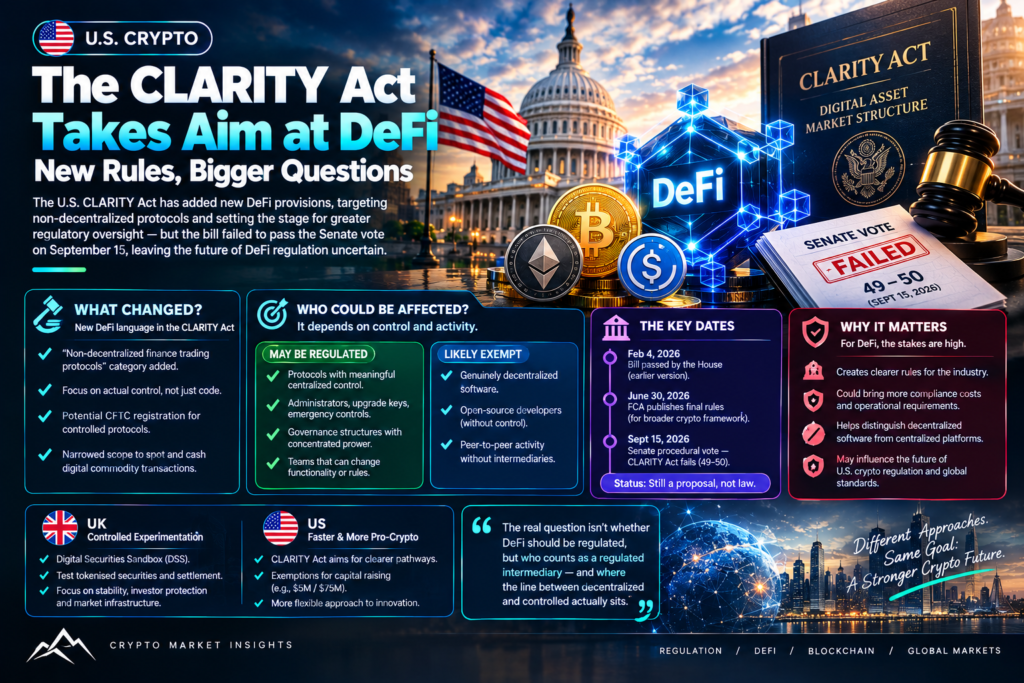
Before its crucial Senate vote on September 15, Republican lawmakers released a heavily revised version of the bill containing new provisions for DeFi protocols that are not considered genuinely decentralized.
The proposed framework could require certain protocols with meaningful centralized control to register with the Commodity Futures Trading Commission (CFTC).
But there is an important twist.
The Senate ultimately failed to advance the CLARITY Act in the September 15 procedural vote, meaning these new DeFi provisions have not become law.
So what exactly changed?
And does the proposed framework make DeFi clearer — or simply create another layer of compliance?
The CLARITY Act Just Got More Specific About DeFi
The revised CLARITY Act was released as a roughly 630-page text before the Senate’s September 15 procedural vote.
Among the changes was a new category covering “non-decentralized finance trading protocols.”
The basic idea is to distinguish between genuinely decentralized software and protocols where a person or group still has meaningful control over how the system operates.
The bill looks at factors such as whether someone can control or materially alter a protocol’s functionality, rules or operations.
That distinction matters because not every project calling itself “DeFi” is equally decentralized.
Some protocols may have administrators.
Others may have upgrade keys, emergency controls, centralized foundations or concentrated governance.
Under the revised proposal, those forms of control could bring a protocol into a regulated category.
Who Would Fall Under the New DeFi Rules?
This is probably the most important part of the revision.
The proposal does not simply say that every DeFi developer must register with the government.
Instead, the focus is on whether someone actually has meaningful control over a covered trading protocol.
That could include situations where a person or group can materially change the protocol’s functionality or rules.
The proposed framework would direct the relevant regulators to establish requirements for these non-decentralized protocols, including potential CFTC registration and compliance obligations.
In other words:
Code alone is not necessarily the target. Control is.
That distinction could become extremely important for developers, protocol teams and decentralized organizations.
Fully Decentralized Protocols Could Get More Protection
The other side of the proposal is just as important.
The CLARITY Act has long included protections aimed at software developers and peer-to-peer activity.
The Senate Banking Committee has described the approach as focusing regulation on centralized intermediaries rather than simply treating software developers as financial intermediaries.
The latest draft continues that general philosophy.
A protocol that genuinely operates without a person or group retaining meaningful control would be treated differently from a platform where administrators can still make significant changes.
That creates a potential regulatory line:
Decentralized software on one side.
Controlled financial infrastructure on the other.
The difficult part is determining where the line actually sits.
The “Admin Key” Problem
This is where things become complicated.
Imagine a DeFi protocol that is mostly automated.
Users interact directly with smart contracts.
There is no traditional company holding customer funds.
At first glance, it looks decentralized.
But what if a development team still holds an upgrade key?
Or an emergency multisig can pause the protocol?
Or a foundation can change important parameters?
Or a small group controls enough governance tokens to determine major decisions?
The latest CLARITY language attempts to address precisely these situations by focusing on actual control rather than simply whether a project uses blockchain technology.
That could make the regulatory framework more targeted.
But it could also create difficult compliance questions for projects operating in the grey area between decentralized software and centralized financial services.
So, Would DeFi Developers Have to Register?
Not automatically.
Writing open-source code is not the same thing as operating a centralized exchange.
The proposed rules are more focused on people or groups that control a covered trading protocol.
That means a developer contributing code to a genuinely decentralized project could be treated differently from a team that retains substantial operational control.
This distinction is critical.
If regulation were applied simply because someone wrote or maintained blockchain code, the potential compliance burden could become enormous.
The revised approach instead attempts to connect regulatory obligations to control and activity.
DeFi Rules Were Also Narrowed
Another notable change involves the scope of certain DeFi provisions.
The revised language narrowed relevant DeFi treatment to spot and cash digital commodity transactions.
Part of the change was connected to concerns around prediction markets and how the legislation could interact with other areas of law.
That means the bill was not simply expanding regulation across every type of on-chain activity.
It was also trying to define where its DeFi framework actually applies.
Why This Could Matter for DeFi
For the DeFi industry, regulatory clarity can have two very different meanings.
On one hand, clear rules can make it easier for businesses, developers and investors to understand what is allowed.
A project can potentially structure itself around known requirements rather than guessing how regulators might interpret existing securities and commodities laws.
On the other hand, registration, reporting, AML obligations and other compliance requirements can create significant costs.
That is especially relevant for smaller protocols that do not operate like traditional financial companies.
So the central question is not simply:
“Will DeFi be regulated?”
It is:
“Who counts as a regulated DeFi intermediary?”
That may ultimately be the more important question.
The Biggest Issue: Where Does Decentralization End?
This is the heart of the debate.
Blockchain projects often describe themselves as decentralized while still maintaining some form of human coordination.
There can be developers.
There can be foundations.
There can be governance systems.
There can be multisig wallets.
There can be front-end operators.
And there can be people with the ability to upgrade or pause smart contracts.
The CLARITY Act is attempting to distinguish between these structures rather than treating every blockchain protocol as identical.
The legislation’s section-by-section explanation specifically says decentralized governance by itself would not constitute control by a person or group.
Instead, the focus is on actual authority over the protocol’s operation.
That could become one of the most consequential definitions in future U.S. crypto regulation.
But the CLARITY Act Did Not Make It Through the Senate Vote
There is an important update to the story.
The Senate held its procedural vote on September 15.
The CLARITY Act failed to reach the 60 votes needed to advance, with the Senate voting 49–50.
That means the revised DeFi provisions remain part of a proposed legislative framework, not enforceable U.S. law.
The bill is not necessarily permanently dead, but the failed vote means the proposed DeFi framework will not immediately become the new federal rulebook for decentralized finance.
And that leaves the central regulatory question unresolved.
Does CLARITY Make DeFi Clearer?
Potentially — but with a trade-off.
The proposed framework tries to create a clearer distinction between genuinely decentralized software and protocols that still have centralized control.
That could reduce one type of uncertainty.
But once a protocol crosses the line into the regulated category, the compliance burden could become much heavier.
Registration.
Recordkeeping.
Market-integrity requirements.
Potential AML obligations.
Regulatory supervision.
For a large financial platform, these may be manageable.
For a small open-source protocol, they could be much harder.
So regulatory clarity does not necessarily mean less regulation.
Sometimes it means more clearly defined regulation.
The Bigger Picture
The CLARITY Act debate shows how difficult it is to regulate DeFi using rules originally designed around traditional financial intermediaries.
A bank has a legal entity.
An exchange has an operator.
A broker has a compliance department.
A DeFi protocol can have thousands of users, open-source code and no single organization that obviously controls the system.
That is exactly what makes DeFi innovative — and exactly what makes it difficult to regulate.
The latest CLARITY proposal attempted to solve that problem by focusing less on the label “DeFi” and more on who actually controls the system.
Whether that approach survives future negotiations remains uncertain after the Senate vote failed.
But one thing is becoming increasingly clear:
The next major battle in U.S. crypto regulation may not be about Bitcoin or stablecoins.
It may be about defining exactly what “decentralized” means.
And whoever gets to define that line could have a major influence on the future of DeFi in the United States.
Need to Receive International Payments?
Open your USD, GBP & EUR account with Kolan.
Fill out the form and book your free consultation.
Secure Your Crypto With OneKey
Looking for a safer way to store your crypto?
Shop OneKey hardware wallets and protect your digital assets with a dedicated hardware wallet.
Join the CryptoMartLive Community
Stay connected with the latest crypto news, market developments, and opportunities.
WhatsApp: CryptoMartLive WhatsApp Group
Telegram Group: CryptoMartLive Telegram Group
Telegram: @sungazerlive
Instagram: @cryptomartlive
Crypto moves fast. Stay informed. Stay ahead.
Tinggalkan Balasan