Trump Backs New Ethics Deal as CLARITY Act Faces Crucial Senate Vote
The biggest U.S. crypto bill in years is back in the spotlight.
But this time, the biggest obstacle isn’t really about crypto.
It is about ethics.
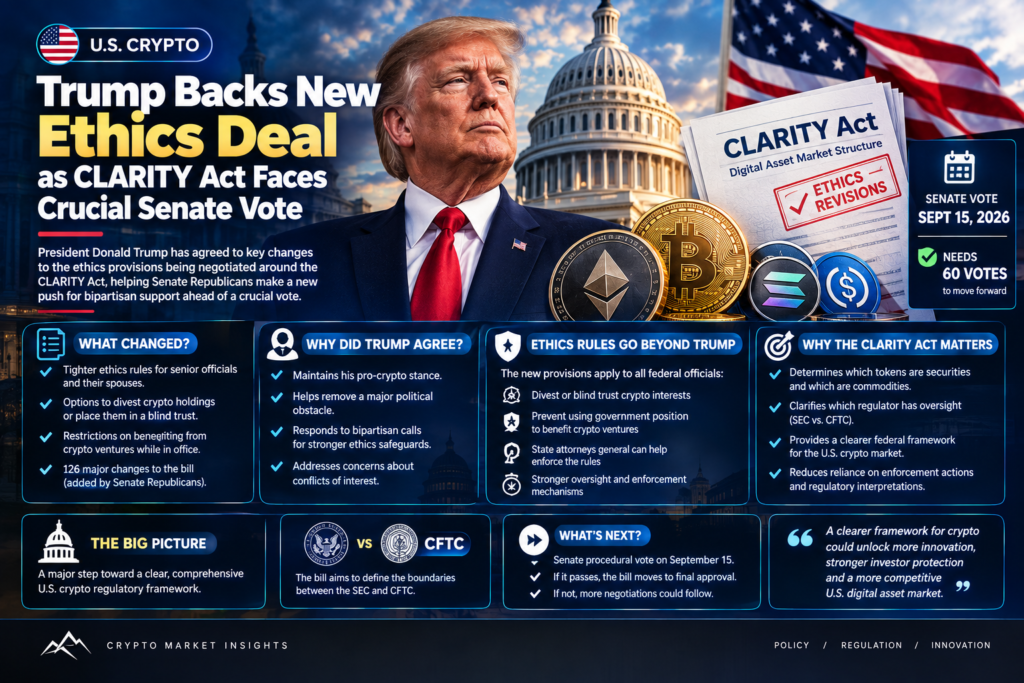
President Donald Trump has agreed to key changes to the ethics provisions being negotiated around the CLARITY Act, helping Senate Republicans make a new push for bipartisan support ahead of a crucial procedural vote.
The revised bill includes tougher restrictions on how senior government officials and their spouses can hold or profit from certain crypto interests.
And now the timing is critical.
The U.S. Senate is scheduled to take a major procedural vote on the CLARITY Act on September 15.
The bill needs 60 votes to move forward.
If it gets there, the United States could be one major step closer to finally establishing a broad federal framework for the crypto industry.
If it doesn’t, the legislation could be pushed back into another round of negotiations.
What Changed in the CLARITY Act?
The latest version of the bill is significantly different from the one that previously stalled in the Senate.
Senate Republicans released a revised draft containing 126 significant changes requested by Democrats.
One of the most politically sensitive areas is ethics.
The new language places tighter restrictions on federal officials who have significant financial interests in crypto-related businesses.
The proposal also includes requirements related to divesting certain crypto holdings or placing them into a qualified blind trust.
There are additional restrictions around government officials and their spouses benefiting from digital-asset ventures while serving in public office.
The changes are designed to address concerns that lawmakers could potentially influence crypto policy while simultaneously benefiting financially from the industry.
And that issue has been particularly sensitive because of Trump’s own ties to the crypto industry.
Why Did Trump Agree to the Changes?
This is where the story gets politically interesting.
Trump has positioned himself as a strongly pro-crypto president.
His administration has pushed for clearer digital-asset rules, while Republicans in Congress have made passage of the CLARITY Act a major legislative priority.
But Democrats have repeatedly argued that the bill needs stronger safeguards around conflicts of interest.
The ethics debate became especially difficult because Trump and his family have substantial connections to crypto businesses.
That created an obvious political problem.
How can Congress pass a crypto market structure bill while lawmakers and senior officials could potentially benefit from the same industry they are regulating?
Trump’s agreement to the new ethics language appears to be an attempt to remove one of the biggest obstacles standing between the bill and a Senate vote.
The Ethics Rules Go Beyond Trump
The new provisions are not simply about the president.
They are designed to establish broader restrictions for federal officials.
Under the proposed framework, officials with significant crypto interests could face requirements to either divest those interests or place them into a blind trust.
The rules also seek to prevent public officials from using their government positions to benefit crypto ventures in which they or their families have financial interests.
Another important change would give state attorneys general a role in enforcing certain ethics provisions, alongside federal enforcement mechanisms.
That could give the rules more teeth if they eventually become law.
Why Is the CLARITY Act So Important?
The CLARITY Act is much bigger than the current ethics fight.
At its core, the legislation is designed to create clearer rules around the U.S. digital-asset market.
One of the biggest questions in American crypto regulation has always been:
Which tokens are securities, and which ones are commodities?
And just as importantly:
Which regulator should oversee them?
The CLARITY Act attempts to provide a framework for determining those responsibilities.
That could reduce one of the biggest sources of uncertainty facing crypto companies in the United States.
Instead of relying heavily on enforcement actions and regulatory interpretations, the industry could finally have a clearer set of rules to operate under.
The SEC vs. CFTC Question
A major part of the bill involves the division of responsibilities between the Securities and Exchange Commission (SEC) and the Commodity Futures Trading Commission (CFTC).
The legislation aims to establish clearer boundaries around which digital assets and activities fall under each regulator.
For crypto companies, that distinction matters enormously.
Being classified under securities rules can mean very different compliance requirements compared with being treated as a commodity.
The CLARITY Act could therefore reshape how exchanges, token issuers, developers and other digital-asset businesses operate in the U.S.
Stablecoins Are Also Part of the Debate
The CLARITY Act isn’t happening in isolation.
The United States has already taken major steps toward creating a federal framework for payment stablecoins through the GENIUS Act.
That means lawmakers are now dealing with several pieces of the digital-asset puzzle at the same time.
Stablecoins.
Crypto market structure.
Token classifications.
Consumer protection.
Banking.
And now ethics.
The overlap is one reason the legislation has become so complicated.
The banking industry has also raised concerns that stablecoins could compete directly with traditional bank deposits.
Banks worry that large-scale movement of money into stablecoins could reduce the deposits they rely on to fund lending.
That debate has become another major sticking point in negotiations around the bill.
The Banking Industry Isn’t Fully Sold
Crypto companies are obviously pushing hard for the CLARITY Act.
But not everyone in traditional finance is celebrating.
Banking groups have warned that some provisions could give stablecoins an advantage over traditional deposits.
Their concern is relatively straightforward.
If consumers and businesses can hold large amounts of money in stablecoins, some of that money could leave bank accounts.
Less money in bank deposits could potentially mean less funding available for loans.
That could have implications for the broader financial system.
So while the crypto industry sees the CLARITY Act as a major step toward regulatory certainty, some banks see parts of the bill as a potential threat to their existing business model.
Why the September 15 Vote Matters
This is where the story becomes much more than another Washington negotiation.
The Senate vote scheduled for September 15 is a procedural vote, not the final vote that would turn the CLARITY Act into law.
But it is still extremely important.
The bill needs 60 votes to clear the procedural hurdle.
That means Republicans will need support from Democrats.
And that is exactly why the ethics compromise matters.
Republicans have already incorporated a large number of Democratic requests into the latest version.
But some Democrats still argue that the changes do not go far enough.
So the question is no longer simply whether Republicans support the bill.
The real question is:
Can enough Democrats and Republicans agree that this version is good enough to move forward?
This Is a Very Different Crypto Market Than a Few Years Ago
The political fight over the CLARITY Act also shows how much the crypto industry has changed.
A few years ago, crypto regulation was often treated as a niche technology issue.
Today, it is tied directly to banking, payments, financial markets and even government ethics.
Major financial institutions are building crypto infrastructure.
Stablecoins are becoming an important part of digital payments.
Tokenized assets are expanding.
And lawmakers are now trying to determine how all of these pieces fit into the existing financial system.
That makes the CLARITY Act potentially one of the most consequential pieces of crypto legislation in the United States.
What Happens If the Bill Passes?
If the CLARITY Act eventually becomes law, the biggest change could be regulatory certainty.
Crypto companies would have a clearer framework for determining what rules apply to their businesses.
The SEC and CFTC would have more clearly defined responsibilities.
Market participants could have a better understanding of how different types of digital assets are treated.
And institutional investors could potentially feel more comfortable entering the U.S. crypto market.
That doesn’t mean regulation would suddenly become easy.
Companies would still face compliance requirements.
But at least the rules could become more predictable.
And predictability is something the crypto industry has been asking Washington for years.
What If It Fails?
The opposite scenario could be just as important.
If the Senate cannot reach the 60-vote threshold, the CLARITY Act could stall again.
That would not necessarily mean crypto regulation disappears.
The SEC, CFTC, Treasury and other agencies would continue developing their own regulatory approaches.
But the industry could remain stuck with a patchwork of rules and ongoing uncertainty.
For crypto companies considering whether to build in the United States, that uncertainty can be expensive.
It can influence where companies incorporate, where they launch products and how much capital they are willing to invest.
The Crypto Industry Is Watching Closely
The industry has been lobbying heavily for the legislation.
Crypto advocacy groups and companies have spent significant resources trying to convince lawmakers that the U.S. needs clearer rules.
The banking industry has been lobbying too.
So have consumer advocates and lawmakers concerned about financial stability.
That makes the CLARITY Act a rare piece of legislation where several powerful industries have something significant at stake.
And with the 2026 midterm elections approaching, the political window is getting tighter.
If Congress wants to make major progress, lawmakers have a limited amount of time to do it.
Trump’s Concession Could Be the Turning Point
The interesting part of Trump’s decision is that it shows how far negotiations have moved.
Trump could have rejected the ethics provisions entirely.
Instead, he agreed to key restrictions that Republicans believe could help bring enough Democratic support to the table.
That doesn’t guarantee the bill will pass.
It doesn’t even guarantee that the Senate will clear the procedural vote.
But it removes one of the biggest political roadblocks.
And that is significant.
For a bill that has already spent months moving between negotiations, committee discussions and political pressure, even a narrow compromise can make a difference.
The Bigger Picture
The CLARITY Act is ultimately about more than defining crypto regulation.
It is about deciding what role digital assets will have inside the American financial system.
If the bill passes, the U.S. could move closer to a regulatory structure where crypto exchanges, token issuers, developers, institutional investors and traditional financial companies all have clearer rules to follow.
If it fails, the debate will continue.
But one thing is already obvious.
Crypto is no longer a side issue in Washington.
It has become part of the conversation around banking, payments, investment, financial stability and government ethics.
And now, President Trump has made a major concession to try to get the legislation across the finish line.
The Senate’s next move could determine whether that gamble pays off.
The CLARITY Act is no longer waiting for another debate.
It is waiting for 60 votes.
Need to Receive International Payments?
Open your USD, GBP & EUR account with Kolan.
Fill out the form and book your free consultation.
Open Your Account: https://bit.ly/4iYqi4N
Shop OneKey
Looking for secure crypto hardware to protect your digital assets?
Shop OneKey: https://onekey.so/r/TRC
Join Our Community & Let’s Discuss
Want to stay updated on crypto, blockchain, DeFi, RWA, payments, regulation, and the latest market developments?
👥 WA Community: https://chat.whatsapp.com/BfQJOFveLuK8QShcJnxDJF
🌐 Telegram Group: https://t.me/cryptomartlive
📲 Telegram: @sungazerlive
📸 Instagram: @cryptomartlive
Crypto moves fast. Stay informed. Stay ahead.
Tinggalkan Balasan