South Africa Is Testing What the Future of Banking Could Look Like on Blockchain
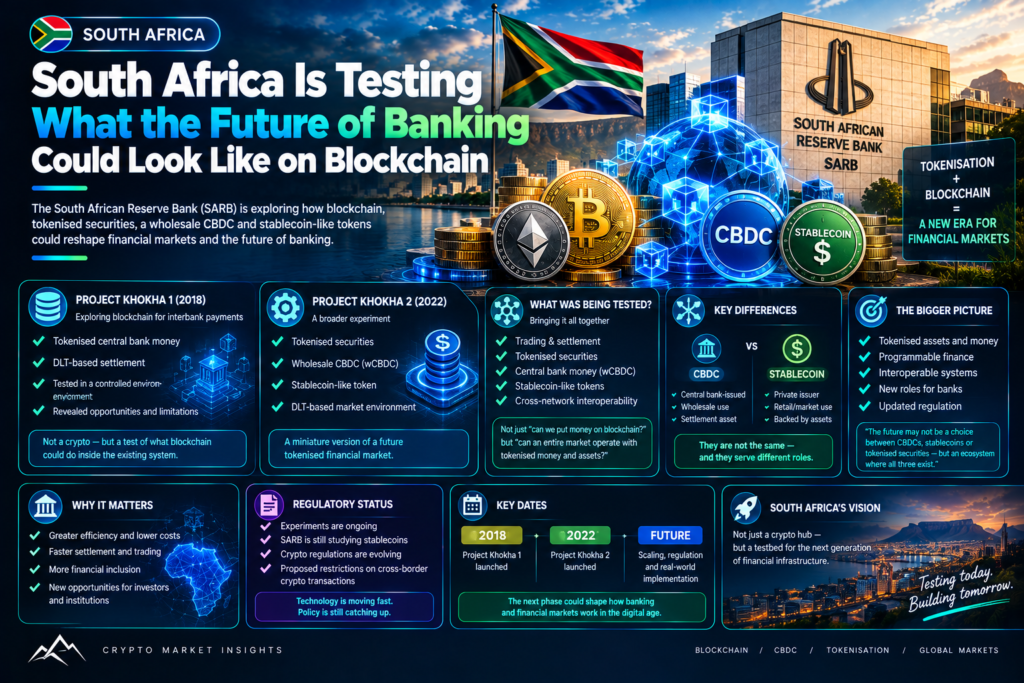
What if the next generation of banking infrastructure does not look like today’s banking system at all?
South Africa is already testing that possibility.
The South African Reserve Bank (SARB) has spent years experimenting with distributed ledger technology, or DLT, through a series of projects designed to understand how blockchain could work inside the financial system.
But the experiments have evolved.
What started as a test of blockchain-based interbank payments has expanded into something much bigger:
tokenised securities, wholesale central bank digital currency, and stablecoin-like tokens operating within the same experimental environment.
That makes South Africa an interesting case study for what financial markets could eventually look like when money and assets become programmable.
And the big question is no longer simply whether blockchain works.
It is:
What happens when the entire financial market starts becoming tokenised?
Project Khokha Started With a Simple Question
The SARB launched Project Khokha in 2018 to explore whether distributed ledger technology could improve wholesale payments and settlement between banks.
The experiment used a permissioned DLT network to move tokenised central bank money and settle transactions in a controlled environment.
It was not an attempt to create a South African cryptocurrency.
Instead, the central bank wanted to understand what blockchain could actually do inside the existing financial system.
The experiment revealed both opportunities and limitations.
DLT could support settlement.
But questions around privacy, interoperability, legal finality and integration with existing payment infrastructure remained important.
That first experiment became the foundation for something considerably more ambitious.
Then Project Khokha 2 Changed the Experiment
In 2022, SARB launched Project Khokha 2.
This time, the experiment moved beyond payments.
The project introduced tokenised securities, a wholesale CBDC issued by SARB, and a stablecoin-like token issued by participating commercial banks.
That created a miniature version of a future tokenised financial market.
There was digital money.
There were digital securities.
And there was a blockchain-based environment in which those assets could interact.
The purpose was not to announce that South Africa had chosen blockchain as its future financial infrastructure.
It was to understand what would happen if financial-market processes were redesigned around DLT.
So What Exactly Was Being Tested?
Think of a traditional financial transaction.
An investor buys a security.
The transaction needs a trading venue.
The asset needs to be recorded and transferred.
Payment needs to settle.
Different financial-market infrastructures handle different parts of the process.
Project Khokha 2 explored whether some of these functions could be brought together on DLT-based platforms.
The project created a tokenised securities environment where SARB debenture tokens could be issued, traded and settled.
The wholesale CBDC provided central-bank money for settlement.
A separate token was also used for secondary-market transactions.
In other words, the experiment was not simply:
“Can we put money on blockchain?”
It was closer to:
“Can an entire financial market operate with tokenised money and tokenised assets?”
This Is Where CBDC Enters the Story
The wholesale CBDC in Project Khokha 2 is particularly important.
Unlike a privately issued stablecoin, a wholesale CBDC represents central bank money.
In the experiment, the wCBDC functioned as a settlement asset comparable in value and quality to central bank reserves.
That gives it a very different role from a private stablecoin.
The basic distinction is:
Wholesale CBDC: central bank-issued money designed for wholesale financial settlement.
Stablecoin-like token: privately issued digital money designed to represent value, typically backed by assets or linked to a reference currency.
Tokenised security: a digital representation of a financial asset or security recorded on DLT.
Project Khokha 2 tested how all three could interact.
And that is where the experiment becomes much more interesting than a typical blockchain pilot.
CBDC vs Stablecoins: They Are Not the Same Thing
Stablecoins and CBDCs are sometimes discussed as if they are competing versions of the same technology.
They are not.
The issuer matters.
A CBDC is a direct liability of the central bank.
A stablecoin is generally a private-sector liability.
That difference affects questions around backing, redemption, regulation and monetary stability.
SARB Deputy Governor Rashad Cassim recently explained that the central bank is still assessing the role stablecoins could play in payments and whether existing regulation is sufficient or whether additional rules may be needed.
He also noted that South Africa’s stablecoin activity is currently concentrated largely around crypto trading, arbitrage and settlement rather than everyday purchases.
That means the central bank is interested in the technology without assuming that stablecoins should automatically become part of mainstream money.
But Stablecoins Could Still Have a Role
This is where the story becomes more nuanced.
SARB is not dismissing stablecoins.
Instead, it is asking what problem they are actually solving.
If stablecoins become popular because traditional payments are expensive, slow or difficult to access, then the central bank could respond by improving the existing payment system.
If stablecoins become popular because they provide functions that traditional money cannot easily offer, then the policy question becomes more complicated.
There are also concerns around currency substitution, exchange controls and the possibility that privately issued digital money could operate outside existing financial safeguards.
So the central bank’s question is not simply:
“Are stablecoins good or bad?”
It is:
“What role should private digital money play alongside public money?”
Tokenised Securities May Be the Bigger Story
CBDCs and stablecoins get most of the attention.
But tokenised securities could ultimately have an equally important impact.
Project Khokha 2 demonstrated that securities could be represented as tokens and traded on a DLT-based infrastructure.
The experiment also showed that several functions traditionally performed by separate financial-market infrastructures could potentially be combined within a shared environment.
That could eventually reduce some operational complexity and potentially lower costs.
But the experiment also showed that technology does not simply eliminate existing financial roles.
Many of those functions still need to exist.
They just may be organised differently.
The Real Change Could Be “Programmable Finance”
This is where tokenisation becomes particularly interesting.
Traditional financial assets are largely represented through databases and account systems.
Tokenisation can introduce programmable rules directly into the asset infrastructure.
That could allow certain transactions, transfers and settlement processes to happen automatically when predefined conditions are met.
Imagine a bond that automatically handles certain settlement conditions.
Or collateral that can be transferred between institutions without moving through multiple disconnected systems.
Or a financial asset that can interact directly with tokenised money.
That is the broader promise behind tokenised finance.
The blockchain itself is only the infrastructure.
The bigger transformation is what financial institutions can build on top of it.
But SARB Is Not Saying Blockchain Is Ready to Replace Everything
This distinction is important.
Project Khokha 2 was an experimental proof of concept.
SARB explicitly stated that the project did not support any specific technology and did not represent a policy shift in South Africa’s financial markets or national payment system.
Instead, the purpose was to understand the policy, legal and regulatory implications of applying DLT to financial markets.
That makes the experiment more interesting, not less.
The central bank is effectively using technology as a laboratory.
It can test what works.
It can identify what breaks.
And it can determine which existing rules may need to change before anything reaches the wider financial system.
Interoperability Could Become the Biggest Challenge
One of the lessons from Project Khokha is that blockchain networks do not automatically communicate with one another.
That matters enormously if tokenised finance becomes mainstream.
Imagine one bank using one DLT network.
Another financial institution using a different network.
A securities market using a third.
And central bank money sitting somewhere else.
If those systems cannot communicate, the financial system could simply replace today’s fragmented infrastructure with a new kind of fragmentation.
Project Khokha 2 therefore explored interoperability between different DLT environments.
The wCBDC was designed so that it could be transferred between networks while maintaining its connection to the central bank’s native DLT environment.
That may prove to be one of the most important lessons from the project.
Tokenisation only becomes truly powerful if tokenised systems can interact.
South Africa Is Also Watching the Retail Side
There is another part of SARB’s strategy.
The central bank has explored the possibility of a retail CBDC, but its current position is that there is no compelling need to implement one immediately.
Instead, SARB has placed significant emphasis on modernising the country’s existing payment system and making digital payments faster, simpler and more secure.
That creates an interesting two-track approach.
At the wholesale level, the central bank is actively experimenting with tokenised money and financial-market infrastructure.
At the retail level, it is focusing more heavily on improving existing digital payment systems.
So South Africa is not simply racing toward a CBDC.
It is testing different forms of digital finance to understand where each one actually makes sense.
And There Is a Bigger Regulatory Question
The experiments are happening while South Africa’s broader crypto regulatory framework is still evolving.
In September 2026, SARB said its approach to stablecoins remained under discussion as regulators continued engaging on crypto-asset policy.
That means the country’s policy direction is not completely settled.
At the same time, the crypto industry has been debating proposed restrictions on cross-border crypto transactions.
That creates an interesting contrast.
South Africa is actively experimenting with blockchain-based financial infrastructure while simultaneously working out how crypto assets should fit within its broader monetary and exchange-control framework.
The technology may be moving quickly.
The policy framework is still catching up.
What Could the Future Banking System Look Like?
Project Khokha gives us one possible glimpse.
A future financial market could contain:
Tokenised securities representing bonds, funds or other financial assets.
Wholesale CBDC providing central bank money for settlement.
Stablecoins or bank-issued digital tokens providing additional forms of digital liquidity.
DLT-based trading and settlement infrastructure connecting the different pieces.
And potentially, smart contracts automating parts of the process.
That does not necessarily mean traditional banks disappear.
In fact, banks may remain central.
But the infrastructure underneath them could change dramatically.
The Bigger Picture
South Africa’s blockchain experiments show that the most important crypto innovation may not happen on a crypto exchange.
It may happen inside the financial system itself.
Project Khokha began as an experiment in blockchain-based interbank settlement.
It evolved into an exploration of tokenised securities, wholesale CBDC and stablecoin-like money.
And the lessons have extended far beyond technology.
They raise questions about how money is issued.
How securities are traded.
How transactions become final.
Who controls financial infrastructure.
How different networks communicate.
And how regulators protect stability while allowing innovation.
That is why South Africa’s experiment matters.
The future of finance may not be a choice between CBDCs, stablecoins or tokenised securities.
It could be an ecosystem where all three exist — each serving a different function.
The biggest change may simply be that the financial assets and money moving through the system become programmable, interoperable and increasingly native to digital infrastructure.
South Africa is not announcing that the future of banking is already here.
It is doing something more useful:
testing what that future might actually look like before deciding how to build it.
Need to Receive International Payments?
Open your USD, GBP & EUR account with Kolan.
Fill out the form and book your free consultation.
Secure Your Crypto With OneKey
Looking for a safer way to store your crypto?
Shop OneKey hardware wallets and protect your digital assets with a dedicated hardware wallet.
Join the CryptoMartLive Community
Stay connected with the latest crypto news, market developments, and opportunities.
WhatsApp: CryptoMartLive WhatsApp Group
Telegram Group: CryptoMartLive Telegram Group
Telegram: @sungazerlive
Instagram: @cryptomartlive
Crypto moves fast. Stay informed. Stay ahead.
Tinggalkan Balasan