International Wire Transfers: Hidden Fees to Watch For in Philadelphia
Introduction: Cross-Border Commerce in the Greater Philadelphia Region
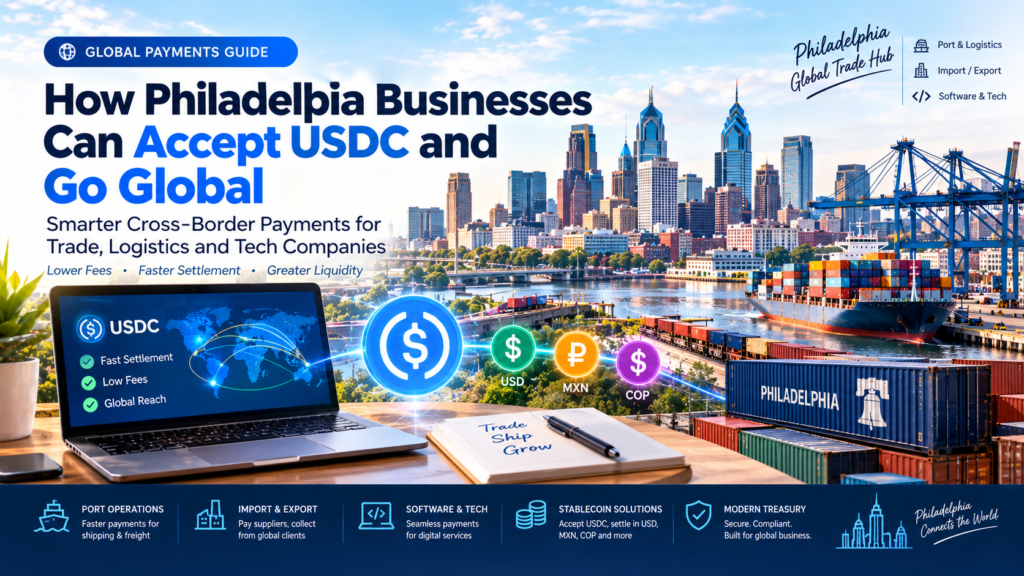
Philadelphia drives major commercial activity across the Mid-Atlantic region. Strategic port access and extensive rail connections make Philadelphia a global trade hub.
With a population exceeding 1.5 million residents, Philadelphia represents a vital Tier 1 commercial market. Thousands of enterprises operate across Greater Philadelphia, University City, Navy Yard, and the Center District. These companies process high-volume international transactions every week.
Local freight forwarders, logistics operators, importers, and software agencies move capital across borders continuously. They pay international suppliers, settle freight invoices, and collect client payments globally.
However, legacy cross-border banking slows company growth in Philadelphia. Opening foreign bank accounts involves heavy compliance burdens and local legal presence abroad.
Consequently, many mid-sized Philadelphia companies still rely on Society for Worldwide Interbank Financial Telecommunication (SWIFT) wire transfers.
Sending or receiving USD, Mexican Peso (MXN), or Colombian Peso (COP) through traditional commercial banks exposes businesses to three main financial drains:
- High fixed outbound and inbound wire fees.
- Unpredictable deductions taken by intermediary banks.
- Heavy foreign exchange spreads hidden inside conversion rates.
Furthermore, multi-day bank delays lock corporate liquidity. For a Philadelphia logistics firm managing port clearances, trapped funds create costly operational delays.
This guide explores how Philadelphia enterprises accept stablecoin payments like USDC and optimize international liquidity using modern treasury infrastructure.
The Philadelphia Economic Engine: Logistics, Port Trade, and Software
To resolve cross-border payment bottlenecks in Philadelphia, one must analyze its core commercial sectors. The region relies heavily on maritime logistics, industrial distribution, and specialized software services.
Port Operations and Logistics Companies
The Port of Philadelphia handles millions of tons of international cargo annually. Freight forwarders and logistics providers coordinate complex supply chains connecting North America with Latin America, Europe, and Asia.
Logistics firms in Philadelphia pay overseas port operators, customs brokers, and transport partners continuously. These transactions require rapid settlement in USD, MXN, and COP.
In maritime transport, payment velocity determines operational efficiency. Foreign vendors hold shipments when traditional wire transfers face bank processing delays.
Unfortunately, standard SWIFT wire transfers require two to five business days to clear. This delay locks working capital and delays cargo releases at shipping terminals.
Importers, Exporters, and Industrial Distributors
Philadelphia hosts a large industrial network of wholesale importers and exporters. Local firms buy raw materials from manufacturing hubs in Mexico and Latin America.
Supplying international trade channels requires consistent cross-border disbursements. Invoices converted between USD, MXN, and COP suffer heavy bank fees.
Commercial banks charge retail foreign exchange markups on every international transfer. Paying these hidden fees reduces profit margins for local industrial distributors.
Digital Consultancies and Software Agencies
Greater Philadelphia hosts a growing network of technology startups, software developers, and creative agencies. These firms deliver digital solutions to clients across Latin America and Europe.
Digital consultancies face payment friction when receiving international client remittances. When a foreign client remits funds via SWIFT, local banks deduct inbound wire fees.
Banks also apply unfavorable conversion rates during payment processing. Over a fiscal year, these silent fee deductions reduce total corporate revenue significantly.
The Rise of Stablecoins: Accepting USDC from Overseas Trade Partners
Global supply chain partners increasingly prefer digital dollars like USDC and USDT for international commerce. Overseas suppliers and clients choose stablecoins because blockchain rails settle transactions instantly.
The Challenge for Traditional Philadelphia Businesses
When an overseas buyer offers to pay an invoice in USDC, traditional Philadelphia businesses often hit an operational wall:
- Lack of Infrastructure: Traditional commercial bank accounts cannot receive or hold digital assets directly.
- Complex Accounting: Managing raw crypto wallets complicates corporate accounting and balance sheet reporting.
- Off-Ramp Friction: Converting USDC to USD through retail exchanges introduces extra conversion fees and transfer delays.
- Regulatory Uncertainty: Unregulated payment setups create compliance risks for corporate treasury managers.
The Hybrid Solution: Accepting USDC Without Corporate Friction
Modern financial infrastructure solves this challenge by bridging digital assets with traditional banking.
Through a modern treasury platform, a Philadelphia company receives USDC directly from overseas trade partners. The platform converts incoming USDC into USD instantly at transparent rates.
Your company holds USD in a virtual corporate account or disburses local currencies like MXN and COP to foreign vendors. This hybrid structure eliminates crypto volatility while delivering instant global settlement.
Deconstructing SWIFT Failure Points: Where Does Your Money Go?
When a Philadelphia business sends an international wire through a commercial bank, funds travel through multiple institutions. The wire routes through a chain of intermediary correspondent banks.
Every institution along this path charges fees on your payment.
1. High Fixed Wire Fees
Commercial banks charge upfront administrative fees for processing international transfers. For a Philadelphia business, sending an outbound SWIFT wire costs between $35 and $65 per transaction. Accepting an inbound wire incurs an extra $15 to $35 fee.
2. Intermediary Correspondent Bank Deductions
Local banks route international transfers through intermediary institutions. These correspondent banks deduct fees directly from your transferred amount. This practice complicates invoice reconciliation for accounting teams.
3. Opaque Foreign Exchange (FX) Markups
The largest hidden expense in cross-border payments is the foreign exchange spread. Commercial banks rarely offer wholesale mid-market exchange rates to mid-sized businesses.
Instead, banks add hidden markups to retail exchange rates. These rates include markups between 1.5% and 4.5% above market rates.
For a Philadelphia importer sending $100,000 to a manufacturing partner in Mexico, a 3% hidden markup wastes $3,000 on a single transaction.
4. Settlement Delays and Locked Liquidity
Legacy SWIFT transfers operate strictly during standard banking hours. Wires stop during weekends, public holidays, and manual compliance checks.
A wire initiated on Friday afternoon in Philadelphia often reaches a foreign vendor on Wednesday. This waiting period locks your capital and slows supply chain operations.
Real-World Case Study: The True Cost of Legacy Banking
To illustrate the financial impact of legacy banking, consider a hypothetical Philadelphia logistics provider. The company processes 25 international vendor payments every month, averaging $20,000 per wire transfer.
Scenario A: Traditional Commercial Bank Wire
- Outbound Wire Fee: $50 per transfer ($1,250 monthly)
- Intermediary Bank Deductions: $30 average per transfer ($750 monthly)
- Hidden FX Markup (2.5% spread): $500 per $20,000 transfer ($12,500 monthly)
- Total Monthly Banking Losses: $14,500
- Total Annual Capital Drain: $174,000
In addition to direct financial losses, the firm experiences an average settlement delay of three business days per wire. This latency forces the company to maintain large cash reserves to prevent supply chain disruptions.
Scenario B: Modern Financial Infrastructure
Modern financial platforms eliminate intermediary bank deductions. Businesses process transfers using wholesale mid-market exchange rates and direct settlement rails.
- Fixed Outbound Fees: Low flat fee
- Intermediary Deductions: $0
- Hidden FX Spreads: 0% (Wholesale mid-market rate)
- Settlement Speed: Under 1 hour
- Annual Savings Generated: Over $150,000
Introducing Kolan: Modern Treasury Infrastructure for Philadelphia Enterprises
Kolan provides Tier 1 enterprises with an agile, cost-effective alternative to legacy banking. It bridges traditional multi-currency account management with hybrid fiat and stablecoin settlement rails.
Core Architectural Pillars of Kolan
- Named Virtual Multi-Currency Accounts: Access company-dedicated international accounts supporting USD, GBP, EUR, AUD, COP, AED, NGN, and MXN. Companies hold and spend local currencies without automatic conversion.
- Hybrid Fiat & Stablecoin Rails: Convert seamlessly between fiat currencies and enterprise stablecoins (USDC, USDT, EURC). Bypass correspondent banking bottlenecks for near-instant global settlement.
- Upfront Transparent Pricing: Enjoy zero hidden FX spreads and clear transaction fees. Retain full visibility over your treasury operations.
- Enterprise-Grade Compliance: Institutional security standards and AML/KYC protocols satisfy strict regulatory demands for Philadelphia enterprises.
Deep-Dive Comparison: Legacy Banking, Foreign Bank Accounts, and Kolan
This table compares foreign bank accounts and SWIFT wires with Kolan.
Comprehensive Feature and Cost Comparison Matrix
| Evaluation Metric | Traditional SWIFT Wire Transfers | Physical Foreign Bank Account | Kolan Virtual Corporate Accounts |
| Entity Setup Requirement | U.S. entity only | Foreign entity required | U.S. entity only (Named Virtual Accounts) |
| Onboarding Speed | Immediate (existing bank) | Months (complex legal paperwork) | Instantaneous digital verification |
| Primary Settlement Rail | Correspondent banking network | Local clearing systems abroad | Direct local rails + stablecoin rails |
| Settlement Velocity | 2 to 5 business days | Domestic speeds locally | Real-time to under 1 hour globally |
| Foreign Exchange Pricing | Opaque retail spreads (1.5%–4.5%) | Variable bank exchange rates | Transparent wholesale mid-market rates |
| Foreign Compliance Burden | Minimal | Heavy (foreign tax filings & audits) | Streamlined U.S. enterprise compliance |
| Multi-Currency Access | Restricted by bank account type | Limited to local country currency | Multi-currency (USD, MXN, COP, EUR, GBP) |
Sector-Specific Application: How Philadelphia Businesses Win with Kolan
Commercial sectors in Philadelphia encounter unique cross-border payment hurdles.
1. Maritime Freight Forwarders at the Port of Philadelphia
- The Challenge: Paying overseas port operators via SWIFT causes multi-day delays, holding up cargo releases at shipping terminals.
- The Kolan Solution: Logistics providers pay overseas vendors instantly using Kolan virtual accounts. Foreign operators receive local funds directly within minutes.
2. Industrial Distributors in Greater Philadelphia
- The Challenge: Importing raw materials exposes local distributors to heavy foreign exchange markups on USD, MXN, and COP currency pairs.
- The Kolan Solution: Kolan enables Philadelphia distributors to pay foreign suppliers at wholesale mid-market rates, eliminating hidden bank FX markups.
3. Digital Consultancies and Tech Agencies in University City
- The Challenge: Software agencies lose revenue to inbound wire fees and conversion markups on Latin American and European client invoices.
- The Kolan Solution: Kolan provides local receiving accounts in major foreign currencies. Agencies collect client payments directly as local domestic transfers with zero inbound wire fees.
Step-by-Step Implementation Guide for Philadelphia Enterprises
Integrating Kolan into existing financial workflows is simple and fast.
Step 1: Enterprise Account Registration
Register for an enterprise account on the Kolan Platform. Submit standard corporate verification documents (EIN and Articles of Organization) to complete institutional verification.
Step 2: Configure Virtual Currency Accounts
Activate specific currency wallets needed for your primary trade corridors (USD, MXN, COP, EUR, GBP).
Step 3: Map Invoicing and Payment Workflows
Add Kolan virtual account details to your invoicing software. Foreign clients send payments directly to your company account. Your team creates templates for instant money transfers.
Step 4: Monitor, Reconcile, and Scale
The Kolan dashboard tracks payment status in real time. Finance teams export transaction records into accounting software instantly.
Enhancing Enterprise Security: Essential Tools for Digital Asset Treasury Management
Maintaining robust cybersecurity is paramount when integrating hybrid fiat and stablecoin rails. Institutional-grade hardware security helps protect corporate digital assets and private keys:
- OneKey Hardware Wallet: An open-source hardware wallet ideal for managing corporate digital asset treasuries with multi-signature support.
- Ellipal Hardware Wallet: A fully air-gapped hardware wallet that completely isolates private keys from network connectivity.
- Mypal Crypto Self-Custody Card: A practical tool for corporate self-custody asset authorization and management.
Conclusion & Actionable Next Steps
Philadelphia enterprises do not need to tolerate hidden SWIFT wire fees or refuse USDC payments from overseas partners. Adopting Kolan virtual multi-currency accounts and hybrid fiat-stablecoin rails gives local businesses full fee transparency and instant cross-border liquidity.
Call to Action & Enterprise Contact Information
Ready to eliminate cross-border B2B payment friction and optimize your treasury operations? Get started with Kolan today:
- Kolan Platform & Account Setup: Access Kolan Multi-Currency Accounts (Supporting USD, GBP, EUR, AUD, COP, AED, NGN & MXN accounts)
- Cryptomart Landing Page: Explore Ecosystem Resources
Direct Consultation & Support
Connect with our team directly for customized enterprise integration or technical support:
- Email: info@cryptomart.site
- WhatsApp: +6285165098877
- Telegram: @sungazerlive
Empower your Philadelphia enterprise with intelligent, high-speed, and transparent cross-border financial infrastructure.
Leave a Reply