SEC Opens the Door to 3x Bitcoin & Ethereum ETFs
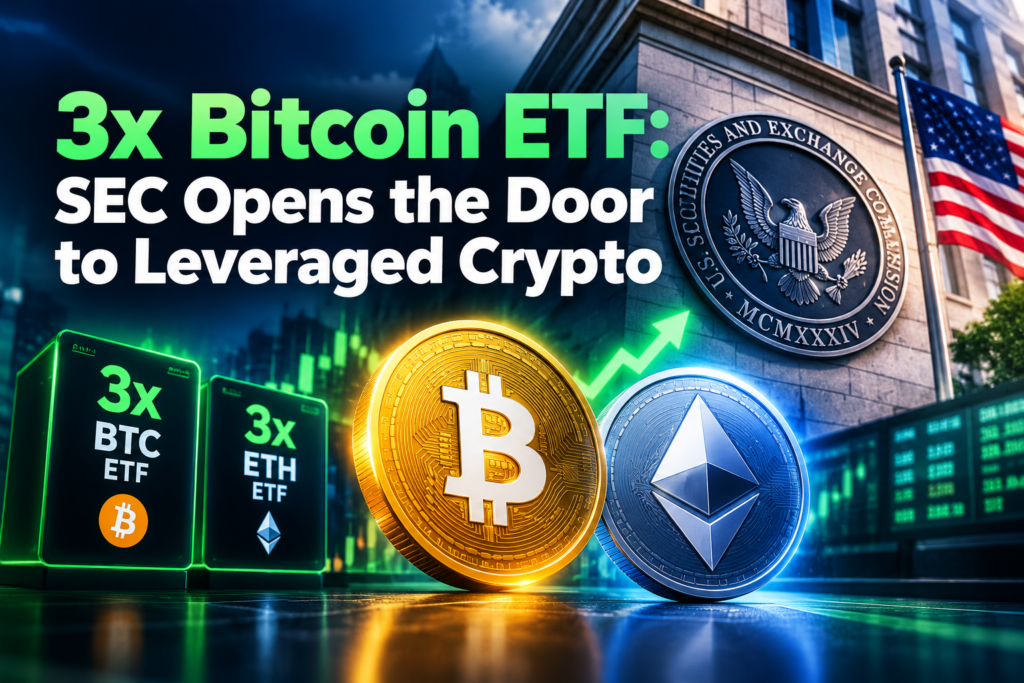
The U.S. crypto ETF market is entering a new phase.
On October 2, 2026, the U.S. Securities and Exchange Commission (SEC) approved a Cboe BZX rule change that allows the exchange to list several leveraged exchange-traded funds, including 3x Bitcoin and 3x Ether ETFs.
The approval covers six products linked to Bitcoin, Ether, gold, silver, crude oil, and natural gas. However, investors should understand one important point: SEC approval of the listing rule does not automatically mean every fund is already trading.
So, what does this mean for crypto investors?
And why could a 3x Bitcoin ETF become one of the most aggressive crypto investment products available in the U.S. market?
What the SEC Approved
The SEC approved Cboe BZX’s proposed rule change on October 2, 2026.
The proposal was originally filed on August 10, 2026. It was later published for public comment on August 19.
The approved products include:
- 3x Gold ETF
- 3x Silver ETF
- 3x Bitcoin ETF
- 3x Ether ETF
- 3x Crude Oil ETF
- 3x Natural Gas ETF
For crypto investors, the Bitcoin and Ether products are the most significant.
These ETFs are designed to seek approximately three times the daily performance of their respective reference assets.
However, that does not mean investors will automatically receive three times Bitcoin’s or Ether’s performance over a month, a year, or another long period.
The leverage target is calculated on a daily basis.
Why the 3x Bitcoin and Ether ETFs Matter
Crypto ETFs have already changed how traditional investors access digital assets.
Spot Bitcoin ETFs, for example, allow investors to gain Bitcoin exposure through a regulated exchange-traded product.
A 3x Bitcoin ETF takes that concept much further.
Instead of targeting roughly 1x daily performance, the fund aims for approximately 3x the daily performance of its reference asset.
In simple terms, if the underlying reference asset rises 2% during a trading day, a 3x product could target roughly a 6% gain before fees, expenses, and other factors.
However, the opposite is also true.
If the underlying asset falls 2%, the leveraged ETF could target roughly a 6% decline.
That makes these products fundamentally different from traditional spot Bitcoin ETFs.
Daily Leverage Changes Everything
The most important concept to understand is daily reset.
A 3x ETF does not simply multiply Bitcoin’s return over a long period by three.
Instead, the fund resets its leverage target every trading day.
This creates a major difference between short-term and long-term performance.
For example, imagine Bitcoin moves like this:
- Day 1: +10%
- Day 2: -10%
Bitcoin would not return to exactly the same price because the percentage changes are calculated from different starting points.
The same principle applies to a leveraged ETF.
Because of daily compounding, volatility can significantly affect long-term results.
Therefore, a 3x ETF can perform very differently from simply taking Bitcoin’s total return and multiplying it by three.
This is one of the biggest risks investors need to understand.
These Products Do Not Simply Hold Bitcoin and Ether
Another important detail is how the funds gain exposure.
The 3x Bitcoin ETF is designed to use Bitcoin futures and other Bitcoin-linked instruments rather than simply holding physical Bitcoin.
The 3x Ether ETF similarly uses Ether-linked instruments, including Ether futures.
That distinction matters.
Futures-based exposure introduces additional considerations, such as futures pricing, market conditions, liquidity, and potential tracking differences.
Therefore, investors should not assume that the ETF will behave exactly like holding Bitcoin or Ether directly.
SEC Approval Does Not Mean Trading Starts Immediately
There is another important distinction.
The SEC’s October 2 decision approved the Cboe BZX listing rule change.
However, regulatory approval of the listing framework is not the same as saying that the funds are already trading.
The funds also need their registration process to become effective before shares can begin trading.
Therefore, investors should watch for additional regulatory filings and exchange announcements before assuming that the products are live.
What Makes These ETFs Different?
The biggest difference is the level of exposure.
A traditional spot Bitcoin ETF generally seeks to provide exposure to Bitcoin itself.
A 3x Bitcoin ETF seeks approximately three times the daily performance of its reference asset.
That creates a completely different risk profile.
| Feature | Spot Bitcoin ETF | 3x Bitcoin ETF |
|---|---|---|
| Target exposure | Approximately 1x | Approximately 3x daily |
| Leverage | No | Yes |
| Daily reset | No 3x reset | Yes |
| Risk level | High | Extremely high |
| Main exposure | Bitcoin/Bitcoin-linked assets | Primarily futures and linked instruments |
| Long-term tracking | Closer to Bitcoin | Can differ significantly |
| Suitable for | Long-term Bitcoin exposure | Advanced, short-term strategies |
The table shows why these products should not be treated as simply “Bitcoin ETFs with more upside.”
They are much more complex.
What 3x Bitcoin ETF Investors Need to Watch
1. Daily Reset
Daily reset is the first major issue.
The fund targets approximately three times the daily return.
As a result, performance can diverge significantly from three times Bitcoin’s return over longer periods.
The longer an investor holds a leveraged product, the more important this effect can become.
2. Volatility
Bitcoin is already a highly volatile asset.
Adding 3x leverage increases the potential size of daily gains and losses.
A large Bitcoin decline can therefore produce an even larger decline in the ETF.
For investors, this means risk management becomes critical.
3. Futures Exposure
The products are designed to obtain leveraged exposure primarily through Bitcoin or Ether futures and related instruments.
Therefore, performance can be affected by futures-market conditions.
The ETF may not perfectly track the underlying spot market.
4. Trading Hours
Bitcoin itself trades around the clock.
However, an ETF listed on a traditional exchange operates within exchange trading hours.
This can create a potential gap between movements in Bitcoin’s market and movements in the ETF.
For example, Bitcoin can move significantly overnight while the ETF market is closed.
When trading resumes, the ETF may open at a substantially different price.
The fund’s prospectus specifically highlights this risk.
5. Fees and Expenses
Leveraged ETFs can also involve higher costs and more complex trading structures.
Investors should review the fund’s prospectus, expense structure, and trading strategy before investing.
A strong Bitcoin rally does not automatically guarantee strong long-term performance in a leveraged ETF.
What About the 3x Ether ETF?
The Ether product follows a similar concept.
Instead of targeting approximately 1x daily Ether performance, the 3x Ether ETF seeks approximately three times the daily performance of its reference asset.
However, Ether can also experience extreme volatility.
That makes the risk profile particularly aggressive.
The fund’s prospectus warns that a severe move in Ether could result in substantial losses, potentially including a near-total loss of an investor’s position under extreme circumstances.
Therefore, the product is clearly aimed at investors who understand leveraged trading and can tolerate significant losses.
Why This Could Be a Big Step for Crypto ETFs
The SEC decision is important for another reason.
It shows how crypto investment products are becoming increasingly sophisticated.
The market is moving beyond simple spot exposure.
Investors are now seeing products built around:
- Leveraged exposure
- Futures
- Derivatives
- Alternative trading strategies
- Tokenized assets
- Innovative ETF structures
This development also fits into a broader SEC effort to consider innovative ETF structures.
Earlier in 2026, the SEC requested public comments on novel ETFs and innovative strategies. The agency said it wanted to facilitate innovation while maintaining investor protection and fair, orderly, and efficient markets.
The approval of the 3x Bitcoin and Ether products therefore fits into a larger evolution of the U.S. ETF market.
The Bigger ETF Trend in 2026
Crypto ETFs are becoming more diverse.
Initially, the main focus was simple exposure to Bitcoin.
Then the market expanded toward Ether and other digital assets.
Now, investors are seeing more sophisticated structures.
The 3x Bitcoin and Ether ETFs represent another step in that evolution.
However, more choice does not necessarily mean lower risk.
In fact, the opposite may be true.
As financial products become more complex, investors need to understand exactly what they own.
A leveraged ETF is not the same thing as owning Bitcoin.
It is a trading instrument with its own mechanics and risks.
Could 3x Bitcoin ETFs Increase Crypto Trading Activity?
Potentially, yes.
Leveraged ETFs can attract active traders who want amplified exposure without directly using margin accounts or futures platforms.
They can also provide another way for traditional-market investors to express short-term views on Bitcoin and Ether.
For example, an investor who expects Bitcoin to rise sharply over a short period could use a leveraged ETF to seek amplified daily exposure.
However, the same structure works against investors when the market moves in the opposite direction.
That is why these products can create both opportunities and significant risks.
What Could Happen Next?
The next stage will be the actual launch and trading of the products once the necessary registration requirements are satisfied.
Investors will then be able to see how these products perform under real market conditions.
Several factors will be important to watch:
- Trading volume
- Liquidity
- Bid-ask spreads
- Tracking performance
- Daily volatility
- Assets under management
- Investor demand
- Performance during major Bitcoin and Ether moves
The first trading periods could provide valuable information about how investors use these products.
FAQ
What did the SEC approve?
The SEC approved a Cboe BZX rule change allowing the exchange to list six leveraged ETFs, including 3x Bitcoin and 3x Ether products.
Does the 3x Bitcoin ETF mean three times Bitcoin’s yearly return?
No.
The fund targets approximately three times the daily performance of its reference asset.
Long-term performance can be significantly different because of daily compounding and volatility.
Does the ETF directly hold Bitcoin?
The 3x Bitcoin ETF is designed to obtain exposure primarily through Bitcoin futures and other Bitcoin-linked instruments rather than simply holding physical Bitcoin.
Is a 3x Bitcoin ETF riskier than a spot Bitcoin ETF?
Yes.
The use of leverage can significantly increase both potential gains and potential losses.
Can a 3x Bitcoin ETF lose most of its value?
Yes.
A major and sustained decline in the underlying asset can result in severe losses.
Is the ETF already trading?
SEC approval of the listing rule does not automatically mean trading has already started.
Investors should wait for the relevant registration and launch announcements.
The Bottom Line
The SEC’s approval of the Cboe BZX rule change marks another important development for the U.S. crypto ETF market.
The 3x Bitcoin and 3x Ether ETFs could give traders access to highly leveraged daily exposure through regulated exchange-traded products.
However, these products are not designed to simply deliver three times Bitcoin’s or Ether’s long-term returns.
Daily resets, volatility, futures exposure, trading-hour differences, and compounding can all affect performance.
Therefore, the opportunity comes with significant risk.
For experienced traders, these ETFs could become powerful tools.
For long-term investors, however, the mechanics are much more complicated than a traditional spot crypto ETF.
The key question is no longer simply whether Bitcoin or Ether will rise.
It is whether investors understand how leverage changes the way their ETF behaves every single day.
Why OneKey Fits the Self-Custody Vault Approach
OneKey is designed around self-custody and hardware-based protection.
Its ecosystem includes open-source components and hardware wallets with Secure Element protection. The available models are designed for different user needs.
OneKey Classic 1S
The Classic 1S is a compact hardware wallet designed for users who want dedicated cold-storage protection without carrying a large device.
It can fit investors who primarily want to separate long-term holdings from exchange accounts.
For a San Jose investor, this setup can create a clear boundary between trading activity and long-term storage.
OneKey Pro
The OneKey Pro targets users who want a more advanced hardware wallet experience.
For active Web3 users, a larger interface can make transaction review more practical when interacting with decentralized applications.
The device also uses multiple Secure Elements and supports Clear Signing.
OneKey KeyTag Titanium
A hardware wallet protects the signing device, but the recovery seed also needs protection.
The KeyTag Titanium is designed as a durable physical backup option for users who want to protect recovery information over the long term.
For investors holding crypto for years rather than days, this part of the setup deserves the same attention as the wallet itself.
OneKey Delivery to San Jose
San Jose investors and Web3 developers can order OneKey through the following link:
Orders above US$99 qualify for free delivery, subject to applicable shipping availability and checkout terms.
The offer also includes up to 5 USDT cashback under the applicable promotion.
For San Jose users, the practical benefit is direct ordering without relying on an unknown local third-party seller.
The important security principle remains the same: purchase through an official or trusted channel and verify the device before setting it up.
Moving Away From an Exchange Creates a New Problem: Spending
Self-custody improves control, but it can also make everyday spending less convenient.
If every purchase requires sending crypto back to an exchange first, users can recreate some of the friction they were trying to avoid.
A better approach is to separate storage from spending.
The long-term holdings can remain protected in cold storage, while a smaller spending balance can move through services designed for everyday payments.
This creates a simple structure:
Cold storage for savings.
Payment tools for spending.
Exchange accounts for trading when needed.
Mypal: Spending From a Self-Custody Wallet
Mypal is designed to help users spend stablecoins without constantly moving funds back to a centralized exchange.
Users can top up from a self-custody wallet using supported assets such as USDT or USDC.
The service also supports Apple Pay and Google Pay for supported use cases, allowing users to connect crypto-based balances with everyday merchant spending.
For San Jose residents, this can be useful for separating long-term crypto holdings from everyday expenses.
Instead of moving the entire portfolio to an exchange, users can keep the majority in self-custody and only allocate the amount needed for spending.
Mypal invitation link:
Get Mypal — Invite Code 27090432
Invite Code: 27090432
KITE: A Spending Bridge for Developers
Web3 developers have a different spending profile.
Instead of mainly paying for retail purchases, developers may need to pay for cloud infrastructure, software subscriptions, API services, development tools, and server resources.
KITE is positioned as a borderless spending option with a virtual card for supported developer expenses.
This can be relevant for services such as AWS, GitHub, OpenAI API usage, and server infrastructure.
For developers who work across countries or operate remote Web3 projects, a separate spending tool can help keep business expenses away from long-term cold storage.
KITE referral link:
Get KITE — Referral Code OKLL5B
Referral Code: OKLL5B
The overall strategy remains straightforward: do not treat a cold wallet as a daily spending account.
Use the hardware wallet for assets that need stronger long-term protection. Then move only the required amount into a spending environment.
Three Self-Custody Paths for San Jose Users
The right setup depends on how the user interacts with crypto.
A solo developer has different requirements from a Web3 startup.
A community organizer also needs a different approach.
1. End User: Investor or Long-Term Holder
Individual investors can use a hardware wallet for long-term holdings.
A typical setup can look like this:
Exchange → Trading funds
OneKey → Long-term holdings
Mypal → Everyday spending
This structure separates different risks instead of placing everything in one account.
2. B2B and Web3 Teams
Startups, blockchain development teams, crypto investment firms, and other organizations can also consider hardware wallet deployments.
A business may need multiple devices for treasury management, operational separation, or controlled access.
Wholesale orders starting from 25 units can be relevant for teams, organizations, and Web3 communities that need hardware wallets at scale.
For teams, the focus should not only be on purchasing the devices.
They should also establish internal procedures for seed backup, transaction approval, device assignment, and recovery.
3. Community and Affiliator Track
Web3 communities, meetup organizers, university blockchain clubs, and local KOLs can also introduce self-custody education to their audiences.
The strongest community approach is educational rather than purely promotional.
Explain why exchange custody creates counterparty risk.
Then explain why hot wallets can expose private keys to online threats.
Finally, introduce hardware wallets as one option for reducing the attack surface.
This approach can create value for both users and community partners.
A Five-Step Secure OneKey Setup
Buying a hardware wallet is only the first step.
Users should also establish a secure setup process.
Step 1: Check the Package
Inspect the packaging and device before connecting it.
If anything looks suspicious, contact the manufacturer through an official support channel before proceeding.
Step 2: Use Official Software
Download the required wallet software from an official OneKey source.
Avoid installing wallet software through unknown links, advertisements, or random file-sharing websites.
Step 3: Generate the Recovery Seed Securely
Generate the recovery seed during the device setup process.
Avoid taking photos of it.
Keep it out of cloud storage.
Do not send it through WhatsApp, Telegram, email, or other messaging services.
The recovery seed should remain offline.
Step 4: Create a Durable Backup
Consider storing the recovery seed on a durable physical backup such as a compatible metal backup solution.
Keep the backup in a secure location separate from the hardware wallet.
Step 5: Consider an Optional Passphrase
Advanced users can consider an additional passphrase.
This is sometimes called a “25th word” when used with a 24-word recovery phrase.
However, a passphrase adds responsibility.
If the user forgets it, the associated wallet may become permanently inaccessible.
For that reason, users should only use this feature if they understand how recovery works.
Frequently Asked Questions
Is keeping crypto on an exchange always unsafe?
No.
Centralized exchanges can provide useful security systems and convenient access to trading.
The issue is counterparty risk.
Users depend on the exchange to maintain access to their assets.
For long-term holdings, some investors prefer to reduce that dependency through self-custody.
Is a hot wallet the same as cold storage?
No.
A hot wallet normally operates in an internet-connected software environment.
A hardware wallet keeps sensitive signing operations on a dedicated device. This can reduce exposure to certain remote attacks.
Can OneKey work with MetaMask, Rabby, and Phantom?
Hardware wallets can work with supported third-party wallet interfaces and decentralized applications.
However, compatibility depends on the specific wallet, network, and integration.
Users should verify current compatibility before connecting a device to a particular application.
Can businesses order OneKey in bulk?
Yes.
Wholesale orders starting from 25 units can be considered for eligible businesses, Web3 teams, communities, and organizations.
The exact wholesale terms should be confirmed before placing an order.
What is the difference between Mypal and KITE?
Mypal focuses on self-custody-based spending and supported retail payment methods such as Apple Pay and Google Pay.
KITE focuses more on borderless spending and virtual-card use cases, including developer and infrastructure expenses.
Both can complement cold storage by providing a spending layer without requiring users to keep their entire crypto portfolio on an exchange.
The Bottom Line: Exchange Collapse vs Self-Custody
The exchange collapse versus self-custody debate is ultimately about control and risk management.
Exchanges remain useful for trading and liquidity. However, users accept counterparty risk when they leave assets under third-party custody.
Hot wallets provide more direct control. However, they can remain exposed to the security risks of internet-connected devices.
Hardware self-custody creates another layer of separation.
For San Jose crypto investors and Web3 developers, a practical setup can combine these approaches instead of relying on one platform for everything.
Keep trading liquidity where it is needed.
Keep long-term holdings in a properly secured hardware wallet.
Use dedicated spending tools for everyday purchases and developer expenses.
For users exploring a self-custody setup, OneKey provides hardware options designed around dedicated key protection, transaction verification, and long-term storage.
OneKey Hardware Vault:
Get OneKey — Free Delivery Over US$99 + Up to 5 USDT Cashback
Mypal Self-Custody Spending:
Get Mypal — Invite Code 27090432
KITE Developer Spending:
Get KITE — Referral Code OKLL5B
The most important principle is simple:
Control your keys, verify what you sign, and separate long-term storage from everyday spending.
Leave a Reply