Can the IRS Really See My Crypto Wallet? Privacy and Tax Reporting Explained
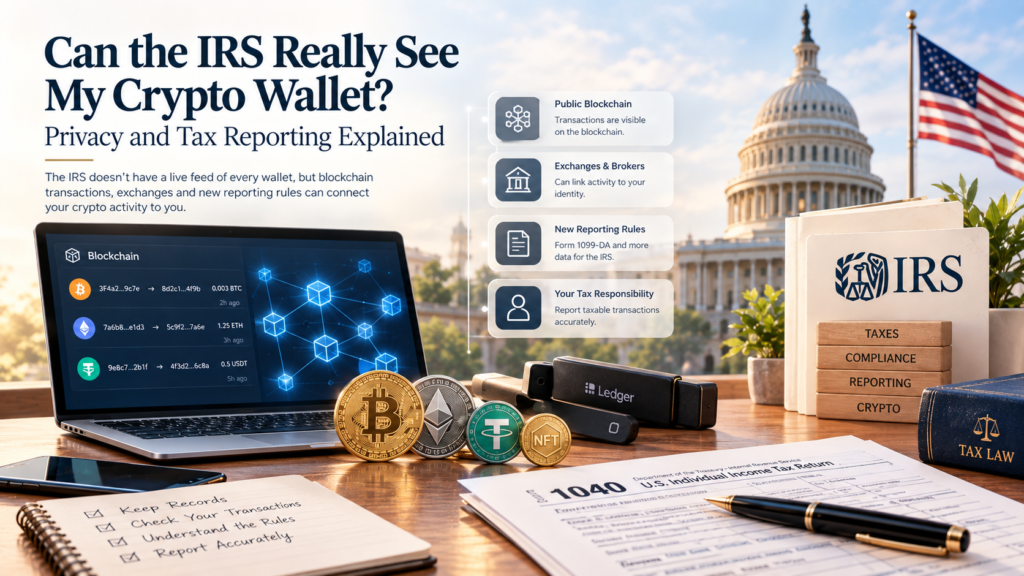
Crypto users often assume that a private wallet means their transactions are invisible to the IRS.
That is not quite how it works.
The IRS does not simply have a window into every private crypto wallet. However, blockchain transactions are generally public, and the agency can receive information from crypto brokers and other sources. New reporting rules are also giving the IRS more transaction data than before.
For U.S. taxpayers, the bigger question is not whether the IRS can watch every wallet in real time. It is whether your crypto activity can be connected to you and whether you are reporting taxable transactions correctly.
Can the IRS See Your Crypto Wallet?
The short answer is: not in the same way you can see a bank account.
A self-custody wallet does not normally contain your name or Social Security number on the blockchain. Instead, transactions are associated with public wallet addresses.
But blockchain transactions are generally visible. If an address can be linked to a specific person through an exchange, transaction history or other information, that activity may become easier to associate with the wallet owner.
The IRS can also obtain information through reporting requirements and other lawful methods.
So, having a self-custody wallet does not automatically make crypto activity private from tax authorities.
What Is the IRS Actually Tracking?
The IRS is primarily concerned with your taxable digital asset activity, rather than simply whether you own a wallet.
The agency requires taxpayers to answer a digital asset question on federal tax returns. Depending on the transaction, taxpayers may need to report income, gains or losses from selling, exchanging or otherwise disposing of digital assets.
That can include transactions involving:
- Bitcoin
- Ethereum
- Stablecoins
- NFTs
- Other digital assets
Simply moving crypto between wallets you own is generally not a taxable event. The IRS specifically says a transfer between wallets, addresses or accounts belonging to the same taxpayer does not create income, gain or loss merely because the transfer occurred.
What About a Private or Self-Custody Wallet?
Self-custody changes who controls the private keys. It does not eliminate tax obligations.
If you hold Bitcoin in a hardware wallet or another self-custody wallet, the wallet itself may not report transactions to the IRS in the same way a custodial exchange does.
But that does not mean the transactions disappear.
For example, imagine you buy Bitcoin through an exchange and withdraw it to your own wallet.
The exchange may already have information connecting your identity to the purchase and withdrawal. The blockchain then records the movement of the Bitcoin to your wallet address.
Later, if you send the Bitcoin back to an exchange and sell it for dollars, the exchange may have information about that sale.
The wallet may be self-custodied, but the surrounding transactions can create a record that connects activity across platforms.
The New Form 1099-DA Changes the Picture
One of the biggest changes for U.S. crypto taxpayers is Form 1099-DA.
Under the IRS’s digital asset broker reporting rules, brokers must report certain digital asset transactions. The rules began applying to transactions from January 1, 2025. Brokers generally report gross proceeds, while reporting of basis applies to certain transactions beginning January 1, 2026.
Form 1099-DA is designed to provide taxpayers and the IRS with information about digital asset dispositions reported by brokers.
This does not mean every crypto transaction suddenly appears on a 1099-DA.
The rules generally cover brokers that take possession of the digital assets involved in the transaction. The IRS says the final regulations do not impose these broker reporting requirements on decentralized or non-custodial brokers that do not take possession of the assets.
That distinction matters.
Does the IRS Know About Every Crypto Transaction?
No.
A 1099-DA does not mean that every transaction on a public blockchain is automatically reported to the IRS.
For example, a transfer between two wallets you control may not generate a broker tax form. Likewise, not every self-custody transaction is reported directly by a wallet.
But taxpayers still have reporting responsibilities.
The IRS states that taxable digital asset transactions must be reported even if the taxpayer does not receive a Form 1099 or other information return.
In other words, no 1099-DA does not mean no tax obligation.
What Crypto Transactions Do You Need to Report?
For U.S. taxpayers, selling or exchanging digital assets can create a taxable event.
Examples can include:
- Selling Bitcoin for U.S. dollars
- Trading Bitcoin for another cryptocurrency
- Using crypto to purchase goods or services
- Certain payments received in crypto
- Other dispositions of digital assets
The tax treatment depends on the type of transaction.
For capital transactions, the IRS says individuals generally report sales and other capital transactions using Form 8949 and then summarize the results on Schedule D of Form 1040, unless specific reporting circumstances allow otherwise.
The important point is that crypto tax reporting does not depend entirely on whether an exchange sends you a form.
What If I Only Transfer Crypto Between My Wallets?
This is where many crypto users get confused.
Suppose you own a Bitcoin wallet and a hardware wallet. You move Bitcoin from one to the other because you want to store it offline.
That transfer is generally not taxable if both wallets belong to you.
The IRS specifically addresses transfers between wallets, addresses or accounts owned by the same person and says they are not taxable events simply because the transfer occurred.
Still, keeping records is important.
Your records should help establish when you acquired the asset, your cost basis, when you transferred it and what happened later.
Does Using a Crypto Mixer or Privacy Tool Hide Transactions From the IRS?
Privacy tools can make blockchain analysis more complicated, but they should not be treated as a way to avoid tax reporting.
If you have taxable crypto income or gains, your reporting obligation does not disappear because a transaction is harder to trace.
The IRS requires taxpayers to maintain records sufficient to establish the positions reported on their tax returns. Its guidance specifically recommends keeping records of digital asset receipts, sales, exchanges and other dispositions, along with relevant fair market values.
Trying to make transactions harder to trace is also very different from legitimately managing your financial privacy.
What Should Crypto Investors Keep for Tax Records?
Good records can make crypto tax reporting much easier.
Consider keeping:
- Date and time of each transaction
- Asset involved
- Amount purchased or sold
- Purchase price
- Fair market value
- Transaction fees
- Wallet addresses
- Exchange transaction IDs
- Transfers between your own wallets
- Sale or exchange records
- 1099-DA forms and other tax documents
The IRS says taxpayers should maintain records sufficient to establish their tax positions.
This becomes particularly important if you use multiple exchanges and wallets.
What If My Exchange Does Not Send Me a 1099-DA?
You still have to report taxable transactions.
The IRS explicitly says taxpayers must report income, gains and losses from taxable digital asset transactions even when they do not receive a payee statement or information return.
This is an important distinction:
Reporting by your exchange and your own tax obligation are two separate things.
A missing tax form does not automatically make a transaction non-taxable.
Is Crypto Privacy Going Away?
Not necessarily.
There is a difference between financial privacy and being invisible to the IRS.
Self-custody gives users control over their private keys. Public blockchains can also provide transparency because transaction histories can be viewed on-chain.
At the same time, centralized exchanges and brokers can connect blockchain activity with customer information when users open accounts, buy or sell crypto, or provide identifying information.
The result is a financial system where some information is public on-chain, some information is held by intermediaries, and tax authorities can receive certain information through reporting rules.
The Bottom Line
So, can the IRS really see your crypto wallet?
Not as a simple live feed of every wallet and every transaction.
But that does not mean a self-custody wallet is invisible.
Blockchain transactions can be publicly visible, exchanges can have identifying information, and broker reporting rules now provide the IRS with additional data on certain digital asset transactions.
For U.S. taxpayers, the safest approach is to focus less on whether the IRS can see a particular wallet and more on whether the transaction is taxable and whether you have the records needed to report it correctly.
Crypto privacy and crypto tax compliance are not the same thing.
Frequently Asked Questions
Can the IRS track my Bitcoin wallet?
The IRS does not simply see every private wallet as if it were a bank account. However, blockchain transactions can be publicly visible, and wallet activity may be connected to an individual through exchanges, reporting information or other records.
Does the IRS know if I own crypto?
The IRS can receive information about certain digital asset transactions from brokers and other sources. U.S. taxpayers also have a digital asset question on federal tax returns.
Do I have to report crypto if I don’t receive a 1099-DA?
Yes. The IRS says taxable digital asset income, gains and losses must be reported even if you do not receive a Form 1099 or another information return.
Is transferring Bitcoin between my own wallets taxable?
Generally, no. The IRS says transferring digital assets between wallets, addresses or accounts that belong to you is not a taxable event simply because of the transfer.
What is Form 1099-DA?
Form 1099-DA is used by brokers to report certain digital asset proceeds and, in some cases, basis information to taxpayers and the IRS. Broker reporting for certain digital asset transactions began with transactions occurring on or after January 1, 2025.
Does using a self-custody wallet mean I don’t have to pay crypto taxes?
No. Self-custody does not remove U.S. tax obligations. Tax treatment depends on what you do with the digital asset, not simply where you store it.
💸 GET PAID GLOBALLY WITH KOLAN
Need to receive international payments? Open your USD, GBP, EUR & AED accounts with Kolan and make international payments easier.
Fill out the form and book your free consultation:
https://forms.gle/QVri289ukKMFR6Qn8
🔐 SECURE YOUR CRYPTO WITH ONEKEY OR ELLIPAL
Get free delivery on orders over US$99 + up to 5 USDT cashback.
OneKey: https://onekey.so/r/TRC
Ellipal: https://www.ellipal.com/?rfsn=9305287.28d2ea6
🌍 GO GLOBAL WITH MYPAL
https://h5.mypal.pro/pm/vhcn?code=27090432
🔗 CONNECT WITH CRYPTOMARTSITE
https://msha.ke/cryptomart.site
Leave a Reply