Is Florida Actually Crypto-Friendly for Investors?
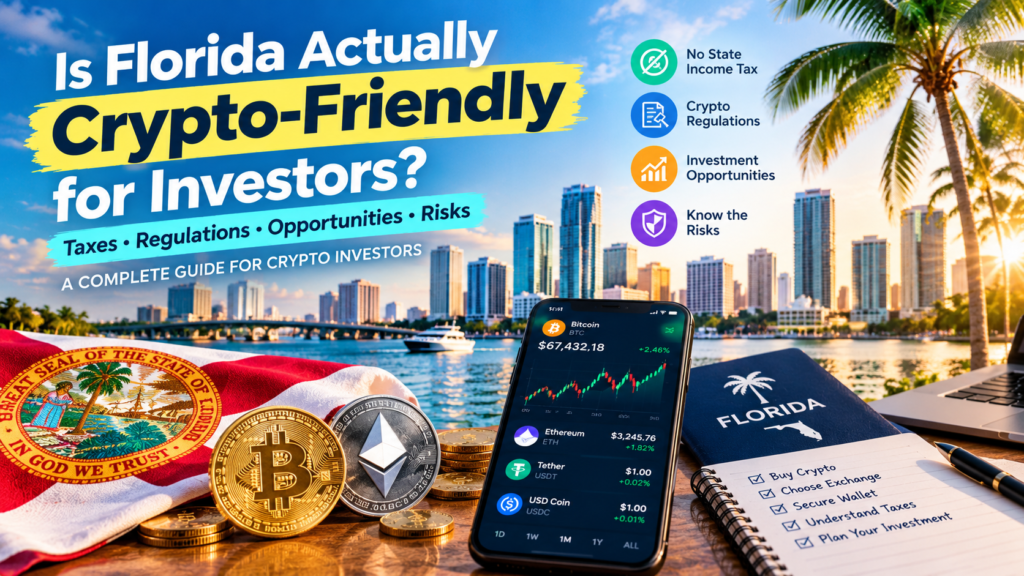
Florida has become an interesting destination for cryptocurrency investors, entrepreneurs, and blockchain businesses. Its lack of a personal state income tax, growing digital-asset industry, and established financial-services framework make it worth considering for people exploring crypto investments in the United States.
But is Florida actually crypto-friendly, or does its reputation overlook important regulations, taxes, and investment risks?
The answer depends on what you want to do. Buying Bitcoin, operating a crypto exchange, running a crypto ATM business, and building a blockchain company can involve very different legal and financial requirements.
This guide explains Florida’s cryptocurrency environment, including taxes, regulations, investor protections, and practical considerations for beginners and experienced investors.
Is Florida Crypto-Friendly?
Florida has several characteristics that appeal to cryptocurrency investors, particularly individuals who value its state tax structure and businesses seeking access to a large US market.
However, Florida is not a regulation-free environment. Crypto businesses may face state licensing requirements, federal compliance obligations, and consumer-protection rules.
Here are the main factors to understand:
- State income tax: Florida does not impose a personal state income tax on individuals.
- Crypto regulation: Certain cryptocurrency-related businesses must comply with Florida financial-services laws and applicable federal regulations.
- Investment access: Investors can access crypto markets through eligible exchanges and other service providers, subject to their availability and requirements.
- Investor protection: Cryptocurrency holdings generally do not receive the same government-backed protections as insured bank deposits.
- Tax reporting: Federal tax obligations can apply even when an investor owes no Florida personal income tax.
The Florida Department of Financial Services provides an overview of cryptocurrency, wallet security, taxation, and consumer risks in its official cryptocurrency guidance.
1. Florida’s Tax Environment: A Major Consideration
One of Florida’s most frequently cited advantages is its lack of a personal state income tax.
For eligible residents, this can make the state attractive compared with jurisdictions that impose personal income taxes. However, it does not eliminate federal taxes on cryptocurrency transactions.
Do Florida crypto investors pay capital gains tax?
Cryptocurrency investors may owe federal tax when they sell, exchange, or otherwise dispose of digital assets in a taxable transaction.
For example, selling Bitcoin for US dollars may trigger a capital gain or loss. Exchanging Bitcoin for Ethereum can also be a taxable disposition under US federal tax rules.
The federal tax treatment depends on factors such as the asset’s cost basis, holding period, transaction type, and individual circumstances.
| Activity | Potential US federal tax treatment |
|---|---|
| Buying crypto with US dollars and holding it | Generally no immediate tax solely from purchasing |
| Selling crypto for a profit | May trigger a capital gain |
| Exchanging one cryptocurrency for another | May trigger a taxable gain or loss |
| Spending crypto on goods or services | May trigger a taxable disposition |
| Receiving crypto as compensation | May create ordinary income |
| Receiving staking rewards | May create taxable income, depending on the circumstances |
Florida’s lack of a personal state income tax does not remove federal reporting requirements. Other taxes and business obligations may also apply depending on the activity.
For details, consult the IRS guidance on digital assets.
Is Florida better for long-term crypto investors?
Florida’s state tax structure may be relevant when comparing potential places of residence. However, the overall financial outcome depends on more than state income tax.
Investors should also consider federal tax, living expenses, insurance, business costs, residency rules, and the tax laws of any other jurisdiction that applies to them.
Moving to Florida does not automatically eliminate tax obligations connected with another state or country.
2. What Cryptocurrency Regulations Apply in Florida?
Florida permits cryptocurrency-related activities, but the rules depend on the type of business and service involved.
A person buying crypto for personal investment generally faces different requirements from a company that transmits virtual currency, holds customer assets, or operates a cryptocurrency kiosk.
Crypto exchanges and money transmission
Florida’s Chapter 560 addresses money services businesses, including certain money transmission activities involving virtual currency.
Under Florida law, businesses that meet the applicable definition of a money transmitter may need a state license. The precise requirements depend on the services provided and any applicable exemptions.
Before using a crypto platform, investors should check its legal entity, operating permissions, custody arrangements, and withdrawal policies.
Official reference: Florida Statutes, Chapter 560.
New rules for cryptocurrency kiosks
Florida’s 2026 statutes also establish a registration framework for virtual currency kiosk businesses. The relevant statutory provisions specify an effective date of March 1, 2027.
This is particularly relevant to businesses operating crypto ATMs and to consumers who use them. Investors should distinguish between rules already in effect and provisions scheduled to take effect in the future.
Read the official Florida statute on virtual currency kiosk registration.
Federal rules still matter
Florida businesses may also need to comply with applicable federal requirements, including anti-money-laundering rules and registration obligations.
For example, certain businesses that exchange or transmit convertible virtual currency may fall within the scope of federal money-services-business regulations.
The Financial Crimes Enforcement Network explains these obligations in its guidance for businesses involving convertible virtual currencies.
Important: Florida’s approach does not mean every crypto business is automatically authorized to operate. Requirements depend on the business model, activities, and applicable state and federal law.
3. Can You Buy Bitcoin and Other Cryptocurrencies in Florida?
Individuals in Florida can generally buy cryptocurrency through platforms that serve eligible US customers, subject to identity verification, platform terms, and applicable regulations.
The process is similar to buying crypto elsewhere in the United States.
A beginner’s checklist
- Choose a platform. Review its regulatory status, supported assets, fees, security, and withdrawal options.
- Complete identity verification. Many regulated services require personal information and identity documents.
- Deposit US dollars. Depending on the provider, options may include bank transfers, debit cards, or other supported payment methods.
- Make a small first purchase. Understand the total cost before committing a larger amount.
- Review your custody options. Decide whether to use the platform’s wallet or a wallet you control.
- Keep transaction records. Record purchase prices, fees, transfers, sales, and other relevant events for tax reporting.
Do not assume every platform offers the same assets, deposit methods, or features in Florida. Availability can change, so check the provider’s current terms before opening an account.
How should you choose a crypto exchange?
Compare platforms based on the following criteria:
- Applicable US and Florida regulatory requirements
- Trading spreads and transaction fees
- Deposit and withdrawal costs
- Supported cryptocurrencies
- Account security and recovery procedures
- Custody arrangements and withdrawal restrictions
- Customer support and complaint history
A platform advertising zero trading fees may still charge through spreads, payment processing, or withdrawals. Compare the total cost of a transaction rather than relying on a single advertised fee.
4. How Should Florida Investors Store Cryptocurrency?
Security is an important consideration regardless of where you live.
Crypto held on an exchange is generally controlled through the provider’s custody arrangements. A self-custody wallet gives you greater direct control over your private keys, but also makes you responsible for protecting them.
Exchange wallets versus hardware wallets
| Feature | Exchange custody | Self-custody hardware wallet |
|---|---|---|
| Private-key control | Generally managed by the provider | Controlled by the wallet owner |
| Account recovery | May be available through the provider | Usually depends on the recovery phrase and wallet procedures |
| Main risk | Provider failure, account compromise, or withdrawal restrictions | Lost recovery phrase, theft, or user error |
| Convenience | Often convenient for active trading | Useful for holding assets outside an exchange |
| Responsibility | Shared with the service provider | Primarily the user’s responsibility |
A hardware wallet may be worth considering for investors who intend to hold assets over the longer term.
For example, you can explore OneKey hardware wallets, which may offer up to 5 USDT cashback through this link, or review ELLIPAL wallet products.
These are commercial options, not guarantees of security. Research compatibility, backup procedures, supported assets, and the risks of self-custody before purchasing a wallet.
Never share your recovery phrase or private keys. A legitimate wallet provider should not need your recovery phrase to provide routine customer support.
5. What Are the Risks of Investing in Crypto in Florida?
A supportive business environment does not make cryptocurrency a low-risk investment.
Florida investors face many of the same risks as other US crypto investors.
Market volatility
Cryptocurrency prices can change sharply over short periods. Bitcoin, Ethereum, and smaller digital assets can experience substantial losses, and some tokens may lose most or all of their value.
Avoid investing money you need for essential expenses or near-term financial commitments.
Scams and misleading promotions
Common warning signs include guaranteed returns, unsolicited investment messages, fake celebrity endorsements, impersonation websites, and requests to transfer cryptocurrency to an unfamiliar wallet.
Be especially cautious when someone pressures you to act quickly or claims that a government agency or legitimate exchange requires an urgent crypto payment.
Custody and platform risks
A cryptocurrency exchange may experience operational problems, restrict withdrawals, suffer a security incident, or enter insolvency proceedings.
Crypto assets are not automatically protected by FDIC deposit insurance. The Florida Department of Financial Services explains this distinction in its consumer cryptocurrency guidance.
Stablecoin and transaction risks
Stablecoins are designed to track the value of another asset, often the US dollar, but they are not risk-free. Their value can deviate from the intended peg, and redemption, issuer, reserve, or platform risks may arise.
Blockchain transfers can also be irreversible. Verify the recipient address, network, and amount before sending funds.
6. Is Florida Suitable for Crypto Businesses and Entrepreneurs?
Florida may be worth evaluating for entrepreneurs building blockchain products, crypto services, payment businesses, or Web3 companies.
The state’s lack of a personal income tax can be relevant to individual founders, but businesses should assess their own tax and regulatory position separately.
Before launching a crypto business, consider:
- Whether the service requires a money transmitter or other license
- Federal registration and anti-money-laundering obligations
- Customer identification and transaction-monitoring procedures
- Custody, cybersecurity, and incident-response arrangements
- Business entity structure and federal tax treatment
- Consumer disclosures and complaint-handling procedures
A company that merely develops blockchain software may face a different regulatory analysis from one that takes custody of customer assets or transfers funds between customers.
If your business plans to accept digital assets or work with international payments, get professional advice on payment processing, compliance, banking access, and applicable licensing before launching.
7. Florida vs. Other US States: What Should Investors Compare?
Florida is often compared with other states based on taxation and the environment for financial technology businesses. A useful comparison should consider actual rules and personal circumstances rather than relying on broad labels.
| Factor | Questions to ask |
|---|---|
| State taxation | Does the state impose personal income tax, and how would its rules apply to your circumstances? |
| Business regulation | What licenses or registrations could your crypto activities require? |
| Exchange access | Which platforms and assets are available to residents? |
| Banking access | Can you reliably fund and withdraw from your chosen platform? |
| Consumer protection | What remedies may be available if a provider fails or a transaction goes wrong? |
| Cost of living | How do housing, insurance, and other expenses affect your finances? |
| Business costs | What are the costs of compliance, staffing, legal services, and operations? |
Florida’s personal tax structure is one factor in this assessment, not a complete measure of whether it is the right location for a particular investor.
Investors should also verify their residency status and any tax obligations in other states or countries before making relocation decisions.
8. A Practical Checklist Before Buying Crypto
Whether you’re a first-time buyer or an experienced investor, use this checklist before making a transaction.
- Choose a provider that can legally serve your location.
- Understand the spread, trading fees, deposit costs, and withdrawal fees.
- Enable multi-factor authentication and secure your email account.
- Start with an amount you can afford to lose.
- Learn how to withdraw assets and verify wallet addresses.
- Consider whether self-custody is appropriate for your needs.
- Keep records for tax and accounting purposes.
- Ignore unsolicited offers and guaranteed-profit claims.
- Review the risks before using leverage, lending, staking, or unfamiliar DeFi products.
Investors should understand a product before using it. Higher potential returns generally come with risks that should be evaluated carefully.
Frequently Asked Questions
Is Florida a crypto-friendly state?
Florida allows cryptocurrency investment and various crypto-related business activities. Its lack of a personal state income tax can be attractive to some residents, but applicable state and federal rules still apply.
Does Florida tax cryptocurrency gains?
Florida does not impose a personal state income tax on individuals. However, cryptocurrency transactions may still create federal tax obligations. Business taxes and other circumstances may also be relevant.
Can I buy Bitcoin legally in Florida?
Individuals can generally purchase Bitcoin through services that are available to them and comply with applicable requirements. Platform availability, identity verification, and transaction limits vary by provider.
Are cryptocurrency investments insured in Florida?
Cryptocurrency holdings are not automatically covered by FDIC deposit insurance. Investors can lose money through market declines, scams, custody failures, or other events.
Do crypto exchanges need a license in Florida?
Certain businesses that transmit virtual currency or perform other regulated financial activities may need Florida licenses or registrations. The answer depends on the services provided and applicable exemptions.
Are crypto ATMs regulated in Florida?
Florida’s 2026 statutes establish registration requirements for virtual currency kiosk businesses, with relevant provisions scheduled to take effect on March 1, 2027. Check the current statute and effective dates before relying on a particular requirement.
Should I use a hardware wallet?
A hardware wallet can help investors manage their private keys outside an exchange. However, it does not eliminate risks such as phishing, compromised recovery phrases, malicious transactions, or user error.
Final Verdict: Is Florida Actually Crypto-Friendly for Investors?
Florida offers a combination of a personal-income-tax-free state structure, access to the US cryptocurrency market, and a regulatory framework for certain crypto-related businesses.
At the same time, investors must account for federal taxes, licensing requirements where applicable, market volatility, scams, and custody risks. The state’s crypto environment is not the same as an absence of regulation or guaranteed investment protection.
For individual investors, the practical approach is to choose a suitable platform, understand the full cost of buying and holding crypto, secure digital assets carefully, and maintain accurate records.
For entrepreneurs, the priority is to confirm licensing, compliance, tax, and banking requirements before offering cryptocurrency services.
Florida may suit some crypto investors, but the right decision depends on your investment strategy, financial circumstances, and regulatory obligations—not just the state’s reputation.
Affiliate disclosure: This article contains affiliate links. The website may earn a commission or the reader may receive a promotional benefit if they use certain links, at no additional cost unless otherwise stated.
Disclaimer: This article is for educational purposes only and does not constitute financial, investment, tax, or legal advice. Regulations and tax treatment may change. Consult qualified professionals about your specific circumstances.
Leave a Reply