Should I Keep My Crypto on an Exchange or in Self Custody?
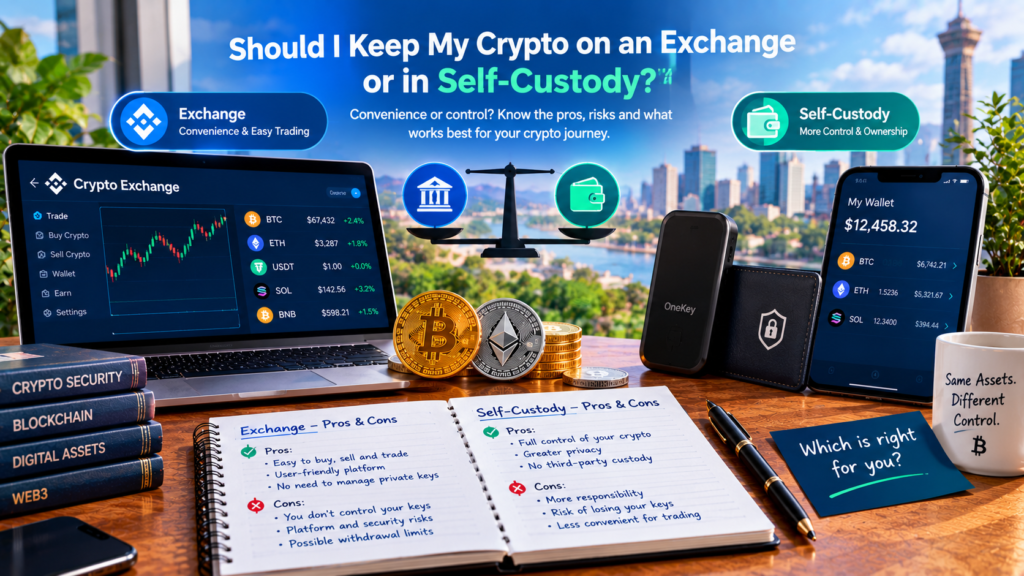
The debate over crypto custody is gaining fresh attention after the US Securities and Exchange Commission (SEC) proposed new rules for how investment advisers and regulated funds can hold crypto assets.
On October 1, 2026, the SEC proposed a tailored framework for crypto custody. The proposal would allow crypto assets to be held in self custody under certain conditions and would also allow state trust companies to act as custodians.
The move highlights an important question for crypto users: Should you keep your crypto on an exchange or use self custody?
Both options have advantages and risks. An exchange can offer convenience and easy trading, while self custody gives users more direct control over their assets and private keys.
So, which option makes more sense?
Why Is Crypto Custody Back in Focus?
Crypto custody has become a bigger issue as digital assets move further into mainstream finance.
The SEC said its new proposal would update custody rules from before the current crypto market emerged. The regulator also wants to give registered investment advisers and regulated funds clearer rules for crypto related investment strategies.
Individual crypto users do not need to move their assets into self-custody under the proposal. Instead, the rules focus on registered investment advisers and regulated funds.
Still, the development shows how regulators are paying closer attention to the difference between third party custody and direct control of crypto assets.
In the UK, the FCA also updated its guidance on September 16, 2026. It clarified that a firm generally would not be providing regulated cryptoasset safeguarding when a customer genuinely controls their own crypto and the firm has no means to transfer the asset itself.
These developments make the exchange versu self custody question increasingly relevant.
What Is Crypto Self Custody?
Crypto self custody means you control the wallet and the private keys that provide access to your crypto.
Instead of leaving custody with an exchange, you manage your own wallet. This can include a hardware wallet, mobile wallet, or desktop wallet.
The biggest advantage is control.
You decide when to move your crypto and where to send it. You also do not need to rely entirely on an exchange to provide access to your assets.
However, self custody also creates a major responsibility.
If you lose your recovery phrase or expose your private keys, you may lose access to your crypto. The SEC’s proposed custody framework also highlights the importance of protecting key materials against loss and unauthorized access.
What Does Keeping Crypto on an Exchange Mean?
Keeping crypto on an exchange means the platform handles custody of the assets rather than you managing the private keys directly.
This setup can be convenient, especially for people who trade frequently.
You can usually buy, sell, swap, and withdraw crypto from the same account. You also do not need to manage a separate wallet for every transaction.
However, convenience comes with dependence.
You rely on the exchange to maintain its systems, protect customer assets, process withdrawals, and keep your account accessible.
Therefore, exchange custody shifts some of the responsibility from the individual user to the platform.
Exchange vs Self Custody: What Is the Difference?
The main difference is who controls the crypto and who carries the responsibility for protecting access.
| Factor | Crypto Exchange | Self-Custody |
|---|---|---|
| Control | Exchange manages custody | User controls the wallet |
| Convenience | Usually easier | Requires more responsibility |
| Trading | Convenient for active trading | May require extra steps |
| Private keys | Usually managed by the platform | Managed by the user |
| Main risk | Platform, custody, or account risk | Lost keys, scams, or user error |
| Recovery | May have account recovery options | Recovery depends on wallet credentials |
| Best suited for | Trading and convenience | Direct control and long-term holding |
Neither option eliminates risk.
Instead, the two methods place different responsibilities on the user and the service provider.
Pros of Keeping Crypto on an Exchange
1. It Is Convenient
Exchanges make it easy to buy and sell crypto.
If you trade regularly, keeping some funds on an exchange can save you the extra step of moving assets between wallets.
2. It Is Beginner-Friendly
New crypto users may find an exchange easier to understand than a self custody wallet.
An exchange account usually looks more familiar because it works similarly to other online financial accounts.
3. Account Security Tools Are Built In
Many exchanges offer tools such as two factor authentication, withdrawal controls, device management, and login alerts.
These features can help users protect their accounts.
However, users still need to protect passwords, authentication codes, and devices from phishing and other attacks.
Cons of Keeping Crypto on an Exchange
The main disadvantage is that you depend on the exchange.
If the platform experiences a security incident, technical problem, or operational disruption, accessing your assets may become more difficult.
There is also a difference between owning crypto through an exchange account and directly controlling the wallet credentials.
For that reason, users should understand how an exchange handles custody before keeping significant amounts of crypto on the platform.
Pros of Crypto Self Custody
1. You Control Your Private Keys
Self custody gives you direct control over the wallet credentials needed to move your crypto.
That can reduce your dependence on a centralized exchange.
2. You Control Transactions
You can initiate transactions directly from your wallet without first requesting a withdrawal from an exchange.
This can provide greater independence when managing your assets.
3. You Reduce Exchange Dependence
Self-custody can be useful for users who want to hold crypto without relying on a centralized platform for every transaction.
However, greater independence also means greater responsibility.
Cons of Crypto Self-Custody
Self custody can introduce risks that users cannot simply pass to a third party.
The biggest concern is protecting your recovery phrase and private keys.
If someone obtains your private keys, they may be able to move your crypto. Likewise, if you permanently lose your recovery information, you may not be able to recover your assets.
Transaction mistakes can also become serious problems.
If you send crypto to the wrong address or approve a malicious transaction, reversing the transaction may not be possible.
Therefore, self custody requires users to understand basic wallet security before moving significant funds.
Is Self Custody Safer Than an Exchange?
Not automatically.
Self-custody can remove certain risks associated with centralized platforms. However, it also creates risks related to personal responsibility.
An exchange user may worry about platform security, account access, or custody practices.
A self custody user may instead worry about losing a recovery phrase, exposing private keys, connecting to a malicious website, or approving the wrong transaction.
The SEC’s proposed framework reflects this balance. Its proposal includes requirements around protecting key materials and controlling access when advisers use self custody for client crypto assets.
In other words, self custody does not mean risk free custody.
What Does the New SEC Proposal Mean for Crypto Users?
The SEC proposal does not mean that every retail investor should move crypto off an exchange.
Its scope focuses on registered investment advisers and regulated funds.
However, the proposal is significant because it recognizes self custody as part of the possible custody framework for certain regulated entities.
Under the proposal, self custody would come with conditions designed to protect crypto assets. Private key controls, access management, and safeguarding systems are key areas in the SEC’s proposal.
The proposal is also still a proposal.
The SEC’s public comment period will remain open for 60 days after publication in the Federal Register. Therefore, the framework could change before any final rules take effect.
What Does the New FCA Guidance Mean?
The UK’s FCA has also provided more clarity around self custody.
Its September 2026 guidance says that a firm generally is not carrying out regulated cryptoasset safeguarding when it provides a solution that allows the customer to control the crypto themselves and the firm has no means to transfer the asset.
However, the distinction depends on actual control.
If a company claims to offer self custody but still has the technical ability to override the customer’s authority and transfer the crypto, the FCA says the arrangement may still fall within regulated safeguarding.
This shows why the term self custody should not simply mean “a wallet app.” The key issue is who actually has control.
Should Beginners Keep Crypto on an Exchange?
For beginners, an exchange may be easier while they learn how crypto works.
You can start by learning how to secure your account, use two factor authentication, identify phishing attempts, and understand deposits and withdrawals.
Once you understand private keys, recovery phrases, wallet addresses, and transaction confirmations, you can consider whether self-custody fits your needs.
You also do not have to choose only one method.
Some users keep a portion of their crypto on an exchange for active trading and hold other assets in a self-custody wallet.
How Much Crypto Should You Keep on an Exchange?
There is no universal percentage that works for every crypto user.
Instead, consider your personal needs.
If you trade frequently, you may need some funds on an exchange. If you mainly hold crypto for the long term, you may prefer to keep less of your portfolio on a centralized platform.
Before deciding, consider:
- How often you trade
- How much crypto you hold
- How long you plan to hold it
- Your ability to protect private keys
- Your understanding of wallet security
- The exchange’s custody and security practices
- How quickly you need access to your funds
The right approach depends on your risk tolerance and how actively you use crypto.
How to Make Crypto Self Custody Safer
If you choose self custody, start with basic security.
First, keep your recovery phrase private. Never share it through email, messaging apps, social media, or websites claiming to provide wallet support.
Second, store your recovery information somewhere secure and protected from unauthorized access.
Third, double-check wallet addresses before confirming transactions.
Finally, be careful when connecting your wallet to decentralized applications and approving transactions. A legitimate-looking website does not guarantee that every transaction request is safe.
The Bottom Line
Recent regulatory developments show that crypto custody remains an important issue for regulators and investors.
Under the SEC’s October 2026 proposal, certain investment advisers and regulated funds could use crypto self custody under specific conditions.Meanwhile, the FCA’s September 2026 guidance provides more clarity around when a crypto arrangement genuinely qualifies as self-custody.
For individual crypto users, however, the basic choice remains the same.
An exchange offers convenience, easy trading, and simpler account management. Self custody provides greater direct control but also puts more responsibility on the user.
So, should you keep your crypto on an exchange or use self custody?
There is no single answer for everyone.
If you actively trade, an exchange may be more convenient. If you want greater direct control over lon term holdings and understand wallet security, self custody may be worth considering.
The most important step is to understand who controls your crypto, what risks you are accepting, and how you can protect access to your assets.
💸 GET PAID GLOBALLY WITH KOLAN
USD/GBP/EUR/AED accounts
Fill out the form: https://forms.gle/QVri289ukKMFR6Qn8
🔐 OneKey / Ellipal
Free delivery over US$99 + up to 5 USDT cashback
OneKey: https://onekey.so/r/TRC
Ellipal: https://www.ellipal.com/?rfsn=9305287.28d2ea6
🌍 GO GLOBAL WITH MYPAL
https://h5.mypal.pro/pm/vhcn?code=27090432
🔗 CONNECT WITH CRYPTOMARTSITE
https://msha.ke/cryptomart.site
Leave a Reply