What Does Clear Crypto Regulation Actually Mean for Me?
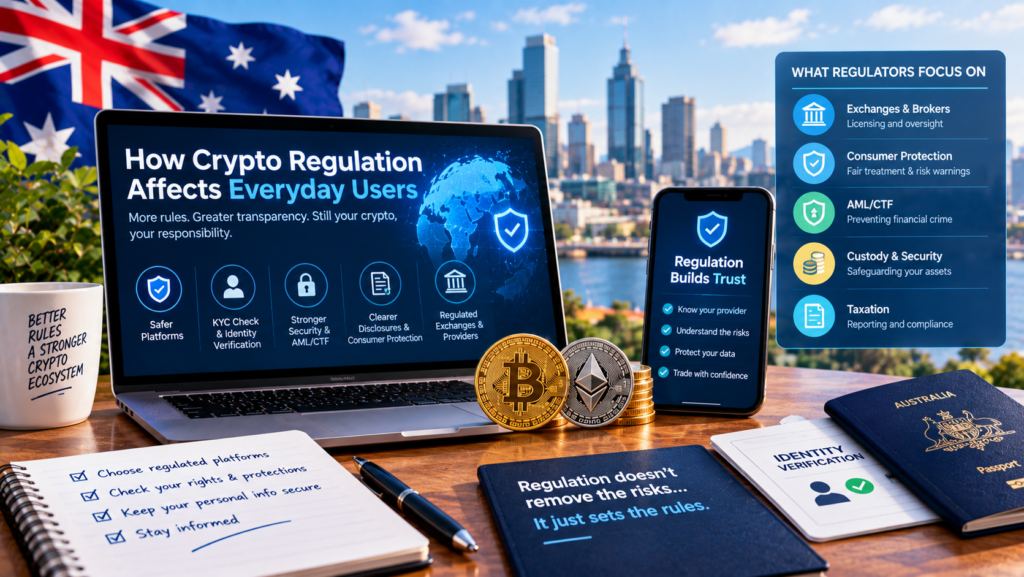
Crypto regulation can sound like something that only matters to exchanges, governments, and large financial companies.
In reality, it can affect everyday crypto users too.
Clear crypto regulation can influence where you buy crypto, what information a platform must provide, how companies handle your data, and what happens when something goes wrong.
However, regulation does not remove the risks of crypto.
Instead, it creates rules around certain businesses, products, and activities. The exact protections depend on the country and the type of crypto service involved.
What Does Crypto Regulation Actually Mean?
Crypto regulation means governments and regulators set rules for businesses and activities involving digital assets.
These rules can cover crypto exchanges, brokers, custodians, stablecoin services, wallet providers, and other crypto businesses.
The rules can also cover areas such as financial promotions, anti-money laundering, consumer protection, licensing, custody, and reporting.
Therefore, crypto regulation does not mean that every cryptocurrency is treated like a traditional bank account.
Instead, regulators usually focus on specific activities and businesses.
That distinction matters for everyday users.
How Does Crypto Regulation Affect Me?
You may notice regulation in several parts of your crypto experience.
For example, a regulated platform may ask for identification before allowing you to trade.
You may also see risk warnings, transaction monitoring, withdrawal checks, or restrictions on certain products.
These steps can sometimes make crypto services feel less convenient.
However, they can also give regulators more visibility over businesses operating in the market.
Australia provides a useful example. AUSTRAC now maintains a public register of virtual asset service providers, allowing users to check whether certain VASPs are registered.
Does Regulation Make My Crypto Safe?
No.
This is one of the most important points for beginners.
Regulation can create requirements for businesses, but it does not guarantee that your crypto investment will increase in value.
Crypto prices can still fall sharply.
A regulated platform can also experience technical problems, operational issues, or other risks.
The Financial Conduct Authority has also studied how information about regulation can affect consumer decisions. Its research found that people can respond differently when they are told that a cryptoasset is regulated or that certain protections apply.
So, the word “regulated” should not be treated as a guarantee of investment safety.
Instead, ask what exactly is regulated.
Does Regulation Protect My Money?
That depends on the country and the specific service.
Different jurisdictions offer different forms of consumer protection.
For example, a crypto platform may have to meet certain requirements for custody, disclosures, financial promotions, or operational controls.
However, those requirements do not necessarily mean your crypto has the same protection as money held in a traditional bank account.
Therefore, always check the specific protection that applies to the platform you use.
Do not assume that regulation automatically means government compensation if a crypto company fails.
Why Do Crypto Platforms Ask for My ID?
If you use a regulated crypto service, you may need to provide personal information.
This can include your name, address, date of birth, identity documents, and information about your transactions.
One reason is anti-money laundering regulation.
Regulated businesses may need to know who their customers are and monitor transactions for suspicious activity.
For example, Australia’s AML/CTF framework requires relevant virtual asset businesses to meet obligations around financial crime risks and suspicious matter reporting.
As a result, identity checks can become part of the normal crypto onboarding process.
Why Can My Crypto Transaction Be Delayed?
Regulation can sometimes affect how quickly transactions are processed by a platform.
For example, an exchange may conduct additional checks before allowing a deposit or withdrawal.
The platform may also ask for more information if a transaction triggers its compliance systems.
These checks can feel frustrating.
However, they are often connected to the platform’s legal and financial crime obligations.
The exact process varies between platforms and countries.
Does Regulation Affect Crypto Withdrawals?
It can.
A platform may place additional checks around withdrawals, especially when large amounts or unusual activity are involved.
For example, a regulated service may need to verify information about a customer or transaction before completing certain activities.
This does not mean that every withdrawal will be delayed.
Rather, regulation can give platforms compliance requirements that influence how they process some transactions.
Therefore, users should read the platform’s withdrawal terms before depositing significant amounts.
Can Regulation Change Which Crypto Products I Can Use?
Yes.
Regulators may place different requirements on different products.
For example, a crypto asset may receive different regulatory treatment from a stablecoin, tokenised investment product, or crypto derivative.
The United States offers a current example.
In March 2026, the SEC issued an interpretation explaining how federal securities laws apply to certain crypto assets and transactions. In August 2026, the SEC also proposed a new framework for certain investment contracts involving crypto assets.
That means the regulatory classification of a product can affect how it is offered or traded.
For users, the practical result can be changes to product availability, disclosures, or platform access.
Does Regulation Affect Crypto Promotions?
Yes.
Regulators can set rules around how crypto products are marketed.
This matters because social media is now a major source of crypto information.
Promotions can make a crypto product appear simple or low-risk when the underlying asset may be highly volatile.
Regulatory rules can require firms to provide clearer information or restrict certain promotional practices.
The UK’s developing crypto regime is one example. The FCA has said its future framework includes standards such as the Consumer Duty, which is intended to set expectations for firms dealing with consumers.
For users, this can mean more information before making a decision.
Can Regulation Help With Crypto Scams?
It can help, but it cannot eliminate scams.
Regulators can register businesses, supervise regulated activities, issue warnings, and take action against firms that break applicable rules.
For example, AUSTRAC reported in September 2026 that it had cancelled, suspended, or refused renewal of 45 remittance and VASP registrations over the previous year.
Australia has also suspended a VASP registration after compliance concerns involving a crypto ATM operator.
These actions show how regulation can provide a mechanism for oversight.
However, scams can still operate outside regulated channels.
That is why users should not rely on regulation alone.
What Should I Check Before Using a Crypto Platform?
Before depositing money, check a few basic things.
1. Check the Regulator
Find out which regulator oversees the platform in your country.
Then check the regulator’s official register where one is available.
2. Check What Is Actually Regulated
A company can operate legally while only certain parts of its business fall under specific regulatory rules.
Therefore, check the exact service rather than relying on a “regulated” label.
3. Check the Legal Entity
Large crypto brands can operate through different companies in different countries.
The legal entity can matter because the regulatory status may apply to one entity and not another.
4. Read the Risk Information
Look at the platform’s terms, fees, withdrawal rules, and risk disclosures.
Do not focus only on trading features.
5. Protect Your Own Account
Use a strong password and two-factor authentication.
Never share your seed phrase or private keys.
Regulation can create rules for businesses, but account security still matters to you.
Does Clear Regulation Mean Lower Crypto Fees?
Not necessarily.
Compliance can create costs for businesses.
Platforms may need staff, technology, legal support, reporting systems, and customer verification processes.
Those costs can influence how a platform structures its fees.
At the same time, clearer rules can reduce uncertainty for businesses.
The overall effect on fees can therefore vary by market, platform, and service.
There is no universal rule that regulation automatically makes crypto cheaper or more expensive.
Does Regulation Affect Privacy?
Yes, it can.
Many regulated crypto services need customer information for identity and compliance purposes.
This means using a regulated exchange is not the same as using an anonymous financial service.
However, this does not mean that regulators automatically have unrestricted access to every crypto transaction.
The level of information available depends on the service, jurisdiction, legal requirements, and transaction history.
For everyday users, the key point is simple: understand what information a platform collects and why.
What About Self-Custody Wallets?
Self-custody works differently from using a centralised exchange.
With a self-custody wallet, you generally control the private keys yourself.
That can reduce your dependence on an exchange for holding the assets.
However, it also means you carry more responsibility.
If you lose your private keys or seed phrase, there may be no company that can restore access.
Regulation of businesses does not remove that responsibility.
Therefore, self-custody requires careful security practices.
Does Crypto Regulation Affect Taxes?
Yes.
Crypto regulation and tax rules are related, but they are not the same thing.
A regulator may oversee a crypto business, while a separate tax authority handles your tax obligations.
For example, the ATO handles crypto tax matters in Australia.
In the UK, HMRC handles crypto tax.
In the US, the IRS handles federal crypto tax reporting.
Therefore, using a regulated crypto platform does not automatically mean your tax obligations disappear.
You may still need to report taxable transactions.
What Does Clear Crypto Regulation Mean for Everyday Users?
For everyday users, clear crypto regulation can mean several practical changes.
You may see:
- More identity checks
- More risk disclosures
- Greater transaction monitoring
- Clearer information about crypto products
- More rules for crypto businesses
- More public regulatory registers
- Restrictions on certain products or promotions
- Greater oversight of some crypto companies
At the same time, regulation does not remove market volatility.
Regulation does not guarantee profits.
It does not make every crypto project legitimate.
Different regulated services may still offer different levels of protection.
The details matter.
Is More Regulation Always Better for Crypto Users?
The effect depends on how the rules are designed and applied.
Clear rules can help businesses understand their obligations.
They can also give consumers more information about who they are dealing with.
However, regulation can also create compliance costs and affect which products businesses offer.
Regulators themselves recognise the need to balance consumer protection with innovation and competition.
For example, the FCA’s 2026 cryptoasset framework aims to create standards for regulated firms while supporting a competitive crypto market.
So, the important question is not simply whether crypto is regulated.
The better question is what the rules cover and what they mean for you.
What Should I Remember About Crypto Regulation?
Crypto regulation is becoming more important as digital assets become part of the wider financial system.
For everyday users, the biggest impact may be less about complicated legal definitions and more about practical changes.
You may need to verify your identity.
You may receive more risk information.
Some products may have restrictions.
Your transactions may be monitored for compliance purposes.
You may also have tax reporting responsibilities.
However, regulation is only one part of managing crypto risk.
You still need to check the platform, understand the product, protect your account, and research an asset before buying it.
Final Thoughts
Clear crypto regulation can make the crypto market easier to understand, but it does not remove every risk.
For everyday users, regulation can affect how platforms operate, what information they provide, how accounts are verified, and which products are available.
At the same time, the exact rules depend on the country and service.
Therefore, do not stop at the word “regulated.”
Check which regulator is involved, what activity is covered, and what protection actually applies.
That approach can help you understand what crypto regulation means for you before you deposit money or use a digital asset service.
FAQ
What does crypto regulation mean for everyday users?
Crypto regulation can affect identity checks, product availability, risk disclosures, transaction monitoring, consumer protections, and tax reporting.
Does crypto regulation make cryptocurrency safe?
No. Regulation can create rules for businesses, but it does not guarantee investment returns or prevent crypto prices from falling.
Why do crypto exchanges need my ID?
Many regulated crypto businesses have customer identification and anti-money laundering obligations. These requirements can involve collecting and verifying customer information.
Can regulation stop crypto scams?
Regulation can help authorities supervise businesses and take action against certain firms. However, scams can still operate outside regulated channels.
Does crypto regulation affect withdrawals?
It can. Platforms may conduct additional compliance checks on some withdrawals or transactions.
Does regulation affect crypto taxes?
Yes, but tax rules are usually handled by tax authorities. Using a regulated platform does not automatically remove your tax obligations.
Is a regulated crypto exchange risk-free?
No. Regulation can provide certain rules and protections, but users can still face market, platform, cybersecurity, and asset-specific risks.
What should I check before using a crypto platform?
Check the relevant regulator, the platform’s legal entity, what activities are regulated, fees, withdrawal rules, risk disclosures, and account-security options.
💸 GET PAID GLOBALLY WITH KOLAN
Need to receive international payments? Open your USD, GBP, EUR & AED accounts with Kolan and make international payments easier.
Fill out the form and book your free consultation:
https://forms.gle/QVri289ukKMFR6Qn8
🔐 SECURE YOUR CRYPTO WITH ONEKEY OR ELLIPAL
Get free delivery on orders over US$99 + up to 5 USDT cashback
OneKey: https://onekey.so/r/TRC
Ellipal: https://www.ellipal.com/?rfsn=9305287.28d2ea6
🌍 GO GLOBAL WITH MYPAL
https://h5.mypal.pro/pm/vhcn?code=27090432
🔗 CONNECT WITH CRYPTOMARTLIVE
Leave a Reply