Can I Buy Bitcoin in Nigeria Safely? Finding Safe Ways to Purchase Crypto
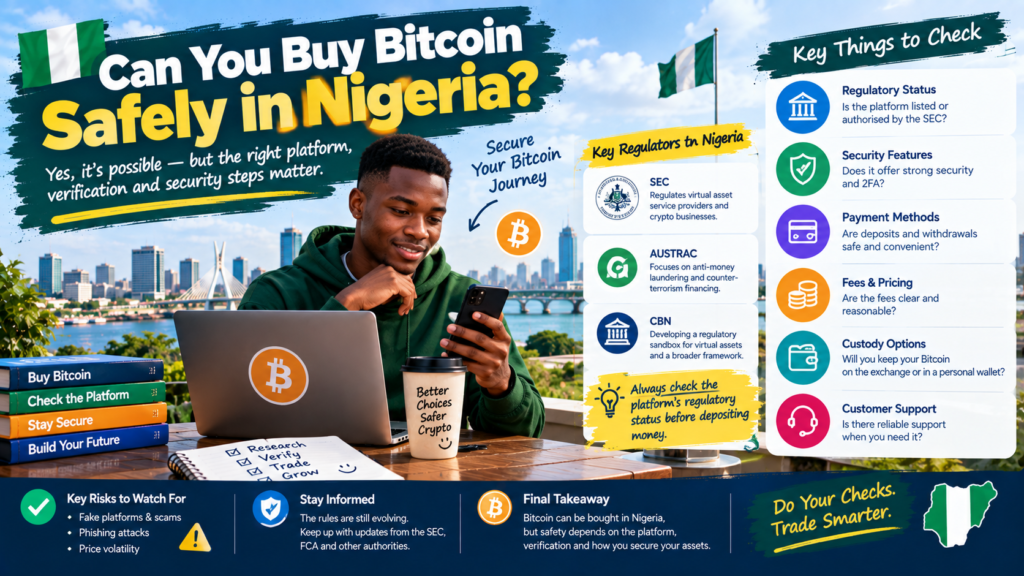
Buying Bitcoin in Nigeria is possible, but choosing where and how to buy it matters. With scams, fake platforms and crypto-related fraud still posing risks, Nigerian buyers need to check an exchange before depositing money.
Nigeria has also been developing a regulatory framework for virtual assets. The Securities and Exchange Commission (SEC) oversees virtual asset service providers and has introduced registration and regulatory incubation processes for crypto businesses operating in the country.
For anyone asking whether they can buy Bitcoin safely in Nigeria, the answer depends on more than the Bitcoin itself. The platform, payment method, account security and custody choices all matter.
Is Bitcoin Legal to Buy in Nigeria?
Bitcoin can be bought and traded in Nigeria, but the crypto market operates within an evolving regulatory framework.
The SEC has rules covering digital assets, virtual asset service providers (VASPs), digital asset exchanges and custodians. The Commission has also created programs that allow eligible crypto businesses to move through regulatory onboarding and approval processes.
In August 2024, the SEC granted Approval-in-Principle to Busha and Quidax under its Accelerated Regulatory Incubation Program. The IMF reported that the approval allowed the two platforms to operate as crypto-trading platforms while progressing toward full registration.
This makes checking a platform’s regulatory status an important step before buying Bitcoin.
How Can Nigerians Buy Bitcoin Safely?
There are several ways to buy Bitcoin, but not every method carries the same level of risk.
1. Use a regulated or authorised crypto platform
One of the first checks should be the platform’s regulatory status.
Nigeria’s SEC publishes information on registered and participating digital asset operators. Its fintech directory includes VASPs and digital asset exchanges, including Busha and Quidax.
Before depositing funds, users should check:
- The company’s legal name
- Its regulatory status
- Whether the service is authorised for the activity it offers
- Its official website and contact details
- Whether the platform has clear security and compliance information
A platform appearing on a regulatory list does not mean Bitcoin itself is risk-free. It simply gives customers another important point of verification.
2. Avoid offers that promise guaranteed returns
Bitcoin prices can move sharply.
That means anyone promising guaranteed profits, fixed daily returns or risk-free Bitcoin investments should be treated with caution.
Scammers often use social media, messaging apps and fake investment websites to attract victims. The Nigerian authorities have also highlighted risks involving crypto scams, fake wallet applications and phishing attacks.
A legitimate Bitcoin purchase does not require someone to promise that your investment will always increase.
3. Check the website before making a payment
Fake crypto websites can look almost identical to legitimate platforms.
Before entering your details, check the website address carefully. Avoid clicking unknown links sent through Telegram, WhatsApp, Instagram or other social platforms.
Users should also be cautious of anyone asking them to send Bitcoin directly to a personal wallet in exchange for investment management or guaranteed profits.
4. Secure your account with strong authentication
Buying Bitcoin safely does not stop after the purchase.
Users should protect their exchange accounts with a strong, unique password and two-factor authentication where available.
It is also important to keep recovery phrases and private keys offline. They should never be shared with another person, including someone claiming to work for an exchange or wallet provider.
Should You Keep Bitcoin on an Exchange?
This depends on how you plan to use your Bitcoin.
Keeping crypto on an exchange can be convenient for active trading. However, users should understand that they are relying on the platform to safeguard their assets.
Another option is moving Bitcoin to a personal wallet. This gives the user greater control over the private keys, but it also creates additional responsibility.
If a wallet’s recovery phrase is lost, the assets may become inaccessible. If the phrase is exposed to someone else, the Bitcoin may be stolen.
For this reason, Nigerian buyers should understand the difference between exchange custody and self-custody before moving significant amounts of Bitcoin.
What Should You Check Before Buying Bitcoin in Nigeria?
A simple checklist can reduce some common risks.
Before buying, ask:
Is the platform legitimate?
Check the company’s identity, website and regulatory information.
Is it listed or recognised by the relevant Nigerian regulator?
The SEC provides information on digital asset operators and its regulatory programs.
How does the platform handle customer funds?
Look for clear information about custody, withdrawals and security.
Does the platform offer realistic pricing?
Be careful if someone offers Bitcoin at a price that looks unusually cheap or promises guaranteed profits.
Are you using the official app or website?
Download applications from official sources and verify the website address before logging in.
Can you withdraw your Bitcoin?
Understand the platform’s withdrawal rules, fees and limits before depositing a large amount.
What Are the Biggest Risks When Buying Bitcoin?
Bitcoin itself is not the only risk.
Nigerian buyers also face risks from fraudulent platforms, phishing attacks, account takeovers and fake investment schemes.
The IMF has noted that crypto exchanges and wallets can be targets for cyberattacks, while recovering funds after crypto fraud can be difficult because transactions can be challenging to reverse or trace.
Price volatility is another consideration. Bitcoin can rise or fall significantly within a short period.
Therefore, buying Bitcoin safely is partly about choosing a credible platform and partly about managing personal risk.
Nigeria’s Crypto Regulation Is Still Developing
Nigeria’s regulatory framework for digital assets continues to evolve.
In July 2026, President Bola Ahmed Tinubu signed an Executive Order on Virtual Assets Coordination. The order aims to improve coordination between agencies involved in virtual asset regulation and address issues including consumer protection, fraud, financial stability and revenue administration.
The government also said the Central Bank of Nigeria would develop a regulatory sandbox for virtual assets, while the Nigerian Revenue Service would issue a tax policy for the sector.
This means Nigerian crypto users should not rely on old articles or outdated exchange lists when deciding where to buy Bitcoin.
So, Can You Buy Bitcoin Safely in Nigeria?
Yes, Nigerians can buy Bitcoin, but safety depends on the steps taken before and after the purchase.
Using a platform with a verifiable regulatory status, avoiding guaranteed-profit schemes, checking official websites and protecting account credentials can reduce common risks.
However, regulation does not remove market risk. Bitcoin remains a volatile asset, and customers can still lose money through price movements, scams, cyberattacks or poor security practices.
The safest approach is therefore to verify the platform first, understand how the transaction works and only use funds you can afford to lose.
Frequently Asked Questions
Can I legally buy Bitcoin in Nigeria?
Bitcoin can be bought and traded in Nigeria within the country’s evolving digital asset regulatory framework. The SEC regulates relevant virtual asset service providers and has established registration and incubation processes for crypto businesses.
Which regulator oversees crypto in Nigeria?
The Securities and Exchange Commission is a key regulator for digital assets and virtual asset service providers in Nigeria. The country’s regulatory framework is also becoming more coordinated across financial and government agencies.
How do I know if a crypto platform is legitimate?
Check the platform’s legal identity, regulatory status, official website, security information and withdrawal terms. The SEC’s published operator information can also help users verify participating digital asset businesses.
Is Bitcoin investment risk-free?
No. Bitcoin prices are volatile, and users can also face risks from scams, phishing, cyberattacks and losing access to their wallets.
Can I keep Bitcoin in my own wallet?
Yes. Users can move Bitcoin from an exchange to a personal wallet, but self-custody means taking responsibility for the wallet’s private keys or recovery phrase.
Final Takeaway
For Nigerian buyers, the question is not simply whether Bitcoin can be purchased. It is where the purchase is made, how the platform is verified and how the Bitcoin is secured afterward.
As Nigeria continues to develop its digital asset framework, checking regulatory information before sending money is becoming an increasingly important part of buying crypto responsibly.
💸 GET PAID GLOBALLY WITH KOLAN
Need to receive international payments? Open your USD, GBP, EUR & AED accounts with Kolan and make international payments easier.
Fill out the form and book your free consultation:
https://forms.gle/QVri289ukKMFR6Qn8
🔐 SECURE YOUR CRYPTO WITH ONEKEY OR ELLIPAL
Get free delivery on orders over US$99 + up to 5 USDT cashback.
OneKey: https://onekey.so/r/TRC
Ellipal: https://www.ellipal.com/?rfsn=9305287.28d2ea6
🌍 GO GLOBAL WITH MYPAL
https://h5.mypal.pro/pm/vhcn?code=27090432
🔗 CONNECT WITH CRYPTOMARTSITE
https://msha.ke/cryptomart.site
Leave a Reply