76% of Businesses Pay Over $10 per Cross-Border B2B Payment: Is Yours One of Them?
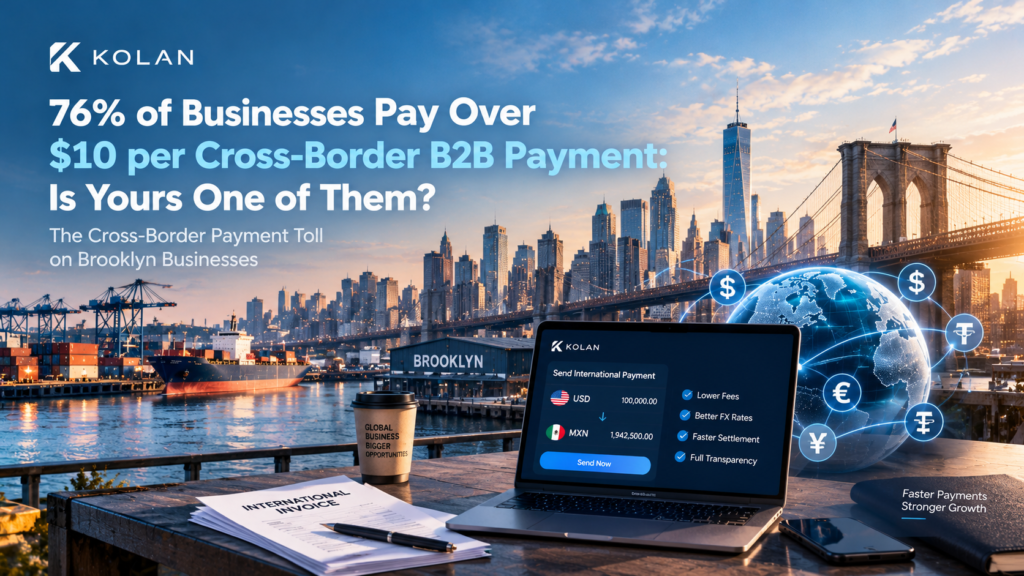
Introduction: The Cross-Border Payment Toll on Brooklyn Businesses
Brooklyn has evolved into a powerhouse of industrial innovation, international trade, and creative technology. From the commercial hubs of Industry City and Brooklyn Navy Yard to Sunset Park logistics centers, Brooklyn enterprises operate globally every day.
With a population exceeding 2.7 million residents, Brooklyn forms a vital Tier 1 business ecosystem. Local enterprises regularly send and receive cross-border B2B invoices. These include freight forwarders, import-export houses, software development agencies, and specialized manufacturers.
According to a global study by Rapyd (2023), 76% of businesses pay over $10 per cross-border B2B payment. For many Brooklyn SMEs, the reality is far worse. Commercial banks routinely charge $25 to $75 per transfer when routing money overseas.
When a Brooklyn import-export firm pays a supplier in Mexico or Colombia, hidden fees accumulate quickly. Traditional SWIFT transfers create unpredictable costs and multi-day delays.
Understanding why B2B cross-border payments remain so expensive is the first step toward reclaiming your profit margins.
The Brooklyn Economic Landscape: Industrial Parks, Import-Export, and Digital Hubs
To understand cross-border payment friction in Brooklyn, one must examine its core commercial sectors. Brooklyn combines physical manufacturing with modern digital services.
Maritime Logistics and Supply Chain Operators
Brooklyn’s waterfront has a rich industrial heritage. Today, maritime operators and logistics providers in Sunset Park and Red Hook move substantial freight volume.
These operators frequently settle payments with international port authorities, overseas customs brokers, and foreign logistics partners. Speed is crucial in supply chain management.
Unfortunately, legacy SWIFT wire transfers take three to five business days to clear. This latency freezes working capital and risks costly shipment delays.
Import-Export SMEs Managing International Suppliers
Thousands of small-to-medium enterprises in Brooklyn import specialty goods, apparel, electronics, and food products. Importing goods from Latin America requires regular foreign payments.
Trade corridors involving USD, Mexican Peso (MXN), and Colombian Peso (COP) face heavy exchange markups. Managing these cash flows through traditional commercial banks erodes narrow profit margins.
Digital Agencies and Software Development Houses
Navy Yard, DUMBO, and Williamsburg house dense concentrations of tech firms, creative agencies, and consultancies. These digital businesses face a reverse cash-flow challenge: receiving international payments.
When a Brooklyn agency invoices a client in Europe or Latin America, traditional banks subtract incoming wire fees. They also apply unfavorable conversion rates. Over a fiscal year, these silent deductions result in significant revenue loss.
Deconstructing the Three Hidden Friction Points of SWIFT Wire Transfers
Three main friction points cause traditional banking to fail Brooklyn businesses.
1. High Fixed Wire Charges and Intermediary “Hop” Fees
Sending an international wire through a commercial bank involves fixed outbound charges ranging from $35 to $60. Additionally, wires pass through intermediary correspondent banks.
Each correspondent institution takes a cut, often between $25 and $75 per hop. Banks deduct these fees directly from the transfer amount. This process makes invoice reconciliation hard.
2. Opaque Foreign Exchange (FX) Markups
The most significant hidden cost in international payments is the foreign exchange spread. Commercial banks rarely offer wholesale mid-market exchange rates.
Instead, banks apply retail FX markups ranging from 1.5% to 4.5% above true market rates. On a $100,000 corporate payment, a 3% hidden markup equals $3,000 in lost revenue.
3. Settlement Latency and Untrackable Funds
SWIFT transfers operate on legacy banking schedules. Wires stop during weekends, bank holidays, and manual compliance checks.
A wire initiated on Friday afternoon in Brooklyn may not settle in a Latin American account until Wednesday. During this period, businesses lose access to their capital and cannot track funds easily.
Introducing Kolan: The Modern Cross-Border Financial Engine
Kolan provides growing enterprises with an agile, high-speed, and cost-effective treasury platform. It bridges multi-currency corporate accounts with hybrid fiat and stablecoin settlement rails.
Core Architectural Pillars of Kolan
- Named Virtual Multi-Currency Accounts: Access company-dedicated receiving accounts in USD, MXN, COP, GBP, EUR, AUD, AED, and NGN. Hold and disburse local funds without forced conversions.
- Hybrid Fiat & Stablecoin Rails: Convert seamlessly between fiat currencies and enterprise stablecoins (USDC, USDT, EURC) for near-instant global settlement.
- Upfront Fee Transparency: Know exact transaction costs before executing transfers. Eliminate surprise intermediary deductions entirely.
- Automated Treasury Management: Track payments in real time and export data directly to enterprise accounting software.
Deep-Dive Comparison: Legacy SWIFT Banking vs. Kolan Enterprise Infrastructure
The comparison table below details how traditional SWIFT wire transfers contrast directly with Kolan enterprise rails.
Comprehensive Feature and Cost Comparison Matrix
| Evaluation Metric | Traditional SWIFT Wire Transfers | Kolan Enterprise Infrastructure |
| Primary Settlement Mechanism | Correspondent banking network (Multi-hop) | Hybrid rails (Direct fiat accounts + stablecoin rails) |
| Average Settlement Speed | 2 to 5 business days | Near-instantaneous (Real-time to < 1 hour) |
| Foreign Exchange (FX) Pricing | Opaque retail spreads (1.5% – 4.5% hidden markups) | Transparent wholesale mid-market conversion rates |
| Fixed B2B Transfer Cost | 76% of businesses pay >$10 (Up to $75/hop) | Low, flat-fee structure with transparent pricing |
| Currency Support | Restricted by traditional banking ties | Broad multi-currency accounts (USD, GBP, EUR, AUD, COP, AED, NGN, MXN) |
| Liquidity & Tracking | Trapped capital; manual reference number tracking | Real-time liquidity access; automated status updates |
| Compliance & Security | Slow, manual institutional auditing | Automated, regulatory-compliant digital asset & fiat rails |
Sector-Specific Application: How Brooklyn Enterprises Win with Kolan
Different Brooklyn business sectors face distinct hurdles when moving money across international borders.
1. Logistics Providers in Sunset Park and Red Hook
- The Challenge: Paying overseas vessel operators or port handlers in Latin America (USD, MXN, COP) requires immediate settlement. SWIFT delays risk demurrage charges.
- The Kolan Solution: Logistics firms can disburse funds instantly using Kolan multi-currency accounts and hybrid rails. Payments settle in minutes, keeping supply chains moving.
2. Import-Export SMEs Sourcing Goods from Emerging Markets
- The Challenge: Sourcing products from suppliers in Mexico or Colombia involves local currency volatility and high bank conversion spreads.
- The Kolan Solution: Kolan enables Brooklyn importers to hold local currency balances and settle invoices at wholesale mid-market rates, eliminating stealth FX markups.
3. DUMBO & Navy Yard Digital Agencies with Overseas Clients
- The Challenge: Tech agencies suffer margin erosion from incoming wire fees and conversion deductions on project invoices.
- The Kolan Solution: Kolan provides localized receiving accounts in major global currencies. Agencies receive client funds as domestic transfers, cutting incoming fees to zero.
Step-by-Step Implementation Guide for Brooklyn Enterprises
Integrating Kolan into existing corporate financial workflows is fast and simple.
Step 1: Enterprise Account Registration
Register for an enterprise account on the Kolan Platform. Submit standard corporate verification documents (EIN and Articles of Organization) to complete setup.
Step 2: Configure Multi-Currency Accounts
Activate specific currency wallets needed for your primary trade corridors (USD, MXN, COP, EUR, GBP).
Step 3: Update Invoicing and Payment Workflows
Add Kolan account details to your invoicing software. Instruct international clients to remit funds directly to your multi-currency accounts. Set up templates for instant disbursements.
Step 4: Monitor, Reconcile, and Scale
Use the real-time Kolan dashboard to track settlement statuses instantly. Export transaction data directly into your ERP or accounting software for streamlined reporting.
Enhancing Enterprise Security: Essential Hardware Self-Custody Tools
Maintaining robust cybersecurity hygiene is essential when managing hybrid fiat and stablecoin treasury rails. Recommended institutional-grade hardware tools include:
- OneKey Hardware Wallet: An open-source hardware wallet ideal for managing corporate digital asset treasuries with multi-signature support.
- Ellipal Hardware Wallet: A fully air-gapped hardware wallet that completely isolates private keys from network connectivity.
- Mypal Crypto Self-Custody Card: A practical security tool for corporate self-custody asset authorization and management.
Conclusion & Actionable Next Steps
Brooklyn enterprises cannot afford to let legacy SWIFT banking networks drain profit margins with hidden fees and multi-day clearing delays. By adopting Kolan multi-currency accounts and hybrid fiat-stablecoin rails, local businesses gain a decisive competitive edge through instant liquidity and complete fee transparency.
Call to Action & Enterprise Contact Information
Ready to eliminate cross-border B2B payment friction and optimize your treasury operations? Get started with Kolan today:
- Kolan Platform & Account Setup: Access Kolan Multi-Currency Accounts (Supporting USD, GBP, EUR, AUD, COP, AED, NGN & MXN accounts)
- Cryptomart Landing Page: Explore Ecosystem Resources
Direct Consultation & Support
Connect with our team directly for customized enterprise integration or technical support:
- Email: info@cryptomart.site
- WhatsApp: +6285165098877
- Telegram: @sungazerlive
Empower your Brooklyn enterprise with intelligent, high-speed, and transparent cross-border financial infrastructure.
Leave a Reply