Bitcoin Regulation in the US: What Comes Next
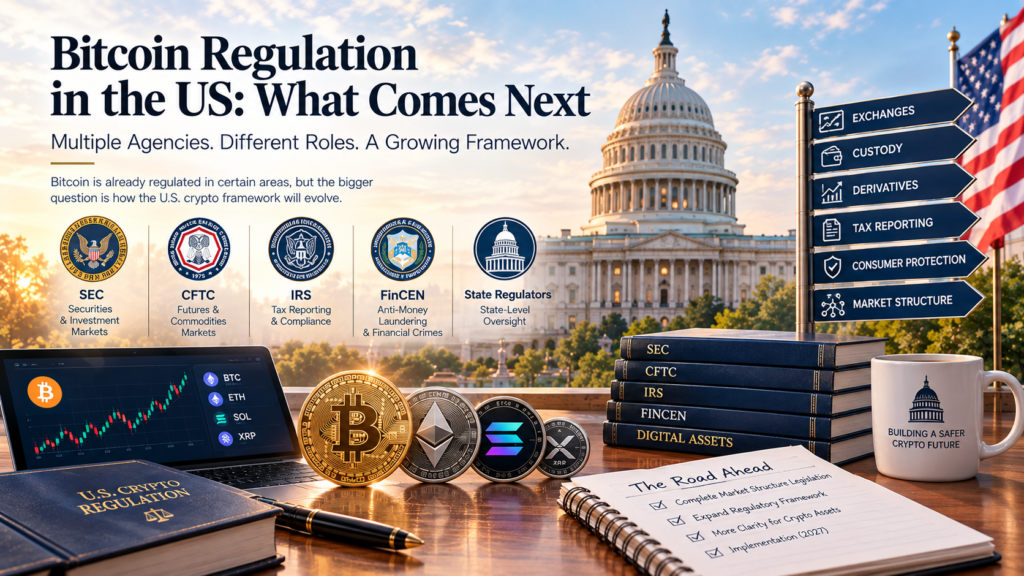
Bitcoin has been part of the U.S. financial market for years. However, the rules around crypto have continued to evolve.
So, will the U.S. government regulate Bitcoin?
In some ways, it already does. Bitcoin falls under several areas of U.S. financial law. The SEC and CFTC also clarified their approaches to crypto assets in 2026.
At the same time, Congress is still working on broader crypto market rules. That means the future of Bitcoin regulation remains an important issue for investors, exchanges, and crypto businesses.
Is Bitcoin Already Regulated in the US?
Yes. Bitcoin already falls under parts of the U.S. regulatory system.
The CFTC treats Bitcoin as a commodity under the Commodity Exchange Act. This gives the agency authority over certain Bitcoin derivatives markets, including futures. The CFTC also has authority to address fraud and manipulation in relevant commodity markets.
The SEC has a different role.
In March 2026, the SEC issued an interpretation on how federal securities laws apply to crypto assets. The CFTC joined the interpretation and said it would administer the Commodity Exchange Act consistently with the framework.
As a result, the U.S. now has a clearer framework for different types of crypto assets.
However, that does not mean every cryptocurrency follows the same rules.
How Does US Bitcoin Regulation Work?
The U.S. does not have one agency that controls the entire crypto market.
Instead, several agencies can have different responsibilities.
For example:
- SEC: Oversees securities markets and certain crypto assets and transactions.
- CFTC: Oversees commodity derivatives and has other authority over commodity markets.
- IRS: Handles federal tax rules and reporting for digital assets.
- FinCEN: Enforces certain anti-money laundering rules.
- State regulators: Can oversee some crypto businesses under state laws.
Therefore, Bitcoin regulation depends on the activity involved.
Buying Bitcoin is not the same as offering a Bitcoin-related investment product. Trading Bitcoin futures is also different from operating a crypto exchange.
This distinction is becoming more important as the U.S. builds a more detailed crypto framework.
Is Bitcoin a Security or a Commodity?
This has been one of the biggest questions in U.S. crypto regulation.
In March 2026, the SEC published an interpretation that created a five-category framework for crypto assets. The categories include digital commodities, digital collectibles, digital tools, stablecoins, and digital securities.
The interpretation specifically lists Bitcoin as a digital commodity.
It also lists several other major crypto assets, including Ether, XRP, Solana, Cardano, Chainlink, Dogecoin, Litecoin, and others, based on their characteristics at the time of the release.
This distinction matters.
A crypto asset does not automatically become a security simply because someone uses it in an investment transaction. The SEC’s interpretation also explains how a non-security crypto asset can become connected to an investment contract.
In other words, regulators can look at both the asset and the transaction.
What Changed in 2026?
The March 2026 SEC-CFTC interpretation was an important development for Bitcoin regulation.
The SEC said the framework was designed to provide more clarity around crypto assets and transactions. It also addressed activities such as airdrops, protocol mining, protocol staking, and wrapping.
The CFTC then provided guidance on how it would administer the Commodity Exchange Act alongside the SEC interpretation.
The SEC also published additional staff FAQs on September 25, 2026.
However, there is an important limitation. The SEC says those FAQs represent the views of its Division of Corporation Finance staff. They are not rules or regulations and do not create new legal obligations.
That means the regulatory picture is clearer than before, but it can still change.
What About Other Major Cryptocurrencies?
Bitcoin is only one part of the U.S. crypto market.
The SEC’s 2026 interpretation identifies several major cryptocurrencies as digital commodities. These include Bitcoin, Ether, XRP, Solana, Cardano, Avalanche, Chainlink, Dogecoin, Litecoin, and others.
However, the classification does not automatically settle every legal question.
The SEC explained that a non-security crypto asset can still be involved in an investment contract. The facts and circumstances of the transaction matter.
Therefore, companies cannot assume that one token classification answers every regulatory question.
This approach could become increasingly important as more crypto projects enter the U.S. market.
What Role Does the CFTC Play?
The CFTC plays a major role in the U.S. crypto market.
Bitcoin and other virtual currencies can qualify as commodities under the Commodity Exchange Act. The CFTC also regulates certain crypto derivatives, such as futures and options.
The agency has also taken steps involving Bitcoin derivatives in 2026.
For example, in May 2026, the CFTC issued a policy statement about perpetual contracts. It also allowed a registered exchange to list a perpetual contract referencing the spot price of Bitcoin.
The move shows how crypto derivatives can operate inside an established U.S. regulatory framework.
Still, derivatives regulation is different from the rules that apply to buying Bitcoin on the spot market.
Is the US Creating New Crypto Laws?
Yes. Congress has been working on broader digital asset market structure legislation.
One of the main proposals is the Digital Asset Market Clarity Act, commonly known as the CLARITY Act.
The Senate Banking Committee advanced the bill in May 2026 after bipartisan negotiations.
However, the bill has not become law.
On September 15, 2026, the Senate failed to invoke cloture on the motion to proceed to the CLARITY Act. The official Senate record lists the motion as rejected.
The House Financial Services Committee said the vote did not end efforts to establish a digital asset market structure framework.
Therefore, the future of comprehensive crypto legislation remains unresolved.
What Could Future Bitcoin Regulation Cover?
Future legislation could address several parts of the crypto market.
1. Exchange Rules
Congress could establish clearer rules for digital asset trading platforms.
These rules could cover registration, custody, disclosures, market conduct, and other requirements.
2. SEC and CFTC Responsibilities
A new market structure law could define which agency oversees specific digital assets and activities.
This could reduce uncertainty for crypto businesses.
3. Consumer Protection
Future rules could also address customer assets, disclosures, conflicts of interest, and market manipulation.
The exact requirements would depend on the final legislation.
4. DeFi
Decentralized finance is another major issue.
The updated CLARITY Act text released in September included provisions concerning certain non-decentralized finance protocols and potential CFTC registration requirements.
However, Congress has not enacted those provisions into law.
5. Digital Asset Tax Rules
Bitcoin also falls under federal tax rules.
The IRS treats digital assets as property for federal income tax purposes. Therefore, buying, selling, exchanging, or using crypto can create tax reporting requirements depending on the transaction.
Tax rules remain separate from SEC and CFTC market regulation.
What About Stablecoins?
Stablecoins are also shaping the future of U.S. crypto regulation.
In July 2025, the GENIUS Act became law. It created a federal framework for payment stablecoins.
Treasury began implementing the law in 2026.
In August 2026, the Treasury Department issued a proposed rule covering the issuance, offering, and sale of payment stablecoins in the United States. Treasury said the expected effective date for the main prohibition on issuing payment stablecoins without an appropriate license is January 18, 2027.
Treasury and FinCEN have also proposed rules covering anti-money laundering and sanctions compliance under the GENIUS Act.
This is important because it shows that U.S. crypto regulation is already moving from legislation into implementation.
Will Bitcoin Regulation Become Stricter?
It is more accurate to say that the regulatory framework is becoming more detailed.
The SEC has already classified Bitcoin as a digital commodity under its 2026 interpretation. The CFTC also recognizes Bitcoin as a commodity and regulates certain Bitcoin derivatives.
Future rules may therefore focus less on simply classifying Bitcoin and more on the businesses and financial products built around it.
For example, regulators could set rules for:
- Crypto exchanges
- Custody providers
- Bitcoin derivatives
- Digital asset brokers
- Investment products
- Stablecoin issuers
- DeFi platforms
- Crypto market infrastructure
The final framework will depend on future legislation, agency action, and legal developments.
What Does Bitcoin Regulation Mean for Investors?
For Bitcoin investors, regulation can affect how the market operates.
For example, new rules could change:
- How exchanges report transactions
- How companies hold customer assets
- Which crypto products are available
- How trading platforms operate
- What disclosures investors receive
- How digital asset businesses register
However, regulation does not remove investment risk.
Bitcoin remains a volatile asset. The CFTC warns that virtual currencies can experience significant price volatility and that spot markets can have less government supervision than regulated derivatives markets.
Therefore, regulatory oversight and investment risk are two different issues.
What Is the Future of Bitcoin Regulation in the US?
The U.S. crypto framework is moving toward clearer definitions, but the process is not finished.
The SEC and CFTC have already provided a more detailed framework for crypto assets. Bitcoin is classified as a digital commodity under the SEC’s 2026 interpretation.
Congress, meanwhile, is still working on broader market structure legislation.
The CLARITY Act advanced through the Senate Banking Committee in May. However, the Senate did not advance the bill in its September 15 procedural vote.
As a result, the next stage of Bitcoin regulation will depend on both regulators and lawmakers.
For investors and crypto companies, the key issue is not simply whether Bitcoin will face regulation. It is how the U.S. will divide regulatory responsibilities and what rules will apply to the businesses and products built around digital assets.
Bitcoin Regulation: Frequently Asked Questions
Is Bitcoin regulated in the US?
Yes. Bitcoin already falls under parts of the U.S. regulatory system. The CFTC treats Bitcoin as a commodity, while the SEC’s 2026 interpretation classifies it as a digital commodity.
Who regulates Bitcoin in the US?
Several agencies can have different responsibilities. The SEC and CFTC are the main federal market regulators involved in crypto, while agencies such as the IRS and FinCEN have roles involving taxes and financial crime rules.
Is Bitcoin a commodity or a security?
The SEC’s March 2026 interpretation identifies Bitcoin as a digital commodity. However, the treatment of specific transactions can depend on their structure and circumstances.
Will the US ban Bitcoin?
Current federal regulatory developments focus on creating rules for digital assets rather than banning Bitcoin. The SEC and CFTC have established frameworks that recognize Bitcoin as a digital commodity.
Does the US have new crypto laws?
Yes. The GENIUS Act established a federal framework for payment stablecoins. Congress is also considering broader digital asset market structure legislation, although the CLARITY Act had not become law as of September 30, 2026.
What happens next for Bitcoin regulation?
The next steps could include further agency guidance, stablecoin implementation, and renewed congressional work on digital asset market structure. The final framework remains subject to future legislative and regulatory action.
💸 GET PAID GLOBALLY WITH KOLAN
Need to receive international payments? Open your USD, GBP, EUR & AED accounts with Kolan and make international payments easier.
Fill out the form and book your free consultation:
🔐 SECURE YOUR CRYPTO WITH ONEKEY OR ELLIPAL
Get free delivery on orders over US$99 + up to 5 USDT cashback.
Leave a Reply