Africa Looks to Stablecoins to Fix Its Cross-Border Payments Problem
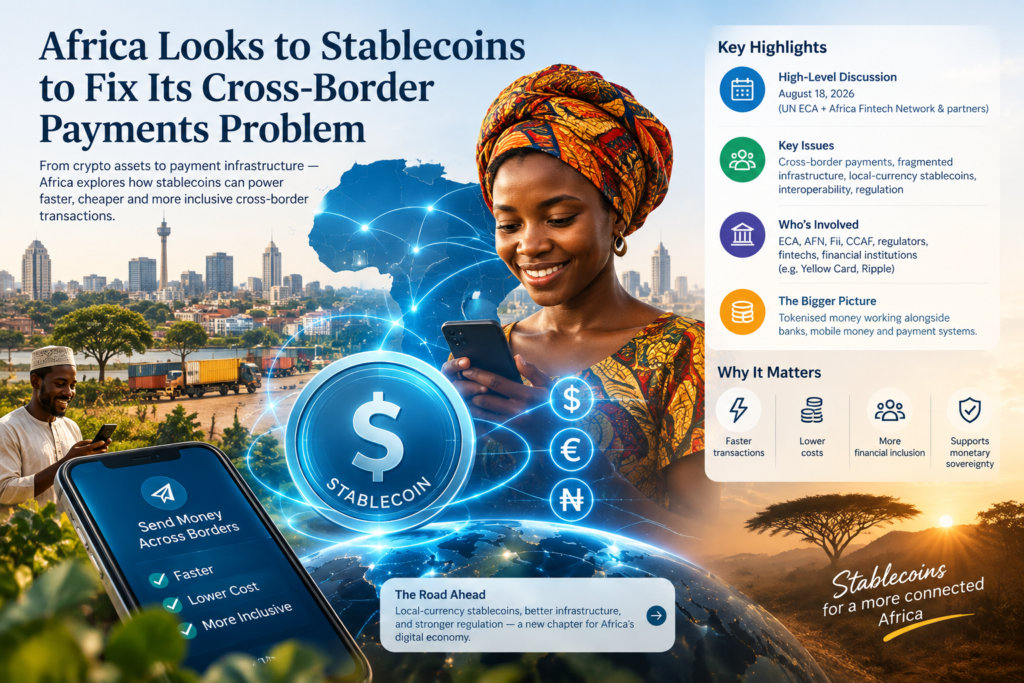
Africa is no longer looking at stablecoins only as crypto assets.
It is increasingly looking at them as potential payment infrastructure.
On August 18, 2026, the United Nations Economic Commission for Africa (ECA), together with the Africa Fintech Network and other financial technology organizations, held a high-level discussion on tokenised money and stablecoins in Africa.
The conversation focused on some of the biggest problems facing the continent’s financial system:
cross-border payments, fragmented payment infrastructure, local-currency stablecoins, interoperability, and regulation.
And there is a reason this conversation matters.
Africa has one of the world’s most active mobile-money and digital finance ecosystems.
But moving money across African borders can still be complicated.
The question now is whether stablecoins can help solve that problem.
Africa Has a Cross-Border Payments Problem
Moving money between African countries is not always as simple as sending a digital payment.
Different countries have different currencies.
They have different banking systems, payment networks and regulatory frameworks.
A transaction may also require multiple intermediaries before money reaches the final recipient.
That fragmentation creates friction for businesses, workers, families and financial institutions.
The ECA has repeatedly highlighted the challenges created by fragmented payment systems and the high cost of remittances and cross-border transactions.
For a continent working toward deeper regional economic integration, inefficient payment infrastructure can become a serious obstacle.
And this is where stablecoins enter the conversation.
Why Stablecoins Are Getting Attention
Stablecoins are digital assets designed to maintain a relatively stable value, usually by being linked to a fiat currency.
The most common examples globally are dollar-denominated stablecoins.
Their appeal for cross-border payments is relatively simple.
A stablecoin can potentially move across blockchain networks without relying entirely on traditional correspondent banking infrastructure.
Transactions can also be designed to operate around the clock.
For Africa, that could create another option for moving money between countries.
But the goal being discussed by policymakers and industry participants is not simply to replace banks with crypto.
It is much broader.
The idea is to explore whether tokenised money can work alongside existing banking, mobile-money and payment systems.
Who Is Exploring the Idea?
The August 18 discussion brought together the UN Economic Commission for Africa (ECA), the Africa Fintech Network (AFN), Financial Innovation for Impact (Fii) and the Cambridge Centre for Alternative Finance (CCAF).
The event also included perspectives from financial regulators and industry participants.
Representatives from institutions including Uganda’s Capital Markets Authority, the Bank of Ghana and the Financial Services Commission of Mauritius discussed different approaches to virtual assets and stablecoins.
Industry participants, including Yellow Card and Ripple, also shared perspectives on stablecoin-based payment infrastructure in Africa.
That combination is important.
This is not only a crypto-industry conversation.
Regulators, policymakers, fintech companies and financial institutions are increasingly discussing the same infrastructure from different angles.
The Focus Is Bigger Than Dollar Stablecoins
When people talk about stablecoins, the conversation often immediately turns to USDT and USDC.
Africa’s discussion could eventually become more complicated.
One of the areas receiving attention is local-currency stablecoins.
A local-currency stablecoin could theoretically represent a digital version of an African currency while using blockchain infrastructure for transfers and settlement.
That could offer an alternative to relying entirely on dollar-denominated digital assets.
It could also help policymakers address an important concern:
monetary sovereignty.
If dollar stablecoins become widely used for everyday payments, African economies could become increasingly dependent on foreign-currency digital money.
Local-currency stablecoins could provide another path.
But they would also introduce new challenges.
Can Local-Currency Stablecoins Actually Work?
Creating a token linked to a local currency is only the beginning.
Users need to trust that the token maintains its value.
Issuers need appropriate reserves.
There needs to be sufficient liquidity.
Businesses need reliable ways to convert between digital tokens and traditional money.
And regulators need visibility into how the system operates.
That means a successful stablecoin ecosystem requires much more than blockchain technology.
It needs financial infrastructure.
The ECA discussion highlighted several of these challenges, including liquidity, infrastructure, regulation, consumer protection and effective on- and off-ramps.
Without those elements, a stablecoin may exist technologically but struggle to become useful as actual payment infrastructure.
Interoperability Could Be the Biggest Challenge
There is another problem that Africa cannot afford to ignore.
Fragmentation.
Imagine every country develops its own stablecoin.
Nigeria has one.
Ghana has another.
Kenya creates another.
South Africa develops its own.
If these systems cannot communicate with each other, the continent could simply create a new version of the same problem it is trying to solve.
That makes interoperability critical.
The goal would not be to create dozens of isolated digital-money systems.
It would be to create infrastructure that allows different networks, currencies and financial institutions to interact.
That could eventually allow stablecoins to connect with banks, mobile-money providers and other payment systems.
In that scenario, blockchain becomes part of the infrastructure rather than an isolated financial ecosystem.
Regulation Will Decide How Far This Can Go
Technology may be able to move money quickly.
Regulators still have to decide how that money should be governed.
Stablecoins raise questions around:
- Consumer protection
- Reserve management
- Financial stability
- Anti-money laundering
- Monetary sovereignty
- Licensing
- Cross-border supervision
- Data and cybersecurity
These issues become even more complicated when a stablecoin operates across multiple countries.
A company may be licensed in one jurisdiction while serving customers somewhere else.
That is why regulatory cooperation could become just as important as the technology itself.
Africa does not necessarily need every country to adopt identical crypto laws.
But compatible rules could make it easier for legitimate payment systems to operate across borders.
Africa Already Has a Large Digital Asset User Base
The potential market is also difficult to ignore.
The ECA has highlighted the scale of digital-asset adoption across Africa, with more than 54 million digital asset users on the continent and Nigeria alone accounting for an estimated 25.9 million users.
That does not mean all of those users are using stablecoins for payments.
But it shows that digital assets already have a significant user base.
The next stage could therefore be less about convincing people that digital assets exist.
It could be about finding practical financial applications for them.
Cross-border payments are one of the clearest candidates.
Stablecoins Could Help Businesses Too
The potential impact goes beyond remittances.
African businesses operating across multiple countries could potentially use tokenised money for treasury management and settlement.
Imagine a company with operations in Kenya, Nigeria, Ghana and South Africa.
Today, managing liquidity across those markets can involve multiple currencies, banks and payment systems.
A more interoperable digital-money infrastructure could eventually make some of those processes more efficient.
That could be particularly relevant for:
- International trade
- Supplier payments
- Corporate treasury
- Remittances
- Digital commerce
- Cross-border settlements
The technology therefore has potential applications far beyond crypto trading.
But Stablecoins Are Not a Magic Solution
There is an important reality check.
Stablecoins do not automatically solve every problem in the payment system.
They still need reliable infrastructure.
They need liquidity.
They need trusted issuers.
They need regulatory oversight.
And they need users.
There is also a broader global debate about whether stablecoins are actually the best form of digital money for mainstream payments.
Some policymakers and financial institutions argue that tokenised bank deposits could offer advantages over privately issued stablecoins because they remain more closely connected to the traditional banking system.
That debate will likely become increasingly relevant in Africa as regulators explore different forms of digital money.
The Competition May Be About Payment Infrastructure
The most interesting part of Africa’s stablecoin story may therefore not be the stablecoins themselves.
It could be the infrastructure surrounding them.
The continent already has major mobile-money networks.
It has fintech companies.
It has banks.
It has emerging digital-asset markets.
And it has regional payment initiatives designed to make African transactions easier.
Stablecoins could potentially become another layer connecting these systems.
If that happens, the biggest winners may not necessarily be stablecoin issuers.
They could be the companies building the infrastructure that allows different forms of digital money to communicate with each other.
Africa Could Build Its Own Digital-Money Model
There is also an opportunity here that is easy to overlook.
Africa does not necessarily have to copy the financial infrastructure developed in the United States or Europe.
The continent already has experience with mobile money and alternative payment systems that developed differently from traditional Western banking models.
That experience could influence how Africa approaches tokenised money.
Instead of simply adopting dollar stablecoins, African markets could explore combinations of:
- Local-currency digital money
- Stablecoins
- Mobile money
- Bank deposits
- Tokenised assets
- Regional payment networks
The result could be a financial system that looks very different from today’s traditional banking infrastructure.
What Happens Next?
The August 18 discussion does not mean Africa is launching a continent-wide stablecoin.
There is no single African stablecoin system being introduced as a result of the meeting.
Instead, the discussion shows that policymakers and industry participants are becoming increasingly interested in the role tokenised money could play in the continent’s financial infrastructure.
The next stage could involve more research, regulatory coordination and real-world pilot projects.
And those experiments will be important.
Because the biggest question is no longer whether blockchain can technically move money.
It can.
The real question is whether the infrastructure can be made safe, interoperable, liquid and useful at scale.
The Bigger Picture
Africa’s stablecoin conversation is ultimately about something much bigger than crypto.
It is about how money moves across borders.
For decades, international payments have depended on systems designed around banks, correspondent relationships and multiple settlement layers.
Blockchain offers another possibility.
Money could become more programmable.
Settlement could become more digital.
Payment networks could become more connected.
And cross-border transactions could potentially become easier to execute.
But technology alone will not determine the outcome.
Regulation, interoperability, liquidity and user adoption will decide whether stablecoins become meaningful payment infrastructure or remain another niche part of the digital-asset market.
For Africa, however, the opportunity is significant.
The continent is not simply asking whether stablecoins can become popular.
It is asking whether they can help build a better way to move money.
And that could make Africa one of the most important testing grounds for the future of digital payments.
Need to Receive International Payments?
Open your USD, GBP & EUR account with Kolan.
Fill out the form and book your free consultation.
Open Your Account: https://bit.ly/4iYqi4N
Shop OneKey
Looking for secure crypto hardware to protect your digital assets?
Shop OneKey: https://onekey.so/r/TRC
Join Our Community & Let’s Discuss
Want to stay updated on crypto, blockchain, DeFi, RWA, payments, regulation, and the latest market developments?
👥 WA Community: https://chat.whatsapp.com/BfQJOFveLuK8QShcJnxDJF
🌐 Telegram Group: https://t.me/cryptomartlive
📲 Telegram: @sungazerlive
📸 Instagram: @cryptomartlive
Crypto moves fast. Stay informed. Stay ahead.
Tinggalkan Balasan