U.S. Bank Tests Stablecoin for Real-World Cross-Border Payments
Stablecoins are moving deeper into traditional banking.
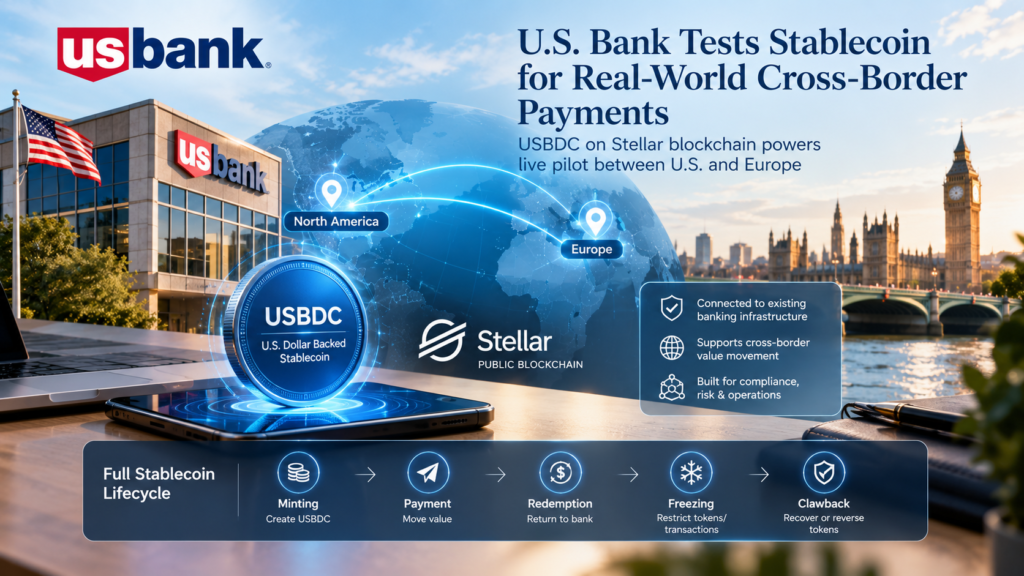
On September 9, 2026, U.S. Bank completed a live pilot transaction using its proprietary USBDC stablecoin on the public Stellar blockchain. The transaction moved value between U.S. Bank entities in North America and Europe, giving the bank a real-world test of how stablecoins could support cross-border money movement.
The pilot tested more than a simple transfer.
U.S. Bank also evaluated the full lifecycle of USBDC, including minting, payment, redemption, freezing and clawback. At the same time, the bank connected the blockchain transaction to its existing finance, risk, compliance and operations infrastructure.
That combination makes the development particularly interesting for the crypto industry.
This is not a crypto startup trying to convince banks to use blockchain.
A major traditional bank is testing its own dollar-backed stablecoin as part of its existing payment and financial infrastructure.
U.S. Bank Takes USBDC to a Public Blockchain
USBDC is U.S. Bank’s proprietary U.S. dollar-backed stablecoin.
For the latest pilot, the bank used Stellar, a public blockchain designed for digital asset and payment applications.
The transaction moved funds between U.S. Bank entities in North America and Europe. According to the bank, the test demonstrated its ability to move value on-chain while keeping the transaction connected to its existing financial, risk and compliance systems.
That connection is important.
A bank cannot simply move money onto a blockchain and ignore the controls that support conventional financial operations.
Instead, institutions need systems that can handle issuance, transfers, redemption, compliance checks and other controls alongside the blockchain transaction.
U.S. Bank used its internally developed Digital Asset Platform for that purpose. The platform supports the issuance, management and movement of tokenised assets while connecting with the bank’s traditional infrastructure.
This Was a Live Pilot, Not a Consumer Launch
There is an important distinction behind the headline.
U.S. Bank completed a live cross-border transaction, but the pilot involved U.S. Bank entities rather than an external customer payment. The bank has not announced general customer access to USBDC as a commercial payment product.
That makes the test more of an institutional infrastructure experiment.
The bank is effectively asking a practical question: can a regulated financial institution move dollar-denominated value across borders using a stablecoin while maintaining the controls required by traditional banking?
So far, the pilot shows that U.S. Bank can execute that type of transaction within its own network.
The next stage would involve broader use cases and potentially external participants.
Why the Stellar Blockchain Matters
Stellar provided the public blockchain infrastructure for the pilot.
The network is designed to support digital asset transfers and financial applications, with fast settlement and low transaction costs. U.S. Bank has also maintained a strategic relationship with the Stellar Development Foundation as it explores institutional blockchain applications.
For U.S. Bank, the choice of a public blockchain is significant.
Traditional banks have historically relied heavily on permissioned systems and established payment networks. Public blockchains offer a different architecture, with transactions recorded on a shared network that can operate continuously.
That model could support 24/7 movement of tokenised value.
U.S. Bank says USBDC could provide continuous transaction capabilities while remaining connected to its existing banking infrastructure.
The pilot therefore tests more than stablecoin technology.
It also tests whether public blockchain infrastructure can work alongside the systems that banks already use.
The Stablecoin Lifecycle Is the Real Test
Sending a token from one wallet to another is only one part of running a regulated stablecoin.
Banks also need to control how tokens enter circulation and how they leave it.
That is why U.S. Bank tested several functions during the pilot.
Minting allows the bank to create USBDC.
Payment allows the stablecoin to move between participants.
Redemption allows the token to return to the banking system in exchange for its underlying value.
Freezing gives the issuer the ability to restrict certain tokens or transactions.
Clawback provides another layer of control when the bank needs to recover or reverse tokens under applicable circumstances.
Together, those functions show how a bank can combine blockchain-based money movement with institutional controls.
The result looks very different from a typical crypto wallet transfer.
Instead, the bank remains responsible for managing the token and the financial infrastructure around it.
Cross-Border Payments Could Be a Major Use Case
Moving money internationally can involve several financial institutions, currencies, payment networks and settlement processes.
Stablecoins offer a different model.
A dollar-backed token can move across a blockchain without requiring every step of the transaction to follow the same traditional payment rails.
That could potentially make international money movement faster and more continuous.
U.S. Bank is exploring exactly that possibility.
The bank says future applications could include cross-border treasury operations, liquidity management and collateral mobility.
Consider a multinational company that needs to move liquidity between different regions.
Today, treasury teams may need to coordinate bank accounts, payment instructions and settlement windows across multiple jurisdictions.
A tokenised dollar could potentially provide another settlement mechanism.
The technology does not automatically remove every regulatory or operational challenge. However, it could give financial institutions another way to coordinate global liquidity.
Treasury Management Could Become More Programmable
The story also goes beyond payments.
U.S. Bank specifically identified treasury operations as one of the potential future applications for its digital asset infrastructure.
That opens the door to programmable money movement.
For example, institutions could potentially automate certain transfers when predefined conditions are met.
Liquidity could also move between entities outside traditional banking hours.
Collateral could potentially move faster between financial institutions.
These are still potential applications rather than fully commercialised services. Even so, they show why banks are increasingly examining stablecoins as financial infrastructure rather than simply as crypto trading assets.
U.S. Bank Is Building Around Existing Banking Controls
One of the biggest themes in the pilot is integration.
U.S. Bank did not replace its existing banking systems with blockchain technology.
Instead, the bank connected its blockchain-based Digital Asset Platform with its traditional finance, risk, compliance and operations infrastructure.
That approach could become important for institutional adoption.
Banks already have extensive systems for managing customers, liquidity, compliance and financial reporting.
A blockchain payment solution therefore needs to fit into that environment.
The technology has to work with existing controls rather than operate separately from them.
USBDC’s pilot provides an example of that approach.
The blockchain handles the movement of tokenised value, while the bank maintains control over the surrounding financial processes.
Stablecoins Are Becoming Part of the Banking Conversation
For years, stablecoins largely developed outside traditional banking.
Banks often approached them from the perspective of regulation, competition or potential disruption.
The latest U.S. Bank pilot shows another direction.
A bank can issue its own dollar-backed stablecoin and test it directly on a public blockchain.
That changes the conversation.
The question is no longer simply whether banks will use stablecoins.
Instead, financial institutions are increasingly exploring what their own stablecoins could do inside institutional payment and treasury systems.
U.S. Bank is not alone in exploring tokenised money.
Banks around the world are examining stablecoins, tokenised deposits and other forms of digital money for settlement and payments.
The difference here is that U.S. Bank has now moved its own stablecoin through a live cross-border pilot on a public blockchain.
Compliance Remains Part of the Design
Institutional stablecoins need more than speed.
Banks also need control.
The inclusion of freezing and clawback functions in the USBDC pilot highlights that requirement.
Those features give the issuer mechanisms that ordinary decentralised tokens may not provide.
For a regulated bank, that distinction matters.
A stablecoin used inside institutional finance needs to operate within a broader compliance framework.
U.S. Bank says the pilot connected USBDC with its finance, risk, compliance and operations infrastructure.
That means the experiment is not only about blockchain settlement.
It is also about whether traditional financial controls can coexist with on-chain money movement.
What Could Come Next?
U.S. Bank has already identified several areas for further exploration.
Cross-border treasury operations are one possibility.
Liquidity management is another.
Collateral mobility could also benefit from faster digital settlement.
The bank is additionally looking at other institutional use cases where blockchain could improve efficiency, transparency and settlement speed.
Still, the pilot does not mean USBDC has reached full commercial deployment.
A wider rollout would require additional testing, operational processes and potentially broader regulatory considerations.
The next important milestone will therefore be external use.
If U.S. Bank eventually allows clients or other institutions to use USBDC for real transactions, the stablecoin could move from an internal pilot toward a broader financial product.
Why This Matters for the Crypto Industry
The biggest takeaway is not simply that another stablecoin exists.
It is who is building it.
U.S. Bank is a traditional commercial bank. Its stablecoin experiment shows that established financial institutions are increasingly exploring blockchain as part of their own payment infrastructure.
That matters for the wider crypto market.
Institutional adoption does not always begin with banks buying Bitcoin or offering crypto trading.
It can also begin with banks putting traditional dollars onto blockchain rails.
USBDC represents that second path.
The U.S. dollar remains the underlying asset, while a regulated bank continues to serve as the issuer. What changes is the transaction layer, which operates on a public blockchain.
That combination could become increasingly important as financial institutions search for ways to modernise cross-border payments.
The Bigger Picture
Stablecoins have spent years moving from a crypto-native product toward a broader financial technology.
U.S. Bank’s latest pilot adds another step to that evolution.
The bank used USBDC to complete a live cross-border transaction between its North American and European entities through Stellar. Along the way, it tested minting, payment, redemption, freezing and clawback while connecting the blockchain workflow to traditional banking infrastructure.
The transaction does not prove that stablecoins will replace traditional cross-border payment networks.
It does, however, show that a major bank can test stablecoin-based money movement in a live institutional environment.
That distinction is important.
The next question is no longer whether a bank can put a stablecoin on a public blockchain.
U.S. Bank has now demonstrated that it can.
The bigger question is how far banks can take this model once stablecoins move beyond pilots and into broader treasury, liquidity and payment operations.
For the global crypto industry, that could be the more important story.
Need to Receive International Payments?
Open your USD, GBP & EUR account with Kolan.
Then, fill out the form and book your free consultation.
Secure Your Crypto With OneKey
Keep your crypto assets protected with a OneKey hardware wallet.
Also, you can explore OneKey’s hardware wallet options here:
Join the Crypto Community
Want more crypto news and digital finance updates?
Then, join the CryptoMartLive community:
Finally, follow CryptoMartLive for more crypto news, market updates and digital finance stories.
Crypto moves fast. Stay informed. Stay ahead.
Tinggalkan Balasan