Australia’s Central Bank Opens the Door to Tokenised Finance
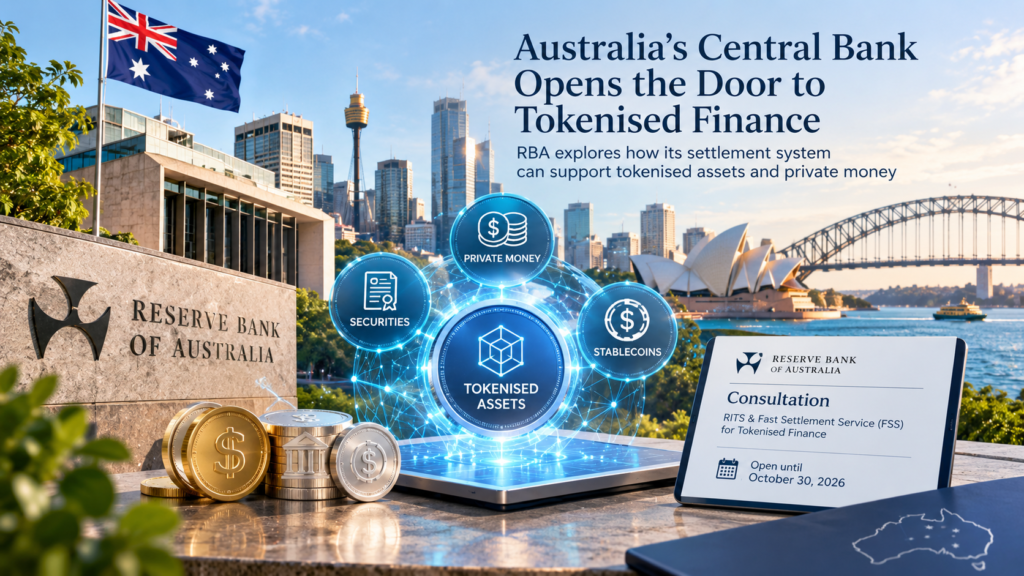
Australia is taking another step toward tokenised financial markets.
On September 3, 2026, the Reserve Bank of Australia (RBA) opened a consultation on how its main settlement system, the Reserve Bank Information and Transfer System (RITS), could support tokenised assets and tokenised private money.
The timing is notable. On the same day, the RBA and Australian Treasury confirmed that Australia still has no clear public-interest case for a retail central bank digital currency (CBDC).
So, while a consumer-facing digital dollar remains off the table for now, Australia is actively exploring blockchain-based infrastructure for wholesale finance.
RBA Wants RITS Ready for Tokenised Finance
RITS sits at the centre of Australia’s wholesale settlement infrastructure.
Financial institutions use the system to settle payment obligations in central bank reserves. RITS also supports the cash leg of delivery-versus-payment arrangements across several Australian asset markets.
Now the RBA wants to explore what happens when financial assets move onto tokenised platforms.
Could those platforms connect with existing settlement infrastructure? What changes would RITS and the Fast Settlement Service (FSS) need?
Those questions form the heart of the new consultation.
Market participants can submit feedback until October 30, 2026. The RBA says the consultation will help shape future settlement services for Australia’s evolving wholesale financial markets.
Why Tokenisation Matters
Tokenisation gives financial assets a digital representation that can move through distributed ledger technology.
A token could represent a security, a deposit or another financial claim. Depending on the structure, smart contracts and digital infrastructure could also automate parts of the transaction process.
That creates potential efficiency gains.
Project Acacia, the RBA’s joint research project with the Digital Finance Cooperative Research Centre, explored several of these possibilities. Its work found that tokenisation combined with new money and settlement infrastructure could improve efficiency, functionality and resilience across Australia’s financial system.
The latest consultation takes that research into the next phase.
Instead of focusing only on whether tokenisation works, the RBA is asking what infrastructure the market needs to scale it safely.
The Cash Leg Still Matters
Tokenised assets still need money to settle their transactions.
That is where delivery-versus-payment, or DvP, becomes important. The mechanism connects the transfer of an asset with the corresponding transfer of funds.
RITS already handles the interbank cash settlement leg in several DvP arrangements.
Asset registries and market infrastructures manage the corresponding asset movement. Financial institutions and custodians then handle the relevant customer-account entries.
Tokenised markets could change how those pieces connect.
Imagine a tokenised security moving between two financial institutions. The market infrastructure could coordinate the asset transfer with a corresponding movement of central bank reserves.
That kind of synchronisation could help reduce settlement risk while bringing traditional settlement rails closer to blockchain-based markets.
Tokenised Private Money Enters the Conversation
The RBA consultation also looks beyond tokenised securities.
Private money forms another major part of the discussion.
Stablecoins and commercial bank deposit tokens are already emerging alongside conventional bank deposits. As these different forms of money develop, financial institutions will need reliable ways to exchange them.
There is an important concept behind that requirement: the “singleness of money.”
In practice, different forms of private money should remain exchangeable at par. A deposit from one commercial bank, for example, should retain the same value when converted into another form of private money.
Without efficient conversion mechanisms, liquidity could become fragmented across separate payment and settlement ecosystems.
Central bank settlement infrastructure could help address that challenge.
Stablecoins Are Part of the Discussion
Stablecoins have a specific place in the RBA’s consultation.
Among the questions, the central bank wants feedback on how stablecoin arrangements might use central bank reserves if access becomes available in the future. The consultation also examines possible account structures, access models and operational requirements.
That does not mean the RBA has already approved a new stablecoin access model.
Instead, the central bank is testing different possibilities.
Financial stability and financial integrity remain part of the discussion. Any future arrangement would therefore depend on the infrastructure, access conditions and policy framework that the RBA ultimately chooses.
For the crypto industry, the development is still significant.
Stablecoins are no longer being discussed only as private digital assets. Their potential interaction with central bank settlement infrastructure has also entered the broader financial-market conversation.
Australia Is Taking a Different Path on Retail CBDC
Australia’s position on retail CBDC remains separate from its work on tokenised wholesale finance.
The RBA and Treasury’s latest assessment says there is currently no clear public-interest case for issuing a retail CBDC in Australia. That conclusion reaffirms the position reached in their earlier research.
A retail CBDC would function as a digital form of central bank money for consumers and businesses.
Australia, however, is not currently pursuing that model.
The country’s existing retail payment system already provides broad digital payment capabilities. Meanwhile, the RBA sees more immediate areas for exploration in wholesale markets.
That creates an interesting split.
Consumer payments are not the main focus. Institutional settlement and tokenised financial markets are.
Wholesale Finance Is Moving to the Forefront
Wholesale finance involves banks, financial institutions and other large market participants.
This is where tokenisation could have some of its most significant applications.
Tokenised securities could support new settlement arrangements. Digital deposits could create alternative forms of programmable money. Stablecoins could potentially connect with other forms of digital value.
Project Acacia explored many of these possibilities with industry participants.
The project brought together 57 industry participants and explored 20 use cases. Following the project, the RBA developed a broader program of work based on its findings. The latest RITS consultation is one of 11 initiatives outlined in the Project Acacia Final Report.
The aim goes beyond simply moving traditional assets onto a blockchain.
Australia is also examining how money, payments and settlement infrastructure can work with those assets.
Tokenised Central Bank Reserves Are Also on the Table
Another area of research involves tokenised central bank reserves.
The RBA describes these reserves as a potential form of wholesale central bank digital currency, or wCBDC. Financial institutions and other eligible wholesale participants could potentially use such money for digital settlement.
No decision has been made to issue tokenised reserves.
For now, the RBA is examining the design questions.
Those questions include issuance, distribution, funding and liquidity management. Researchers are also considering how tokenised reserves could interact with existing settlement systems.
A tokenised reserve model could potentially offer 24/7 settlement, greater programmability and atomic settlement.
Still, the RBA sees synchronisation with existing systems as a possible incremental path while it continues studying tokenised reserves.
The Infrastructure Question Comes First
Blockchain technology gets much of the attention in crypto.
Settlement infrastructure may ultimately prove just as important.
A tokenised market needs more than digital assets. Participants also need reliable settlement, liquidity, interoperability and operational resilience.
Consider a tokenised security traded between two institutions.
The asset may exist on one distributed ledger, while the payment still relies on another system. Connecting those layers efficiently becomes a critical part of the market design.
That is why the RBA’s latest consultation matters.
The central bank is looking at the bridge between traditional financial infrastructure and emerging tokenised markets.
What Could This Mean for Financial Institutions?
Banks could play a major role in Australia’s tokenised finance ecosystem.
One possibility involves tokenised commercial bank deposits. Another could involve tokenised securities and new settlement arrangements.
Stablecoin issuers could also become part of the conversation if future infrastructure gives them access to central bank reserves.
Yet none of those outcomes is guaranteed.
The consultation remains open, and the RBA has not selected a single market structure or tokenisation model. Instead, officials are collecting evidence about emerging use cases, technical requirements and possible design choices.
For financial institutions, that makes the consultation an opportunity to influence the technical discussion through industry feedback.
Innovation Still Needs Stability
Australia’s approach places innovation alongside financial stability.
New technology can create faster settlement and more automated transactions. At the same time, new infrastructure can introduce operational, liquidity and financial-integrity risks.
The RBA therefore wants future settlement arrangements to support tokenised finance without weakening the foundations of the financial system.
That balance appears throughout the consultation.
Central bank reserves would continue to provide an important settlement foundation. New tokenised forms of money would then need to interact with that foundation in a reliable way.
The result could be a gradual transition rather than a sudden replacement of existing systems.
What Happens Next?
The current consultation runs until October 30, 2026.
Banks, financial institutions, technology providers, industry bodies and other stakeholders can submit views on the future role of RITS and the FSS in tokenised finance.
After the consultation closes, the RBA will assess the feedback and consider what changes its settlement services may need.
Further work will also continue under the wider Project Acacia program.
That means Australia’s tokenised finance framework is still taking shape.
The September consultation does not introduce a finished system. Instead, it starts a detailed conversation about the infrastructure that could support one.
Why This Matters for Global Crypto
Australia’s latest move highlights a part of the crypto industry that often receives less attention.
The conversation is shifting beyond crypto trading and retail digital currencies.
Financial institutions are increasingly looking at tokenised securities, digital deposits, stablecoins and blockchain-based settlement.
Australia is now examining how those developments could connect with central bank infrastructure.
That approach could become relevant beyond the country itself.
Other central banks are also exploring tokenised reserves, wholesale CBDCs and new settlement models. Australia’s RITS consultation adds another example to that broader international discussion.
For crypto and blockchain companies, the message is clear: market infrastructure matters.
The Bigger Picture
Australia is not currently preparing to launch a retail digital dollar.
Instead, the RBA is concentrating on a different question: how should the country’s financial infrastructure evolve if tokenised markets continue to grow?
RITS and the FSS could eventually play a role in connecting central bank money with tokenised assets and private digital money.
Stablecoins are part of that conversation. So are tokenised bank deposits and potential tokenised central bank reserves.
Much of the final direction remains undecided.
The October 30 consultation deadline will give the RBA more industry feedback before it considers the next steps.
For the global crypto industry, that makes Australia’s latest move worth watching.
The future of tokenised finance may depend not only on the tokens themselves, but also on the settlement infrastructure that allows them to move safely through the financial system.
Need to Receive International Payments?
Open your USD, GBP & EUR account with Kolan.
Then, fill out the form and book your free consultation.
Secure Your Crypto With OneKey
Keep your crypto assets protected with a OneKey hardware wallet.
Also, you can explore OneKey’s hardware wallet options here:
Join the Crypto Community
Want more crypto news and digital finance updates?
Then, join the CryptoMartLive community:
Finally, follow CryptoMartLive for more crypto news, market updates and digital finance stories.
Crypto moves fast. Stay informed. Stay ahead.
Tinggalkan Balasan