Bank of England Gets New Mission to Support Stablecoin Innovation
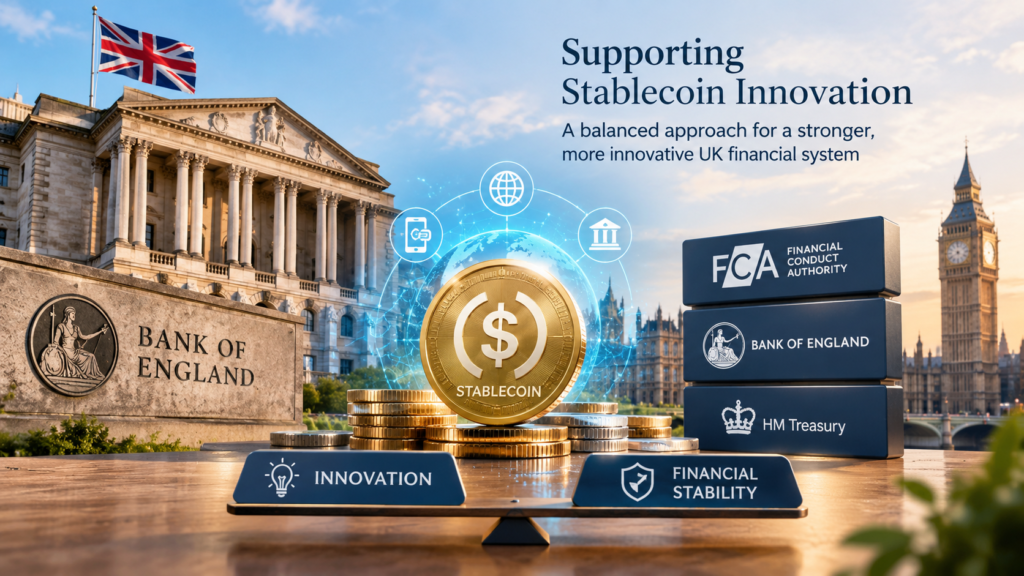
The Bank of England is preparing to take on a new role in digital finance.
Now, the UK government plans to give the central bank a new secondary objective. This objective will support innovation in payment systems and emerging forms of digital money.
Also, stablecoins are part of this wider approach.
However, financial stability will remain the Bank of England’s primary objective.
Previously, regulators focused heavily on the risks linked to new financial technologies. Today, they are also looking at how these technologies can support innovation.
As a result, the UK is taking a broader approach to digital finance.
What Is the New Bank of England Objective?
First, the UK government announced the planned change in August 2026.
The new objective will encourage innovation in payment systems. It will also cover new forms of digital money.
For example, stablecoins can fall within this wider area of innovation.
However, the new objective will remain secondary to financial stability. Therefore, the Bank of England will not have to support an innovation if it creates serious financial risks.
The government wants the UK’s payment system to keep pace with technology.
At the same time, it wants businesses to have more opportunities to develop new financial products.
Therefore, the proposed framework has two main goals.
First, it supports innovation. Second, it protects financial stability.
Why Are Stablecoins Important?
Stablecoins are digital assets designed to maintain a stable value.
Usually, their value is linked to a traditional currency. For example, many stablecoins are linked to the US dollar.
Stablecoins can have several uses.
For instance, companies can explore them for digital payments and cross-border transfers.
They can also support financial settlement and trading.
In addition, stablecoins can support programmable financial services.
Meanwhile, the UK has already started developing rules for stablecoins.
The Financial Conduct Authority, or FCA, will regulate qualifying stablecoins issued in the UK. Also, the Bank of England will have a greater role when a stablecoin becomes important to financial stability.
As a result, stablecoins are moving closer to the regulated financial system.
However, not every stablecoin will receive the same treatment.
Instead, the level of oversight can depend on the scale and potential impact of the stablecoin.
Bank of England and FCA Will Work Together
Next, the Bank of England and FCA have developed a joint approach to systemic stablecoins.
The FCA will focus on qualifying stablecoin issuers.
Meanwhile, the Bank of England will focus on stablecoins that could create wider financial risks.
Also, HM Treasury will have a role in determining whether a stablecoin should be treated as systemic.
Therefore, different stablecoins could face different levels of oversight.
For example, a smaller stablecoin may have a limited impact on the financial system.
On the other hand, a stablecoin used widely for payments could become more important to regulators.
As a result, problems with a widely used stablecoin could affect more users and businesses.
The UK Is Moving Beyond Risk Management
For years, regulators have focused heavily on the risks linked to crypto assets.
Now, potential benefits are receiving more attention.
For example, stablecoins could support faster payment services.
Also, they could make some financial transactions more flexible.
In addition, digital money could support new programmable financial services.
The Bank of England has highlighted similar possibilities when discussing new payment technologies and digital money.
However, new technology can also create new risks.
Therefore, regulation remains an important part of the UK’s strategy.
Instead, the government is trying to support innovation while maintaining financial stability.
What Could This Mean for Stablecoin Companies?
A clearer regulatory framework can give companies a better understanding of the rules.
For example, payment companies may want to use stablecoins for international transfers.
Similarly, financial institutions could explore stablecoins for settlement.
Also, other businesses may use stablecoins as part of programmable financial products.
However, these companies will still need to meet regulatory requirements.
They may also need strong systems for reserves, governance and risk management.
Furthermore, these requirements become more important when a stablecoin reaches a significant scale.
If a major stablecoin experiences a serious problem, the impact could extend beyond its users.
Therefore, financial stability remains central to the Bank of England’s approach.
Stablecoins Are Not the Only Focus
In addition, the UK’s digital finance strategy covers other technologies.
For instance, the Bank of England is exploring tokenisation and distributed ledger technology.
These technologies could change how financial markets operate.
For example, they could support faster settlement.
They could also reduce the number of intermediaries involved in some transactions.
The Bank’s DLT Innovation Challenge explored these possibilities in 2026.
However, technology alone cannot transform financial markets.
Therefore, strong governance is still necessary.
Moreover, clear rules are also important.
In addition, financial infrastructure needs reliable systems and operational resilience.
Why Tokenisation Matters
Tokenisation is another important part of the digital finance conversation.
In simple terms, tokenisation means creating a digital representation of an asset on a blockchain or another distributed ledger.
That asset could represent money, securities or another financial instrument.
As a result, tokenisation could change how financial assets move between market participants.
It could also bring payments and financial assets closer together.
Similarly, stablecoins can connect digital money with payment systems.
Therefore, stablecoins and tokenisation are often discussed as part of the same broader trend.
Both technologies could change the infrastructure behind financial markets.
Financial Stability Still Comes First
There is an important limit to the new objective.
First, financial stability will remain the Bank of England’s primary responsibility.
Therefore, the new objective does not change the Bank’s core role.
If a new technology creates significant risks, the central bank can still respond.
The government has also made clear that the Bank does not need to support innovation when it could undermine financial stability.
In other words, the new objective does not remove the Bank’s existing responsibilities.
The UK wants digital finance to develop.
At the same time, it wants that development to happen within a stable financial system.
As a result, innovation will not become a goal at any cost.
What Happens Next?
Next, the proposed objective could give the Bank of England a clearer role in digital finance.
It could also encourage more dialogue between regulators and financial technology companies.
Several priorities will need to remain in balance.
These include:
- Financial stability
- Consumer protection
- Innovation
- Competition
- Payment efficiency
In addition, the government plans to increase accountability around the new objective.
The Bank of England will report on its progress under the new framework.
Therefore, the coming years will show how the new approach works in practice.
Why This Matters for Global Crypto
The UK is not the only major financial market exploring stablecoin regulation.
Similarly, other countries are developing frameworks for digital money.
For example, the UK and US have discussed the potential benefits of well-regulated stablecoins.
These benefits can include greater payment efficiency and more competition.
However, both countries also recognise the importance of financial stability and consumer protection.
Because of this, the UK’s approach could become relevant to the wider crypto industry.
The country is not simply asking how stablecoins should be controlled.
Instead, policymakers are also considering how these assets could fit into the future financial system.
The Bigger Picture
The UK’s stablecoin strategy is entering a new phase.
Meanwhile, financial stability will remain the Bank of England’s main responsibility.
At the same time, the central bank is expected to have a stronger role in supporting payment innovation.
Stablecoins are part of that wider conversation.
In addition, tokenisation, digital money and distributed ledger technology are becoming increasingly important.
The key question is no longer only whether these technologies create risks.
Instead, regulators are also asking how they can develop safely.
As a result, the UK’s approach could influence the future of digital payments.
It could also provide a framework for how stablecoins interact with traditional financial infrastructure.
Finally, the direction is becoming clearer.
The UK wants digital finance to grow. However, it also wants that growth to happen within a clear and stable financial system.
Need to Receive International Payments?
Open your USD, GBP & EUR account with Kolan.
Then, fill out the form and book your free consultation.
Secure Your Crypto With OneKey
Keep your crypto assets protected with a OneKey hardware wallet.
Also, you can explore OneKey’s hardware wallet options here:
Join the Crypto Community
Want more crypto news and digital finance updates?
Then, join the CryptoMartLive community:
Finally, follow CryptoMartLive for more crypto news, market updates and digital finance stories.
Crypto moves fast. Stay informed. Stay ahead.
Tinggalkan Balasan