A USD Account in Your Company Name, Without Opening a Bank Abroad
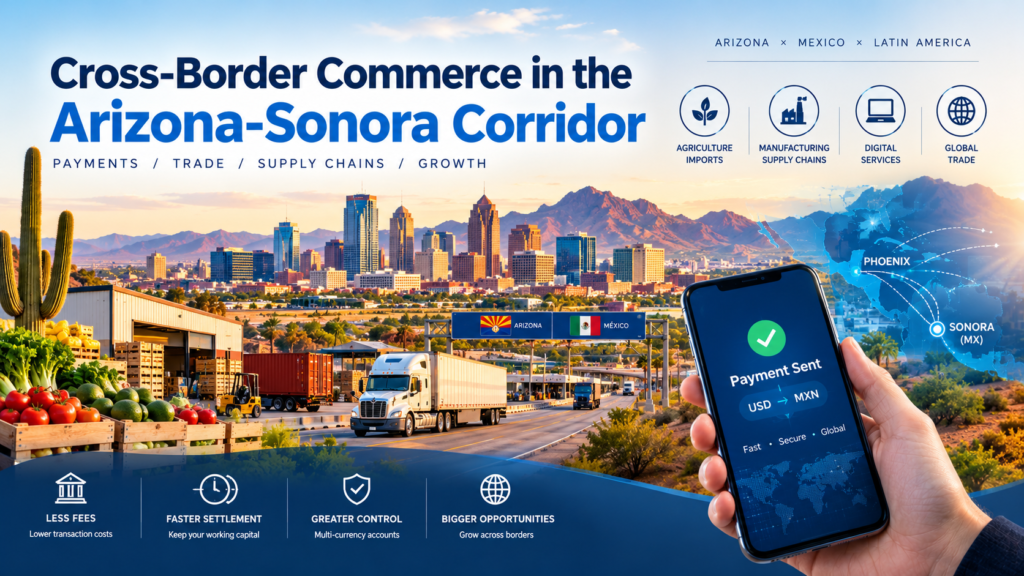
Introduction: Cross-Border Commerce in the Arizona-Sonora Corridor
Phoenix powers one of the fastest-growing industrial economies in the United States. Located near the Mexican border, Phoenix serves as a primary trade hub for North American commerce.
With a population exceeding 1.6 million residents, Phoenix represents a major Tier 1 business ecosystem. Thousands of enterprises operate across the East Valley, West Valley, Sky Harbor, and Deer Valley. These firms handle high-volume cross-border trade daily.
Local agricultural importers, manufacturing suppliers, freight forwarders, and software agencies move capital across borders regularly. They settle invoices with Mexican growers, pay foreign assembly plants, and receive international client payments.
However, cross-border banking creates friction for Arizona enterprises. Opening a physical bank account in Mexico or Colombia requires complex legal structures and local corporate presence.
Consequently, most local businesses rely on legacy Society for Worldwide Interbank Financial Telecommunication (SWIFT) wire transfers.
Sending USD, Mexican Peso (MXN), or Colombian Peso (COP) through traditional banks exposes companies to three major financial losses:
- High fixed wire fees on outbound transfers.
- Unpredictable deductions taken by intermediary banks.
- Heavy foreign exchange spreads hidden inside conversion rates.
Furthermore, multi-day settlement delays freeze working capital. For a Phoenix produce importer moving perishable goods, trapped liquidity causes operational bottlenecks.
This guide compares virtual corporate accounts with physical foreign bank accounts and provides actionable strategies for Phoenix enterprises.
The Phoenix Economic Ecosystem: Cross-Border Trade, Agriculture, and Tech
To understand payment friction in Phoenix, one must examine its core commercial sectors. Arizona and Sonora, Mexico share a direct border. Together, both regions build an integrated supply chain for manufacturing and agriculture.
Agricultural Importers and Produce Logistics
Arizona serves as a major entry gateway for Mexican agricultural exports. Logistics companies transport produce from Sonora through Arizona distribution hubs to North America.
Importers in Phoenix settle invoices continuously with Mexican farming cooperatives and packing facilities. These transactions require fast MXN or USD disbursements.
In the produce industry, settlement speed is critical. Suppliers hold shipments when wire transfers experience bank delays.
Unfortunately, traditional SWIFT wires require two to five business days to clear. This latency locks working capital and risks product spoilage.
Cross-Border Manufacturing and Supply Chains
Phoenix houses a booming advanced manufacturing and industrial corridor. Local firms import raw materials and sub-assemblies from manufacturing facilities in Sonora and border regions.
Supplying cross-border assembly lines requires regular international payments. Trade corridors involving USD, MXN, and COP face heavy conversion fees.
Commercial banks charge high retail conversion spreads on every international invoice. Managing multi-currency cash flows through traditional banks erodes narrow industrial margins.
Software Agencies and Digital Services in the Sun Corridor
Phoenix and Scottsdale host a growing ecosystem of software developers, creative agencies, and digital consultancies. These firms service clients across North America and Latin America.
Digital agencies face a reverse cash-flow challenge when accepting international payments. When an agency invoices a foreign client, traditional banks deduct incoming wire fees.
Banks also apply unfavorable conversion rates during currency processing. Over a fiscal year, these silent deductions result in significant revenue losses.
Virtual Accounts vs. Opening a Bank Account Abroad: A Direct Comparison
Phoenix companies face a major dilemma when trading with Latin America. They must choose between opening a physical bank account abroad or using virtual multi-currency accounts.
The Realities of Opening a Physical Bank Account Abroad
Opening a traditional commercial bank account in Mexico or Colombia presents severe legal and administrative barriers:
- Local Entity Requirements: Most foreign jurisdictions require businesses to register a local legal entity (such as a Mexican S.A. de C.V.).
- Complex Paperwork: Opening a foreign corporate account requires notarized tax documents, certified articles of incorporation, and local legal representation.
- Mandatory Physical Presence: Bank rules force directors to visit foreign offices in person.
- Ongoing Tax Complexity: Managing physical foreign accounts creates complex international tax filing requirements for U.S. parent companies.
The Virtual Multi-Currency Account Advantage
A virtual multi-currency account provides the benefits of local banking without foreign administrative hurdles.
Kolan issues virtual multi-currency accounts directly in your U.S. business name. These accounts support major currencies, including USD, MXN, COP, EUR, and GBP.
Local suppliers pay your business using domestic clearing systems like SPEI in Mexico or ACH in the United States. Your business retains full control over currency conversions and global disbursements.
Deconstructing SWIFT Failure Points: Where Does Your Money Go?
When a Phoenix enterprise sends an international wire through a commercial bank, funds rarely move directly. Instead, the payment routes through a chain of intermediary correspondent banks.
Every institution along this chain imposes a financial toll on your transfer.
1. High Fixed Wire Fees
Commercial banks charge upfront administrative fees simply to process international wire requests. For a Phoenix business, sending an outbound wire costs between $35 and $60 per transfer. Accepting an inbound wire incurs an additional $15 to $30 fee.
2. Intermediary Correspondent Bank Deductions
Local banks route international transfers through intermediary institutions. These correspondent banks take fees directly from your transfer amount. This process complicates invoice reconciliation for accounting teams.
3. Opaque Foreign Exchange (FX) Markups
The most significant hidden cost in cross-border payments is the foreign exchange spread. Commercial banks rarely offer wholesale mid-market exchange rates to growing businesses.
Instead, banks bundle currency conversion into retail exchange rates. These rates include hidden spreads between 1.5% and 4.5% above market rates.
For a Phoenix importer transferring $100,000 to a partner in Mexico, a 3% hidden markup wastes $3,000 in capital on a single transaction.
4. Settlement Latency and Capital Immobilization
Legacy SWIFT transfers operate strictly on traditional banking schedules. Wires pause during weekends, international holidays, and manual compliance checks.
A wire initiated on Friday afternoon in Phoenix may not settle in a Mexican account until Wednesday. This waiting period locks your capital and complicates payment tracking.
Real-World Case Study: The True Cost of Legacy Banking
To illustrate the financial impact of legacy banking, consider a hypothetical Phoenix agricultural importer. The firm processes 20 international supplier payments every month, averaging $25,000 per wire transfer.
Scenario A: Traditional Commercial Bank Wire
- Outbound Wire Fee: $45 per transfer ($900 monthly)
- Intermediary Bank Deductions: $35 average per transfer ($700 monthly)
- Hidden FX Markup (2.5% spread): $625 per $25,000 transfer ($12,500 monthly)
- Total Monthly Banking Losses: $14,100
- Total Annual Capital Drain: $169,200
In addition to financial losses, the firm experiences an average settlement delay of three business days per wire. This latency forces the company to hold large working capital reserves just to maintain operational flow.
Scenario B: Modern Financial Infrastructure
Modern financial platforms eliminate intermediary bank deductions. Businesses process transfers using wholesale mid-market exchange rates and direct settlement rails.
- Fixed Outbound Fees: Low flat fee
- Intermediary Deductions: $0
- Hidden FX Spreads: 0% (Wholesale mid-market rate)
- Settlement Speed: Under 1 hour
- Annual Savings Generated: Over $150,000
Introducing Kolan: The Next-Generation Cross-Border Financial Engine
Kolan provides Tier 1 enterprises with a modern, agile, and cost-effective alternative to legacy banking. It bridges traditional multi-currency account management with hybrid fiat and stablecoin settlement rails.
Core Architectural Pillars of Kolan
- Named Virtual Multi-Currency Accounts: Access company-dedicated international accounts supporting USD, GBP, EUR, AUD, COP, AED, NGN, and MXN. You can hold and disburse local currencies without forced conversion.
- Hybrid Fiat & Stablecoin Rails: Convert seamlessly between fiat currencies and enterprise stablecoins (USDC, USDT, EURC). Bypass correspondent banking bottlenecks for near-instant global settlement.
- Upfront Transparent Pricing: Enjoy zero hidden FX spreads and clear transaction fees. Retain full visibility over your treasury operations.
- Enterprise-Grade Compliance: Institutional security standards and AML/KYC protocols satisfy strict regulatory demands for Phoenix enterprises.
Deep-Dive Comparison: Legacy Banking, Foreign Bank Accounts, and Kolan
This table compares foreign bank accounts and SWIFT wires with Kolan.
Comprehensive Feature and Cost Comparison Matrix
| Evaluation Metric | Traditional SWIFT Wire Transfers | Physical Foreign Bank Account | Kolan Virtual Corporate Accounts |
| Entity Setup Requirement | U.S. entity only | Foreign entity required (S.A. de C.V., etc.) | U.S. entity only (Named Virtual Accounts) |
| Onboarding Speed | Immediate (existing bank) | Months (complex legal paperwork) | Instantaneous digital verification |
| Primary Settlement Rail | Correspondent banking network | Local clearing systems abroad | Direct local rails + stablecoin rails |
| Settlement Velocity | 2 to 5 business days | Domestic speeds locally | Real-time to under 1 hour globally |
| Foreign Exchange Pricing | Opaque retail spreads (1.5%–4.5%) | Variable bank exchange rates | Transparent wholesale mid-market rates |
| Foreign Compliance Burden | Minimal | Heavy (foreign tax filings & audits) | Streamlined U.S. enterprise compliance |
| Multi-Currency Access | Restricted by bank account type | Limited to local country currency | Multi-currency (USD, MXN, COP, EUR, GBP) |
Sector-Specific Application: How Phoenix Businesses Win with Kolan
Phoenix businesses face unique challenges when paying foreign suppliers.
1. Agricultural Importers in Phoenix and Nogales Corridors
- The Challenge: Paying growers in Mexico via SWIFT causes multi-day delays, risking produce freshness and supply chain holds.
- The Kolan Solution: Importers send MXN or USD instantly using Kolan virtual accounts. Mexican growers receive funds directly via SPEI within minutes.
2. Manufacturing Suppliers in the Arizona-Sonora Region
- The Challenge: Supplying sub-assemblies to Mexican factories exposes suppliers to heavy foreign exchange markups on USD/MXN pairs.
- The Kolan Solution: Kolan enables Phoenix manufacturers to pay foreign plants at wholesale mid-market rates, eliminating hidden bank FX taxes.
3. Digital Agencies in Scottsdale and Tech Hubs
- The Challenge: Software consultancies lose revenue to incoming wire fees and conversion markups on Latin American client invoices.
- The Kolan Solution: Kolan provides localized receiving accounts in major currencies. Agencies collect client payments as domestic transfers with zero incoming wire fees.
Step-by-Step Implementation Guide for Phoenix Enterprises
Integrating Kolan into existing financial workflows is simple and fast.
Step 1: Enterprise Account Registration
Register for an enterprise account on the Kolan Platform. Submit standard corporate verification documents (EIN and Articles of Organization) to complete institutional verification.
Step 2: Configure Virtual Currency Accounts
Activate specific currency wallets needed for your primary trade corridors (USD, MXN, COP, EUR, GBP).
Step 3: Map Invoicing and Payment Workflows
International clients send funds directly to your account. Your team creates templates for instant money transfers.
Step 4: Monitor, Reconcile, and Scale
The Kolan dashboard tracks payment status in real time.
Finance teams export transaction records into accounting software instantly.
Enhancing Enterprise Security: Essential Tools for Digital Asset Treasury Management
Maintaining robust cybersecurity is paramount when integrating hybrid fiat and stablecoin rails. Institutional-grade hardware security helps protect corporate digital assets and private keys:
- OneKey Hardware Wallet: An open-source hardware wallet ideal for managing corporate digital asset treasuries with multi-signature support.
- Ellipal Hardware Wallet: A fully air-gapped hardware wallet that completely isolates private keys from network connectivity.
- Mypal Crypto Self-Custody Card: A practical tool for corporate self-custody asset authorization and management.
Conclusion & Actionable Next Steps
Phoenix enterprises do not need to open physical bank accounts abroad or tolerate legacy SWIFT banking delays. Adopting Kolan virtual multi-currency accounts and hybrid fiat-stablecoin rails gives local businesses full fee transparency and instant cross-border liquidity.
Call to Action & Enterprise Contact Information
Ready to eliminate cross-border B2B payment friction and optimize your treasury operations? Get started with Kolan today:
- Kolan Platform & Account Setup: Access Kolan Multi-Currency Accounts (Supporting USD, GBP, EUR, AUD, COP, AED, NGN & MXN accounts)
- Cryptomart Landing Page: Explore Ecosystem Resources
Direct Consultation & Support
Connect with our team directly for customized enterprise integration or technical support:
- Email: info@cryptomart.site
- WhatsApp: +6285165098877
- Telegram: @sungazerlive
Empower your Phoenix enterprise with intelligent, high-speed, and transparent cross-border financial infrastructure.
Leave a Reply