Businesses in New York City: Where Does Your International Wire Fee Actually Go?
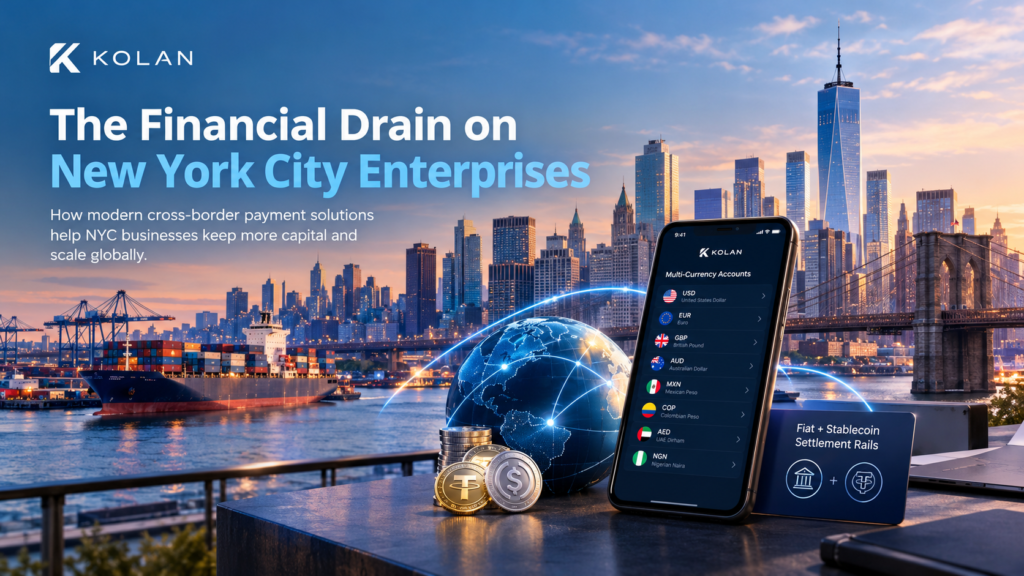
Introduction: The Invisible Financial Drain on New York City Enterprises
New York City stands as the undisputed global capital of finance and international trade. From the Port of New York and New Jersey to digital agencies in Manhattan, Brooklyn, and Queens, NYC businesses operate at the epicenter of international exchange.
The city boasts a population exceeding 8.8 million residents and a Tier 1 economic footprint. Local enterprises routinely process high-volume international invoicing. These include logistics providers, freight forwarders, import-export firms, and cross-border service agencies.
Yet, a persistent operational headache affects these enterprises. That headache is cross-border payment friction.
For decades, NYC companies have relied on traditional banking networks like SWIFT. SWIFT remains a foundational pillar of global finance. However, it no longer matches the speed and agility of modern commerce.
When a Brooklyn forwarder pays a shipping partner in Latin America, delays occur. Similarly, when a Manhattan software agency invoices a client in Mexico City or Bogotá, fees add up. Transactions are bogged down by three hidden costs:
- Exorbitant Wire Transfer Fees: Outbound and inbound wire fees charged by commercial banks.
- Opaque Foreign Exchange (FX) Markups: Inflated exchange rates hidden behind “zero-commission” claims.
- Protracted Settlement Times: Multi-day delays caused by correspondent banking chains.
These hidden frictions compound over time. They erode profit margins and strangle cash flow liquidity.
Enter Kolan. Kolan modernizes international treasury operations. It combines multi-currency accounts with hybrid fiat and stablecoin settlement rails. By bridging traditional banking with digital asset rails, Kolan eliminates legacy payment friction. New York enterprises can now retain more capital and scale globally without banking bottlenecks.
The New York City Economic Landscape: Trade, Logistics, and Digital Agencies
To understand payment friction in NYC, one must examine its core economic sectors. NYC is not just a financial district. It is a complex ecosystem where physical goods and digital services intersect daily.
The Maritime, Logistics, and Freight Forwarding Hub
The Port of New York and New Jersey is the busiest port on the East Coast. It handles millions of Twenty-Foot Equivalent Units (TEUs) annually. The port sustains an extensive network of logistics providers, freight forwarders, customs brokers, and warehousing operators. These businesses are concentrated in Elizabeth, Newark, Staten Island, and industrial Brooklyn.
For logistics enterprises, operational velocity is essential. Cargo vessels cannot sit idle waiting for funds to clear. Intermodal transport needs fast capital deployment.
Traditional SWIFT wires take three to five business days to clear. As a result, freight forwarders must float capital just to keep goods moving.
Import-Export Enterprises and Supply Chain Networks
NYC is home to thousands of import-export enterprises. These companies source goods from Latin America, Europe, and Asia. These companies regularly pay for apparel, electronics, foods, and machinery.
Trade corridors involving USD, Mexican Peso (MXN), and Colombian Peso (COP) face high banking costs. Managing multi-currency cash flows through legacy banking channels is exceptionally expensive.
Agencies, Software Houses, and Digital Service Providers
Manhattan and Brooklyn house dense concentrations of creative agencies, software firms, and consultancies. These firms routinely service international clients.
Digital businesses face a reverse cash-flow challenge with inbound payments. When an agency invoices an overseas client, incoming wire fees and currency markups shave off 3% to 6% of the invoice. Over a fiscal year, these deductions cause significant revenue loss.
Deconstructing the Three Hidden Costs of International Invoicing
Legacy financial infrastructure fails New York enterprises due to three primary financial drains.
1. Intermediary Bank Fees and Unpredictable Wire Charges
International wires sent via SWIFT rarely move directly from sender to recipient. Funds route through a chain of correspondent banks. Each intermediary institution takes a cut between $25 and $75 per transaction.
For an NYC firm making dozens of supplier payments monthly, these fees accumulate quickly. The exact deduction amount is rarely known in advance. This lack of transparency makes accounting reconciliation difficult.
2. The Opaque Foreign Exchange (FX) Markup
The largest financial drain is foreign exchange markup. Commercial banks rarely offer true mid-market exchange rates. Instead, they bundle currency conversion into proprietary rates with hidden spreads of 1.5% to 4.5%.
Consider an NYC logistics firm converting USD to MXN or COP. On a $100,000 corporate transfer, a 3% hidden FX markup equals $3,000 lost strictly to exchange spreads.
3. Settlement Latency and Capital Immobilization
Traditional SWIFT transfers operate on legacy banking hours. They are subject to weekend halts, holidays, and manual compliance reviews. A payment sent on Friday afternoon may not settle until the following Wednesday.
Capital is completely immobilized during this multi-day window. This lag forces businesses to maintain expensive working capital buffers.
Introducing Kolan: The Next-Generation Cross-Border Financial Engine
Kolan provides Tier 1 enterprises with a modern and agile alternative. It bridges multi-currency accounts with hybrid fiat and stablecoin rails.
Core Architectural Pillars of Kolan
- Multi-Currency Accounts: Access dedicated international accounts supporting USD, GBP, EUR, AUD, COP, AED, NGN, and MXN. Hold and disburse funds locally without mandatory conversion.
- Hybrid Fiat & Stablecoin Rails: Convert seamlessly between fiat currencies and digital stablecoins (USDC, USDT, EURC). Bypass correspondent banking bottlenecks for near-instant settlement.
- Transparent Pricing: Enjoy zero hidden FX spreads and clear transaction fees. Retain full visibility over your treasury.
- Enterprise-Grade Compliance: Institutional security standards and AML/KYC protocols satisfy strict regulatory demands.
Deep-Dive Comparison: Legacy SWIFT vs. Kolan Infrastructure
The comparison table below details how SWIFT banking contrasts directly with Kolan enterprise rails.
Comprehensive Feature and Cost Comparison Matrix
| Evaluation Metric | Traditional SWIFT Banking | Kolan Enterprise Infrastructure |
| Primary Settlement Mechanism | Correspondent banking network (Multi-hop) | Hybrid rails (Direct fiat accounts + stablecoin rails) |
| Average Settlement Speed | 2 to 5 business days | Near-instantaneous (Real-time to < 1 hour) |
| Foreign Exchange (FX) Pricing | Opaque retail spreads (1.5% – 4.5% hidden markups) | Transparent wholesale mid-market conversion rates |
| Incoming / Outbound Wire Fees | High fixed fees ($25–$75 per hop) | Low, flat-fee structure with transparent pricing |
| Currency Support | Limited by traditional banking ties | Broad multi-currency accounts (USD, GBP, EUR, AUD, COP, AED, NGN, MXN) |
| Liquidity Management | Capital trapped in transit | Real-time liquidity access; zero trapped capital |
| Reconciliation & Tracking | Manual, opaque tracking | Automated digital ledger with instant updates |
| Compliance & Security | Legacy institutional compliance | Automated, regulatory-compliant digital asset & fiat rails |
Sector-Specific Application: How New York City Businesses Win with Kolan
Different NYC business sectors face distinct operational hurdles when moving money across borders.
1. Logistics Providers and Freight Forwarders in the Port of NY/NJ
- The Challenge: Paying overseas agents in Latin America involves complex currency pairs (USD to MXN or COP) and urgent deadlines. Delays cause cargo demurrage charges.
- The Kolan Solution: Logistics operators can disburse funds instantly using Kolan multi-currency accounts and hybrid rails. Payments settle in minutes, keeping cargo moving smoothly.
2. Import-Export Enterprises Sourcing from Emerging Markets
- The Challenge: Sourcing goods from Latin American hubs involves local currency volatility and high bank conversion spreads on USD/MXN and USD/COP pairs.
- The Kolan Solution: Kolan lets importers hold local currency balances and settle invoices at wholesale rates. Importers can eliminate stealth banking conversion taxes easily.
3. Digital Agencies and Software Houses with Global Client Rosters
- The Challenge: NYC agencies suffer margin erosion from incoming wire fees and conversion deductions on project invoices.
- The Kolan Solution: Kolan provides localized receiving accounts in major global currencies. Agencies receive client payments as domestic transfers, slashing incoming wire fees to zero.
Step-by-Step Implementation Guide for New York Enterprises
Integrating Kolan into existing financial workflows is straightforward and fast.
Step 1: Account Setup and Verification
Register for an enterprise account on the Kolan Platform. Submit standard business documents (EIN and Articles of Incorporation) for institutional verification.
Step 2: Configure Multi-Currency Wallets
Activate the specific currency accounts required for your trade corridors (USD, MXN, COP, EUR, GBP).
Step 3: Map Invoicing and Disbursement Workflows
Add Kolan account details to your invoicing software. Instruct clients to remit payments directly to your multi-currency receiving accounts. Set up templates for instant disbursements.
Step 4: Monitor, Reconcile, and Scale
Use the Kolan dashboard to monitor cash flows and track settlement statuses instantly. Export data directly to your ERP or accounting software.
Enhancing Enterprise Security: Essential Tools for Digital Asset & Treasury Management
Maintaining robust cybersecurity is paramount when integrating hybrid fiat and stablecoin rails. Institutional-grade hardware security helps protect corporate digital assets and private keys:
- OneKey Hardware Wallet: An open-source hardware wallet ideal for managing digital asset treasuries with multi-signature support.
- Ellipal Hardware Wallet: A fully air-gapped hardware wallet that isolates private keys from network connectivity.
- Mypal Crypto Self-Custody Card: A practical tool for corporate self-custody asset authorization and management.
Conclusion: Future-Proofing New York Commerce with Kolan
New York City businesses thrive on speed and competitive advantage. Relying on 20th-century banking infrastructure like SWIFT creates an unnecessary drag on profitability.
Kolan eliminates wire fees, opaque FX markups, and settlement delays. It empowers NYC logistics providers, import-export firms, and digital agencies to reclaim their margins. Switch to modern financial infrastructure to accelerate your cash flow today.
Call to Action & Enterprise Contact Information
Ready to eliminate cross-border payment friction and optimize your treasury operations? Get started with Kolan today:
- Kolan Platform & Account Setup: Access Kolan Multi-Currency Accounts (Supporting USD, GBP, EUR, AUD, COP, AED, NGN & MXN accounts)
- Cryptomart Landing Page: Explore Ecosystem Resources
Direct Consultation & Support
Connect with our team directly for enterprise integration or technical support:
- Email: info@cryptomart.site
- WhatsApp: +6285165098877
- Telegram: @sungazerlive
Empower your New York enterprise with intelligent, high-speed, and transparent cross-border financial infrastructure.
Leave a Reply