St. Cloud to Somalia: How Self-Custody Wallets and USDT Could Help Families Send Money
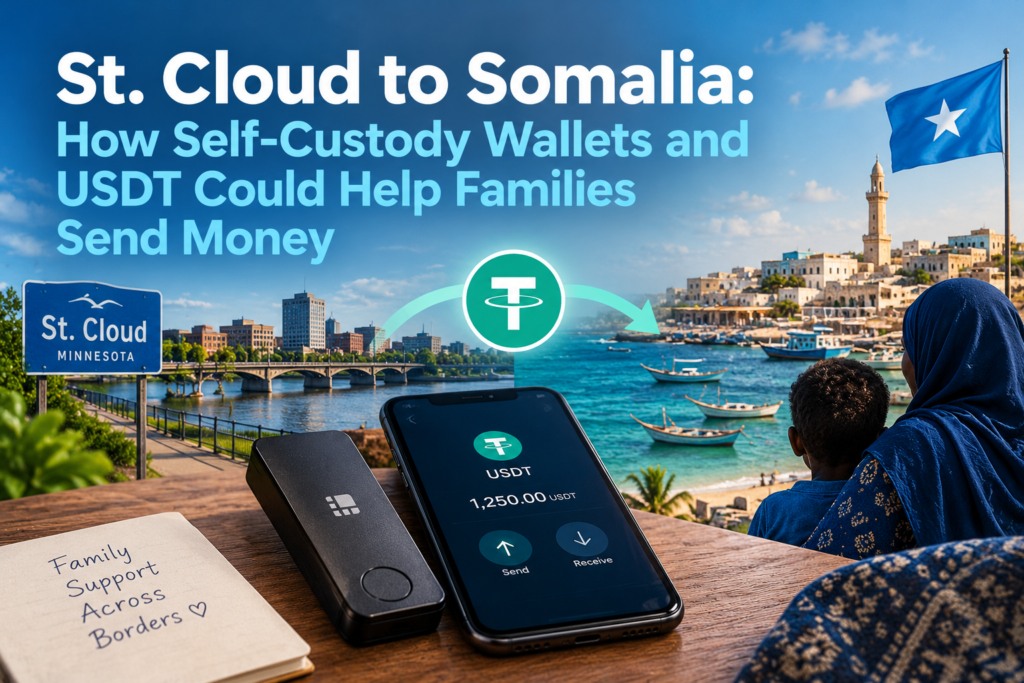
For many Somali American families in St. Cloud, Minnesota, supporting relatives abroad is an important financial responsibility. International remittances help families pay for everyday necessities, education, healthcare, and other essential expenses.
However, sending money internationally can involve transfer fees, exchange-rate costs, delays, and limited access to financial services in the recipient’s location. Somalia’s financial system has developed significantly, but access to conventional banking remains uneven, making mobile money and money-transfer providers important parts of the financial landscape.
Could cryptocurrency offer another option?
USDT, combined with a self-custody wallet and a secure backup card, may provide an alternative way to transfer digital dollars across borders. However, this approach requires careful planning: both sender and recipient need a suitable wallet or service, a compatible blockchain network, and a reliable way to convert USDT into usable local money when necessary.
For users who want stronger control over their crypto assets, we recommend exploring OneKey hardware wallets, alongside ELLIPAL and MyPal as additional options.
Explore your crypto security options:
Important: These products are not all equivalent, and a hardware wallet is not itself an international money-transfer service. Verify each provider’s features, USDT support, and recovery options before purchasing.
Why International Remittances Matter to St. Cloud’s Somali Community
St. Cloud is one of Minnesota’s established Somali American population centers. The Minnesota Department of Health identifies St. Cloud, alongside the Minneapolis–St. Paul area and Rochester, as a community where Somali refugees and immigrants have settled.
For some households, supporting relatives in Somalia is part of regular family budgeting. International transfers may help recipients cover food, school expenses, medical bills, and other living costs.
According to the U.S. International Trade Administration’s Somalia financial-services guide, published in January 2024:
- Somalia’s remittance inflows were estimated at approximately $2 billion annually.
- Mobile money was widespread, with estimated penetration of 73%.
- The guide reported that fewer than 9% of adults had a bank account.
- Mobile phones and mobile financial transactions played important roles in everyday financial activity.
These are historical estimates cited in the guide, not guaranteed current figures. Nevertheless, they illustrate why accessible payment methods matter.
Somalia’s financial infrastructure is also evolving. The World Bank has documented improvements in payment systems and financial-sector development. Therefore, it is more accurate to describe Somalia as a market with uneven access to conventional banking and significant mobile-money usage than to say that its banks barely function.
For families sending money from Minnesota, the practical question is straightforward: Which transfer method delivers usable funds to the recipient with acceptable costs, reliability, and security?
What Is USDT, and How Could It Help With Remittances?
USDT, commonly known as Tether, is a stablecoin designed to track the value of the U.S. dollar. Unlike Bitcoin, which can experience substantial price fluctuations, USDT is intended to maintain a value close to one U.S. dollar per token.
USDT operates on multiple blockchain networks, including Ethereum and Tron. The network used by the sender must be supported by the recipient’s wallet or service.
For international transfers, USDT may offer several potential benefits.
1. Transfers Without a Traditional Bank-to-Bank Route
A blockchain transfer can move USDT between compatible wallet addresses without requiring the sender to initiate a conventional international bank wire.
However, that does not mean every transfer is free of intermediaries. Buying USDT, converting it into local currency, or withdrawing funds may still require an exchange, payment provider, or local service.
2. Dollar-Referenced Digital Value
Because USDT is designed to track the U.S. dollar, it may be useful for people who want to transfer a dollar-referenced digital asset rather than a cryptocurrency whose market price changes substantially.
Nevertheless, USDT is not the same as a U.S. bank deposit or physical cash. Its market price can deviate from its intended peg, and access to redemption depends on the issuer’s terms and the services available to the user.
3. Potentially Convenient Cross-Border Transfers
A blockchain transfer may be processed outside traditional banking hours. The time required depends on the network, network congestion, exchange processing, and any additional steps needed to deliver spendable funds.
As a result, a USDT transfer may be convenient in some situations. It is not automatically faster or cheaper than a licensed remittance service.
How a Self-Custody Wallet Fits Into the Process
A self-custody wallet allows you to control the private keys associated with your crypto assets instead of relying entirely on a third-party custodian to hold them for you.
This can provide greater control, but it also creates more responsibility. If you lose access to your wallet and cannot recover it, you may permanently lose access to your assets.
For families considering USDT transfers, a self-custody wallet can be part of a setup for holding and sending supported tokens. Before choosing one, confirm that it supports the relevant USDT network and that you understand how to send and receive tokens safely.
A practical setup includes:
- A compatible self-custody wallet.
- Support for the specific USDT network you intend to use.
- A secure recovery phrase backup.
- Enough of the network’s native token to cover transaction fees, where required.
- A reliable and lawful method for the recipient to convert USDT into local currency or use it for payments.
The final point is particularly important. Sending USDT is only one part of a remittance process. The recipient must also be able to use the funds in a practical way.
Why a Secure Backup Card Matters
A backup card or recovery backup can help preserve the information needed to recover a wallet. However, products described as wallet cards can work in different ways.
Some are physical devices used to access a wallet, while others are simply storage products for recovery information. These are not interchangeable.
Before purchasing a self-custody card, determine exactly what the product does and how it handles private keys. Never assume that every card offers offline key storage or supports USDT directly.
For recovery phrase storage, consider these precautions:
- Keep the recovery phrase private.
- Never send it to a relative over a messaging app.
- Do not photograph it or store it in an unprotected cloud account.
- Use a backup product appropriate for your physical storage conditions.
- Follow the manufacturer’s setup and recovery instructions.
A backup card can help with recovery, but it does not eliminate phishing, fraud, device theft, or mistakes when sending cryptocurrency.
How to Send USDT From St. Cloud to Somalia
If you are considering USDT for family transfers, use a small, carefully planned test before sending a larger amount.
Step 1: Confirm That the Recipient Can Actually Use USDT
Before purchasing any cryptocurrency, ask the recipient which wallets, exchanges, or payment services they can access.
Confirm that the service is legitimate, available to the recipient, and permitted to handle the transaction. Also determine how the recipient will convert USDT into usable funds if they need local currency.
Do not assume that every mobile-money provider accepts USDT directly.
Step 2: Choose a Compatible Wallet
The sender and recipient need compatible wallet addresses and networks. For example, a USDT transfer on Tron must be sent to a destination that supports USDT on Tron.
Sending tokens to an incompatible network or incorrect address can result in a loss of funds.
Therefore, verify the network and destination details carefully before confirming the transaction.
Step 3: Compare the Total Cost
Calculate the complete cost of the transfer rather than looking only at the blockchain fee.
Your comparison should include:
- The cost of buying USDT.
- Any exchange or withdrawal charges.
- The blockchain transaction fee.
- The recipient’s conversion or cash-out fee.
- The exchange rate offered when the recipient converts the funds.
- Any minimum withdrawal or service charges.
For example, a transfer with a low network fee may still be expensive if the recipient faces a poor conversion rate or a high cash-out charge.
Compare the final amount the recipient receives with the amount delivered by a reputable remittance service.
Step 4: Send a Small Test Transfer
Once both parties have verified the wallet addresses and network, send a small amount first.
Wait for confirmation and ask the recipient to verify that the funds arrived in the correct wallet. Only proceed with a larger amount after confirming that the complete process works.
Step 5: Keep the Recovery Phrase Secure
Never share your recovery phrase with the recipient, an exchange representative, or someone claiming to provide technical support.
The recipient should control their own wallet credentials. Likewise, you should retain control of your own recovery information.
Step 6: Confirm the Recipient’s Cash-Out Method
A successful blockchain transaction does not guarantee that the recipient can immediately exchange USDT for cash or mobile money.
Before sending a larger amount, verify the recipient’s conversion options, transaction limits, identity requirements, and service fees. In addition, check whether the provider is authorized to offer the relevant services.
OneKey: Our First Choice for Crypto Self-Custody
For users who want to hold supported crypto assets under their own control, OneKey is our primary hardware-wallet recommendation.
A hardware wallet can help protect private keys, but it does not independently transfer money to Somalia or guarantee that a recipient can convert USDT into local currency.
Why consider OneKey?
- It offers hardware wallets designed to help users manage supported crypto assets.
- Official documentation explains its security approach.
- It can form part of a self-custody setup for assets supported by the selected model and wallet software.
- It allows users to review product specifications and setup instructions before purchasing.
Before using OneKey for USDT transfers, verify that your chosen model and compatible wallet software support the specific USDT network you intend to use.
Explore OneKey Hardware Wallets
Do not send funds until you understand the network, transaction fees, recovery process, and recipient’s cash-out method.
ELLIPAL: Another Hardware Wallet to Compare
Explore ELLIPAL Hardware Wallets
ELLIPAL is another hardware wallet brand worth researching if you want to compare different self-custody products.
Review the current specifications of the exact model you are considering. In particular, confirm its supported assets, network compatibility, security features, and recovery process.
For remittances, the most important question is whether the wallet supports your intended USDT workflow. Hardware-wallet ownership alone does not guarantee that the recipient can receive or cash out the transfer.
MyPal: Review the Product Before Choosing
MyPal is another option to investigate when comparing crypto-related services. However, verify the specific product and its current capabilities before relying on it for self-custody or remittances.
Check whether it is a self-custody wallet, a custodial service, a payment product, or another type of offering. Then confirm supported networks, fees, recovery options, and availability for both sender and recipient.
Choose based on verified features and your family’s actual transfer requirements rather than assuming all crypto products offer equivalent protection.
USDT vs. Traditional Remittance Services
Neither crypto nor traditional remittance services are universally best. The right option depends on the amount, recipient’s location, available cash-out methods, fees, and risk tolerance.
| Factor | USDT transfer | Traditional remittance service |
|---|---|---|
| How it works | Blockchain transfer between compatible wallets or services | Transfer through a remittance provider |
| Access requirements | Compatible wallet or service and internet access | Provider’s supported payment and collection methods |
| Costs | Purchase, network, exchange, and cash-out costs may apply | Transfer fee and exchange-rate margin may apply |
| Recipient access | Must have a practical way to use or convert USDT | May offer bank deposit, cash collection, or supported mobile-money options |
| Main risks | Wrong network, scams, key loss, price deviation, cash-out limitations | Provider restrictions, transfer delays, fees, and exchange-rate costs |
| Recovery options | Self-custody transfers generally cannot be reversed by the sender once confirmed | Provider policies may offer dispute or cancellation procedures in certain cases |
The table describes typical differences, not a guarantee about every provider.
Before choosing, compare the amount the recipient will actually receive, the time required, and the process for resolving problems. If a licensed remittance service offers a better combination of price, convenience, and protection, it may be the more suitable option.
Important Risks to Understand Before Sending USDT
USDT Is Not Risk-Free
USDT is designed to track the U.S. dollar, but it is not identical to cash held in a bank account. Market prices can deviate from the peg, and redemption is subject to the issuer’s terms and access requirements.
Blockchain Transactions Can Be Irreversible
Once a transaction is confirmed, recovering funds sent to the wrong address can be difficult or impossible. Always verify the destination address and network before sending.
Fees Can Reduce the Amount Received
Even if the blockchain fee is low, buying and selling USDT may involve additional costs. Therefore, calculate the full transfer cost before committing.
Self-Custody Means You Are Responsible for Recovery
If you lose your recovery phrase and cannot access your wallet, you may lose your funds. Keep your recovery information private and use a backup method you understand.
Scams Target People Sending Money to Family
Fraudsters may impersonate wallet support, exchanges, relatives, or remittance agents. Never share recovery words, approve unexpected transactions, or trust an unfamiliar person who promises guaranteed exchange rates.
Check Legal and Regulatory Requirements
Crypto services, money transfers, and stablecoin transactions may be subject to different rules depending on where the sender and recipient live.
In the United States, verify that the exchange or service you use is authorized to operate in your jurisdiction. In Somalia, confirm the recipient’s service is legitimate and permitted to handle the transaction. Also consider any applicable tax, reporting, identity-verification, and anti-money-laundering requirements.
This article is educational and does not provide legal or financial advice.
Final Thoughts: A More Flexible Way to Explore Family Remittances
For Somali American families in St. Cloud, supporting relatives in Somalia can be an important financial priority. Traditional remittance providers, banks, hawalas, and mobile-money services remain important options, while USDT may provide an additional method for people who understand how to use it safely.
A self-custody wallet can provide greater control over supported digital assets. However, the complete transfer process must also work for the recipient, including access to a compatible wallet, a reliable conversion method, and clear information about fees.
Our primary hardware-wallet recommendation is OneKey, with ELLIPAL and MyPal as additional options to compare. Before purchasing, verify the exact product, supported USDT network, recovery method, and security features.
Explore your options:
Most importantly, compare the total cost and final amount received against established remittance services before deciding which method to use.
Sources and Further Reading
- Minnesota Department of Health — Somali Refugee Health Profile
https://www.health.state.mn.us/communities/rih/coe/profiles/somali.html
Background on Somali communities in Minnesota, including St. Cloud. - U.S. International Trade Administration — Somalia: Banking Services and Financial Services
https://www.trade.gov/country-commercial-guides/somalia-banking-services-and-financial-services
Information about Somalia’s financial sector, mobile money, and remittance economy. - World Bank — New Bank Payment Systems Get Money Moving in Somalia
https://blogs.worldbank.org/en/africacan/new-bank-payment-systems-get-money-moving-somalia
Background on payment-system development and the role of remittances. - World Bank — Somalia Economic Update, June 2025
https://www.worldbank.org/en/news/press-release/2025/06/30/somalia-afe-economic-prospects-are-positive-but-foreign-aid-cuts-are-downsizing-growth
Economic context, including the contribution of remittances to household consumption. - Tether — Official Transparency Information
https://tether.to/en/transparency/
Issuer information about USDT reserves and circulating tokens. - Tether — How Tether Tokens Work
https://tether.to/en/hadron
Overview of Tether tokens and supported blockchain protocols. - OneKey — Official Store
https://onekey.so/r/TRC - ELLIPAL — Official Website
https://www.ellipal.com/?rfsn=9305287.28d2ea6 - MyPal — Product and Service Link
https://h5.mypal.pro/pm/vhcn?code=27090432 - Cryptomart — Crypto Guides and Resources
https://msha.ke/cryptomart.site
Affiliate Disclosure
Some links in this article are affiliate links. If you purchase or sign up through them, Cryptomart may receive a commission or referral benefit at no additional cost to you. Affiliate relationships do not guarantee a product’s security, suitability, or compatibility with a specific USDT network.
Disclaimer
This article is for educational and informational purposes only. It is not financial, investment, legal, tax, or remittance advice. Stablecoins and cryptocurrency involve risks, including loss of funds, fraud, price deviations, transaction errors, and limited access to conversion services. Always verify fees, network compatibility, provider legitimacy, and applicable rules before transferring money.
Leave a Reply