From Crypto Asset to Payment Tool: The Growing Role of Stablecoins in the Digital Economy
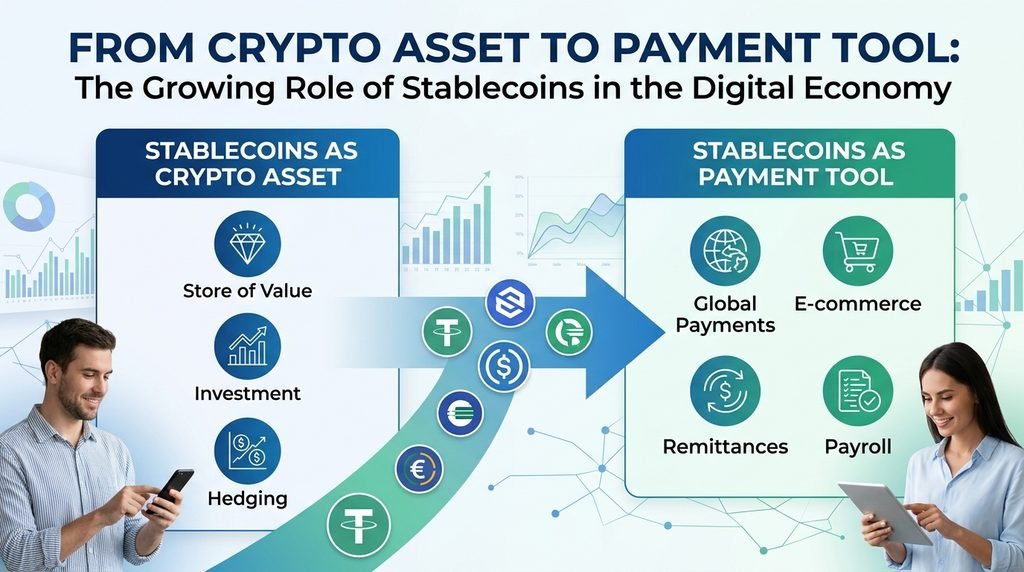
Madrid, September 16, 2026 — Stablecoins are increasingly moving beyond their traditional role within cryptocurrency trading and becoming part of a broader conversation around digital payments, financial services, cross-border transactions, and global commerce.
For businesses operating in an increasingly digital and interconnected economy, stablecoins offer a potential bridge between blockchain-based infrastructure and real-world financial activity. Their ability to maintain a relatively stable value compared with more volatile crypto-assets has made them a focus of attention for payment providers, fintech companies, financial institutions, and digital-asset platforms.
Stablecoins Move Beyond Crypto Trading
Unlike cryptocurrencies whose prices can fluctuate significantly, stablecoins are generally designed to maintain a stable value against a reference asset, most commonly a fiat currency such as the US dollar.
This characteristic has made them particularly relevant for transactions where price stability and settlement efficiency are important.
Instead of being used exclusively as an instrument for moving funds within crypto markets, stablecoins are increasingly being explored for payments, transfers, treasury operations, and settlement between businesses.
This evolution is changing the way the digital-asset industry is viewed.
The question is no longer simply whether cryptocurrencies can become an alternative investment class. It is increasingly about how blockchain-based assets can become part of the infrastructure supporting everyday financial activity.
A New Layer for Digital Payments
One of the areas attracting significant attention is digital payments.
Stablecoins can enable transactions to take place on blockchain networks, potentially allowing value to move between digital wallets without relying entirely on traditional payment infrastructure.
For businesses operating internationally, this could create new possibilities for transferring and settling funds across borders.
Payment companies and fintech platforms are consequently exploring ways to integrate stablecoins into cards, wallets, merchant payments, and other financial services.
The development of these products illustrates a broader convergence between the crypto industry and traditional financial technology.
Cross-Border Transactions and Global Commerce
International payments remain one of the areas where blockchain technology could have practical applications.
Traditional cross-border transfers can involve multiple intermediaries, different banking systems, currency conversions, and settlement processes.
Stablecoins offer an alternative digital settlement mechanism in which value can be transferred using blockchain infrastructure.
For companies involved in international commerce, this could potentially support faster movement of digital funds and simplify certain settlement processes.
However, the practical benefits depend on factors including network costs, liquidity, regulatory requirements, wallet infrastructure, and the availability of compliant service providers in different jurisdictions.
As regulatory frameworks mature, these considerations are becoming increasingly important for businesses evaluating stablecoin-based payment solutions.
Stablecoins and the Fintech Industry
The growth of stablecoins is also creating new opportunities for fintech companies.
Digital wallets, payment platforms, crypto exchanges, and financial technology providers are developing services that allow users to hold, transfer, convert, or spend digital assets.
The result is an increasingly interconnected financial ecosystem in which traditional currencies and blockchain-based assets can coexist within the same digital environment.
For fintech businesses, stablecoins can therefore represent more than another type of crypto asset. They can potentially function as a technological layer for moving value across digital networks.
This could become particularly relevant for companies serving freelancers, international businesses, digital merchants, exporters, and other users who regularly move money across borders.
The Role of Regulation
The expansion of stablecoins into payments also brings greater regulatory attention.
In Europe, the Markets in Crypto-Assets Regulation (MiCA) establishes specific requirements for certain categories of stablecoins, including asset-referenced tokens (ARTs) and e-money tokens (EMTs).
The framework addresses areas such as authorization, reserves, governance, and consumer protection.
As stablecoins become increasingly connected to payment and financial infrastructure, regulatory clarity will play an important role in determining how these assets can be used within the European market.
For businesses, compliance is therefore becoming an integral part of building sustainable digital-asset and payment solutions.
From Digital Assets to Financial Infrastructure
The growing role of stablecoins reflects a wider transformation within the crypto industry.
Blockchain technology is increasingly being explored for applications beyond cryptocurrency trading, including tokenization, payments, digital custody, settlement, and financial infrastructure.
Stablecoins sit at the intersection of these developments because they combine blockchain-based transfer mechanisms with a value designed to remain relatively stable.
This makes them particularly relevant to businesses looking for ways to connect digital assets with existing financial operations.
The development also reinforces the idea that the future of crypto may involve multiple layers: digital assets, payment networks, wallets, financial applications, and blockchain infrastructure working together.
Connecting Crypto With the Real Economy
The evolution of stablecoins demonstrates how the digital-asset industry is increasingly connected to practical economic activity.
From international payments and cross-border settlements to digital wallets and fintech applications, blockchain technology is gradually becoming part of a broader financial ecosystem.
For businesses, the opportunity lies not simply in adopting another form of digital asset, but in understanding how blockchain-based infrastructure can improve the way value moves across digital and international markets.
Stablecoins are becoming a bridge between crypto and payments — connecting blockchain technology with businesses, financial services, and the real economy.
Discover New Opportunities in the Digital-Asset Ecosystem
The evolution of stablecoins is creating new possibilities across payments, international transfers, digital wallets, and blockchain-based financial services.
Explore solutions designed to connect blockchain technology with the real world:
👉 Open Your Account: Open Your Account
🔐 Buy OneKey and Get Up to 5 USDT Cashback: OneKey
💳 Discover MyPal: MyPal
Tinggalkan Balasan