Why Are So Many Crypto Investors Moving to Miami?
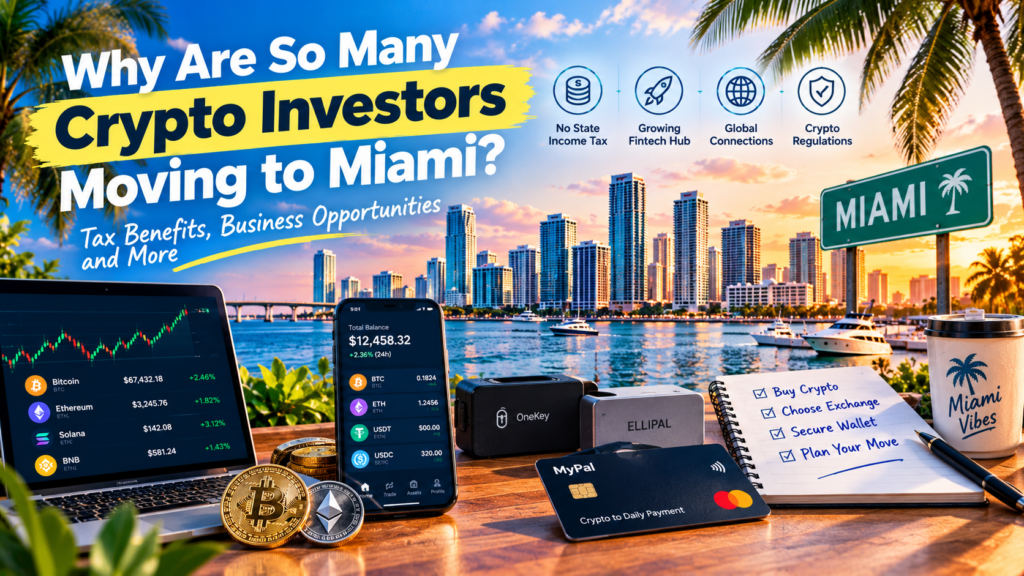
Miami has become one of the most talked-about destinations for cryptocurrency investors, blockchain entrepreneurs, and digital finance companies. Its sunny climate and waterfront lifestyle attract attention, but the city’s growing fintech ecosystem is also an important part of the story.
From Florida’s tax structure to international business connections, several factors help explain why Miami appeals to people working in crypto. However, the trend is more complicated than social media headlines suggest. Not every crypto investor is relocating, and moving to Miami does not guarantee better investment returns or lower overall costs.
In this guide, we explore why Miami attracts crypto investors, the opportunities available, and the financial and regulatory considerations worth understanding before making a move.
1. Florida Has No Personal State Income Tax
One of the most frequently cited reasons investors consider Florida is its personal income tax structure.
Florida does not impose a personal state income tax. For eligible residents, that can be an important consideration when comparing locations for work, business ownership, and investment activities.
For crypto investors, however, the distinction between state and federal taxes matters.
Does Miami eliminate crypto taxes?
No. US federal tax obligations can still apply to cryptocurrency transactions. Selling Bitcoin at a profit, exchanging one digital asset for another, or receiving taxable crypto income may create federal reporting or payment obligations.
Florida’s tax structure also does not automatically remove tax liabilities connected with another state, business entity, or country.
Investors considering relocation should review their residency status, federal obligations, and any applicable rules before making decisions based on tax savings.
For official guidance, consult the IRS digital assets resource.
2. Miami Is Developing a Fintech and Blockchain Ecosystem
Miami’s appeal extends beyond cryptocurrency trading. The city has connections to international finance, technology startups, venture capital, and cross-border payments.
A developed fintech ecosystem can offer crypto founders and investors access to potential business partners, financial technology companies, compliance professionals, and startup networks.
For entrepreneurs building crypto-related services, reliable payment infrastructure is another important consideration. Businesses handling international clients may need ways to manage payments across different currencies and digital assets.
Companies exploring these options can learn more about opening a Kolan account, which is presented for personal and business use cases involving USDT, USDC, EUR, USD, GBP, and AED. Before signing up, review the service’s availability, fees, supported transactions, and compliance requirements for your particular situation.
A strong business network can be valuable, but it does not guarantee that a startup will obtain funding or that a crypto project will succeed.
3. International Business Connections Make Miami Attractive
Miami has long-standing commercial and cultural connections with Latin America and other international markets. That position can be useful for companies developing payment services, digital wallets, remittance products, and blockchain-based financial infrastructure.
Cryptocurrency and stablecoins can be relevant to some cross-border business models because blockchain networks allow digital assets to move between compatible wallets.
However, crypto transfers are not automatically cheaper, faster, or safer than traditional payment methods. Users may encounter network charges, exchange spreads, compliance checks, delays, and currency-conversion costs.
For individuals who want to use digital assets for everyday spending, a crypto payment card may also be worth researching. The MyPal Crypto Card is one option to explore for crypto-to-daily-payment use cases.
Before choosing any card, check supported countries, currencies, conversion rates, spending fees, limits, and the terms governing access to your funds. Product availability and eligibility can vary.
Businesses exploring international crypto payments should assess the legal and operational requirements in every jurisdiction where they operate.
4. Crypto Conferences Help Build the Community
Miami’s event calendar has helped strengthen its visibility among people working in digital assets.
One example is Consensus Miami, which took place on May 5–7, 2026. The event brought together participants from crypto, digital finance, technology, and related industries.
Conferences can help founders meet investors, developers, service providers, and potential customers in person. They also provide opportunities to discuss regulation, tokenization, stablecoins, blockchain infrastructure, and institutional adoption.
For entrepreneurs, these relationships may be as important as the city’s tax environment.
Nevertheless, attending an event or participating in a local crypto community should not be confused with evidence that a particular investment is profitable.
5. Miami Offers Opportunities Beyond Buying Bitcoin
The city’s digital-asset ecosystem includes more than individual cryptocurrency investors.
Different types of businesses may explore Miami as a base for developing or expanding their operations.
Crypto and blockchain startups
Companies building wallets, custody services, blockchain analytics tools, trading infrastructure, and decentralized applications may benefit from proximity to other technology businesses.
Stablecoin and payment services
Businesses working on international transfers or digital payment infrastructure may find Miami’s international commercial connections relevant to their target markets.
For businesses that need to accept or manage multiple currencies, payment services can form part of the operational setup. Providers such as Kolan may be worth researching, depending on eligibility and business needs. Always assess fees, transaction limits, supported jurisdictions, and regulatory requirements before relying on a service.
Tokenization and digital securities
Tokenization involves representing certain assets or financial interests digitally on a blockchain. Depending on the structure, these products can involve securities laws and other financial regulations.
Investors should examine what legal rights a token actually provides rather than assuming that every token represents direct ownership of a physical or financial asset.
Crypto-related professional services
As digital-asset businesses grow, they may need legal advice, tax accounting, cybersecurity services, compliance support, and specialized technology development.
These opportunities contribute to the broader fintech ecosystem, although individual companies still face competition, operating costs, and regulatory requirements.
6. Is Miami More Crypto-Friendly Than Other US Cities?
Miami is frequently described as a crypto-friendly city, but the term can mean different things.
Some people use it to describe the local business community. Others mean tax considerations, access to industry events, or the availability of professional services.
It is more useful to compare specific factors than to assume one city is best for every investor.
| Factor | What to consider in Miami |
|---|---|
| State personal income tax | Florida does not impose a personal state income tax |
| Crypto business environment | Requirements depend on the services a company provides |
| Industry networking | Conferences and fintech businesses can create professional connections |
| International commerce | Cross-border business links may benefit certain companies |
| Cost of living | Housing, insurance, transportation, and other expenses affect the overall budget |
| Federal compliance | US federal tax and applicable financial regulations still matter |
| Investment protection | Crypto assets do not automatically receive bank-deposit insurance |
The right location depends on your circumstances. A remote investor who trades occasionally may have different priorities from a founder operating a regulated financial-services company.
7. The Cost of Living Can Offset Some Financial Advantages
Florida’s personal income tax structure may be attractive, but relocating involves more than comparing tax rates.
Miami’s housing expenses, insurance costs, transportation, healthcare, and lifestyle spending can affect how much money an individual ultimately saves.
The same applies to entrepreneurs. Office space, employee compensation, legal services, insurance, compliance, and customer acquisition can all influence the cost of running a crypto business.
Before relocating, prepare a realistic budget that includes housing, utilities, insurance, transportation, business services, tax preparation, and networking expenses.
Compare your current location with Miami using your actual income and expenses. A general claim about tax savings is not enough to establish that moving will improve your financial position.
8. Crypto Regulations Still Apply in Florida
Miami’s reputation as a technology and crypto hub does not mean digital-asset businesses operate without regulation.
Depending on their activities, businesses may need to comply with Florida financial-services laws, federal anti-money-laundering requirements, securities laws, consumer-protection rules, and tax obligations.
For example, a company transmitting virtual currency may face different licensing requirements from a software developer that does not handle customer funds.
Federal securities laws may also apply to certain digital assets and investment arrangements. The legal treatment depends on the specific asset, transaction, and business model.
Before investing through a platform or launching a crypto business, review the relevant regulatory requirements and verify the provider’s legal status.
Useful official resources include:
- Florida Department of Financial Services: Cryptocurrency
- FinCEN: Financial crime compliance guidance
- SEC Investor.gov: Crypto asset information
9. How Should Crypto Investors Protect Their Digital Assets?
A growing crypto ecosystem makes security and custody important considerations for both individual investors and business owners.
Cryptocurrency held on an exchange is generally managed under the provider’s custody arrangements. A self-custody wallet, by contrast, gives the owner more direct control over private keys and responsibility for protecting them.
Consider a hardware wallet for long-term storage
Hardware wallets can help users manage private keys separately from an internet-connected computer or phone. They do not eliminate all risks, but they may be useful for investors who want to hold assets outside an exchange.
Two options worth researching are:
- OneKey hardware wallets — explore available wallet models and check the terms for the offer of up to 5 USDT cashback.
- ELLIPAL hardware wallets — compare available models, supported cryptocurrencies, backup procedures, and security features.
Choose a wallet based on your needs rather than marketing claims. Check compatibility with your assets, recovery procedures, software updates, and the risks of self-custody before purchasing.
Never share your recovery phrase or private keys. A legitimate wallet provider should not need your recovery phrase to provide routine customer support.
Remember that security is a process
Use strong, unique passwords and multi-factor authentication where available. Verify wallet addresses and blockchain networks before sending funds, and be cautious of unsolicited investment offers.
No wallet or security product can guarantee that your cryptocurrency will be safe in every situation.
10. What Risks Should Crypto Investors Consider Before Moving?
Relocating to a city with an active fintech community does not remove the risks associated with cryptocurrency.
Market volatility
Bitcoin, Ethereum, and other digital assets can experience sharp price changes. Investors can lose a substantial portion of their capital, and some assets may become worthless.
Scams and misleading promotions
Crypto investors may encounter fake investment platforms, impersonation schemes, fraudulent token offerings, and promises of guaranteed returns.
Be cautious when someone pressures you to invest quickly or asks you to send funds to an unfamiliar wallet.
Exchange and custody risks
An exchange may restrict withdrawals, suffer a security incident, or become insolvent. Self-custody provides greater control over private keys but also places responsibility for backups and recovery on the wallet owner.
Tax and compliance mistakes
Poor recordkeeping can complicate tax reporting. Business owners may also face legal consequences if they fail to meet applicable licensing or compliance requirements.
The Florida Department of Financial Services provides consumer information about crypto risks, scams, and wallet security in its cryptocurrency guidance.
11. Should You Move to Miami for Crypto?
Miami may be worth considering if your plans involve building a fintech company, developing professional relationships in the digital-asset industry, or accessing international business networks.
But relocating solely because a city has a strong crypto reputation may be a poor decision.
Before making a move, ask yourself:
- Will Miami improve my career or business opportunities?
- How will my total living costs compare with my current location?
- Have I calculated my tax position with qualified professional advice?
- Does my business need any state or federal licenses?
- Can I build a sustainable professional network there?
- Am I moving for a realistic opportunity rather than a speculative investment trend?
For some investors, Miami may offer a useful combination of business connections and lifestyle. For others, their existing location may already meet their needs.
The decision should be based on personal finances, career goals, business requirements, and risk tolerance.
Frequently Asked Questions
Why are crypto investors moving to Miami?
Commonly cited reasons include Florida’s lack of personal state income tax, Miami’s fintech ecosystem, international business connections, and crypto industry events. These factors appeal to some investors and entrepreneurs, but they do not establish that every investor is relocating.
Does Miami have a cryptocurrency tax?
Miami does not impose a city personal income tax. Florida also has no personal state income tax. However, federal tax rules can apply to crypto gains and income, and other obligations may depend on the investor’s circumstances.
Is Miami a good place to start a crypto company?
Miami may offer networking opportunities, access to fintech businesses, and connections to international markets. Whether it is suitable depends on operating costs, customer demand, licensing, banking access, and the company’s business model.
Can crypto businesses operate without a license in Miami?
Not necessarily. Certain activities may trigger Florida licensing or registration requirements and applicable federal obligations. Requirements depend on the services offered and the legal structure of the business.
Should I use a hardware wallet?
A hardware wallet may be useful for managing private keys outside an exchange, especially for longer-term holdings. Research the device, supported assets, recovery procedures, and security practices before buying one.
Can I use crypto for everyday payments?
Some services and cards are designed to connect crypto holdings with everyday spending. Availability, supported assets, fees, exchange rates, and eligibility differ by provider, so read the terms carefully before signing up.
Does moving to Miami make cryptocurrency investments safer?
No. A relocation does not eliminate market volatility, fraud, exchange failure, custody risks, or tax obligations. Investors should evaluate each asset and service provider independently.
Conclusion: Why Miami Continues to Attract Crypto Investors
Miami’s appeal comes from a combination of factors rather than a single crypto policy. Florida’s personal income tax structure, the region’s fintech activity, international business connections, and industry events have all contributed to the city’s visibility among digital-asset professionals.
For founders and investors who value networking and cross-border business opportunities, Miami may offer practical advantages. At the same time, living costs, federal taxes, regulatory obligations, and cryptocurrency risks remain important considerations.
Whether you are building a crypto business, exploring payment services, or securing your digital assets, research providers carefully and compare their costs and terms before making a commitment.
The key question is not simply whether crypto investors are moving to Miami. It is whether Miami fits your financial situation, business strategy, and long-term goals.
Affiliate disclosure: This article contains affiliate links. The publisher may receive a commission or the reader may receive a promotional benefit when certain links are used. This does not change the price unless the provider’s terms state otherwise. Please review each provider’s terms before signing up or purchasing a product.
Disclaimer: This article is for educational purposes only and does not constitute financial, tax, investment, or legal advice. Consult qualified professionals before making relocation, investment, or business decisions.
Leave a Reply