Can the IRS See Your Crypto in a Cold Wallet? A Mountain View Guide
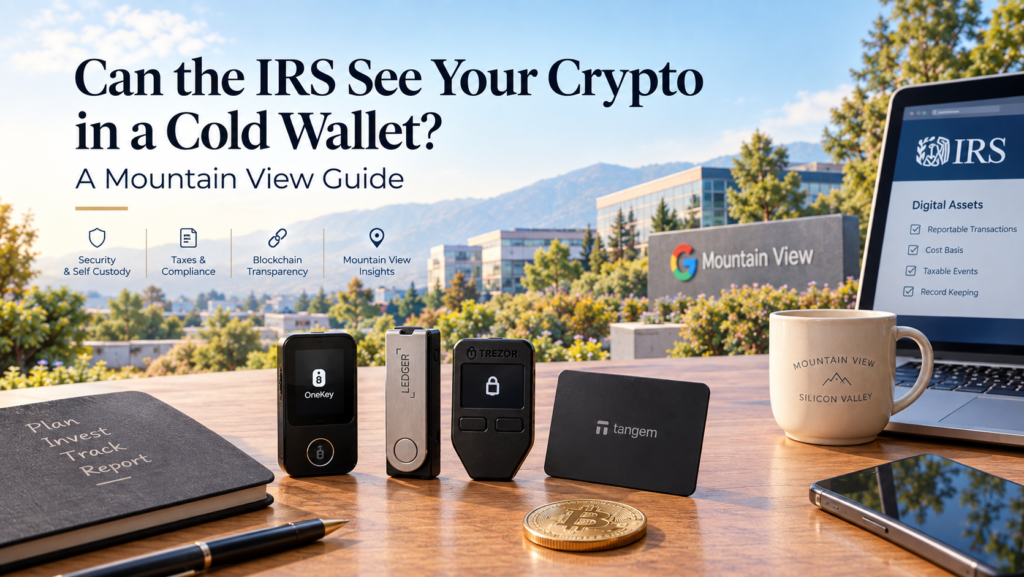
A cold wallet can keep your private keys away from exchanges, browsers, and internet connected devices. However, that does not mean your cryptocurrency becomes invisible to the IRS.
For crypto investors and Web3 developers in Mountain View, this distinction matters.
A hardware wallet can provide stronger control over private keys. It can also reduce exposure to certain online threats. Yet blockchain transactions remain recorded on public networks, and tax reporting depends on what you do with your digital assets rather than simply where you store them.
That means moving Bitcoin, Ethereum, XRP, stablecoins, or another digital asset from an exchange into a cold wallet does not automatically create a tax event. It also does not remove your responsibility to report taxable activity.
Mountain View sits in the heart of Silicon Valley, where technology professionals, startup teams, investors, and developers regularly work with digital assets and financial technology. Around Downtown Mountain View, Castro Street, North Bayshore, and the Shoreline area, users may have very different reasons for holding cryptocurrency.
Some may hold crypto as a long term investment. Others may use digital assets for Web3 applications, business payments, or decentralized finance.
Regardless of the use case, the basic tax principle remains important.
A cold wallet is a security tool.
It is not a tax hiding tool.
Can the IRS See Crypto in a Cold Wallet?
The short answer requires an important distinction.
The IRS does not need direct access to your hardware wallet to understand that blockchain activity occurred.
A cold wallet stores or controls the private keys needed to authorize transactions. The blockchain itself records transactions on a public ledger.
For example, imagine you purchase Bitcoin through a centralized exchange and later transfer it to your own hardware wallet.
The exchange may have records showing the purchase and withdrawal. The blockchain records the transfer to the destination address. Your hardware wallet controls the private keys associated with that address.
The cold wallet does not erase the previous exchange records.
It also does not make the blockchain transaction private.
Instead, it changes who controls the private keys.
This is an important difference between privacy and self custody.
What Does a Cold Wallet Actually Hide?
A hardware wallet primarily protects private keys.
It does not hide blockchain addresses or transactions from public blockchains.
When you send cryptocurrency from a cold wallet, the transaction is normally broadcast to the relevant blockchain network. Anyone who can inspect that blockchain may be able to see the transaction details available on that network.
What may not be immediately obvious is the real world identity behind the address.
This is where blockchain privacy becomes more complicated.
An address may not display your name directly. However, an address can sometimes be connected to a known exchange account, payment service, business, or other identifiable activity.
Once an address is linked to a person or organization, other related transactions may become easier to analyze.
Therefore, pseudonymous does not mean completely anonymous.
Does Moving Crypto to a Cold Wallet Create a Taxable Event?
Generally, moving your own digital assets from one wallet or account that you control to another wallet or account that you also control is not itself a taxable event under current IRS guidance.
This distinction is especially useful for someone moving assets from an exchange to a hardware wallet.
Suppose you buy Ethereum on an exchange and later move it to your OneKey device.
The transfer itself does not automatically mean you sold the Ethereum.
However, transaction fees can create a separate tax consideration when digital assets are used to pay those fees.
The IRS specifically addresses transfers between wallets, accounts, or addresses controlled by the same person. The agency states that such transfers generally do not create gain or loss, except for digital assets used or withheld to pay transaction services.
This means investors should keep records of the original purchase and the later transfer.
The cold wallet does not reset your cost basis.
It also does not reset your holding period.
Why Your Cost Basis Still Matters
Cost basis is one of the most important pieces of information when you later sell or dispose of digital assets.
Imagine a Mountain View investor buys Bitcoin for $40,000.
The investor later transfers that Bitcoin to a cold wallet.
The Bitcoin then rises in value.
Moving the Bitcoin into cold storage does not turn the original purchase into a new acquisition.
The investor still needs records showing when the asset was acquired, the acquisition value, and relevant transaction information.
If the investor eventually sells the Bitcoin, those records can help determine the resulting gain or loss.
This is one reason crypto investors should not treat a cold wallet as a replacement for tax records.
The hardware wallet protects access.
It does not maintain a complete accounting system for every acquisition, sale, exchange, fee, or income event.
Can the IRS Track a Blockchain Address?
Public blockchain networks can provide significant transaction information.
Depending on the blockchain, observers may see wallet addresses, transaction amounts, timestamps, destination addresses, and other information.
The difficult part is connecting an address to a real person.
That connection can happen through several sources.
A centralized exchange may know the identity linked to an account.
Payment providers may also keep customer information.
Users sometimes share wallet addresses publicly.
Businesses may publish wallet addresses for payments.
Blockchain analytics companies can also identify patterns that connect addresses and transactions.
Payment providers may also keep customer information.
Users sometimes share wallet addresses publicly.
Businesses may publish wallet addresses for payments.
Blockchain analytics companies can also identify patterns that connect addresses and transactions.
Therefore, moving funds into self custody does not necessarily remove the trail created by earlier activity.
It simply changes the custody arrangement.
Exchange Records and Cold Wallet Records Are Different
This distinction becomes easier to understand through an example.
Imagine a user in Mountain View purchases $25,000 of Bitcoin through a regulated exchange.
An exchange can keep records linked to the user’s account.
After that, the user transfers Bitcoin to a hardware wallet.
On the blockchain, the transfer appears as a recorded transaction.
The exchange also records the withdrawal.
Once the transfer reaches the hardware wallet, the user controls the private keys.
Later, the user sends part of the Bitcoin to another platform and sells it for U.S. dollars.
The cold wallet does not make that sale disappear.
The taxable transaction still needs to be considered under applicable federal tax rules.
This is why self custody and tax compliance should be treated as separate issues.
What Transactions Can Create Tax Consequences?
Storage itself is not the main tax question.
The important question is what happened to the digital asset.
Depending on the circumstances, tax consequences can arise from activities such as selling cryptocurrency for U.S. dollars, exchanging one digital asset for another, using digital assets to purchase goods or services, receiving crypto as payment, and receiving certain rewards or other digital asset income.
Mining and staking can also create tax considerations.
The exact treatment depends on the nature of the transaction and the taxpayer’s circumstances.
For that reason, users should not assume that a transaction is taxable or nontaxable simply because it happened through a cold wallet.
The wallet is the custody mechanism.
The transaction is what needs to be evaluated.
What About Crypto to Crypto Swaps?
Crypto users sometimes assume that taxes only apply when they convert cryptocurrency into U.S. dollars.
That assumption can be dangerous.
A swap between two digital assets can also create a taxable event under U.S. federal tax rules.
For example, suppose a user exchanges Ethereum for another cryptocurrency.
The fact that the user never received dollars does not automatically mean there was no reportable transaction.
The user may need to determine the value of the assets involved and calculate the resulting gain or loss.
A cold wallet does not change this treatment.
The transaction still occurs on the relevant blockchain.
What About Moving Crypto Between Your Own Wallets?
This is where cold storage can be misunderstood.
Suppose you have one hardware wallet in your home office and another hardware wallet stored in a secure location.
You transfer Bitcoin between the two wallets.
If both wallets belong to you, the transfer itself is generally not a taxable event.
The IRS specifically states that transfers between wallets, accounts, or addresses belonging to the same taxpayer are generally not taxable, subject to the treatment of digital assets used to pay transaction fees.
However, you should still keep records.
A future tax review may require you to explain where an asset came from and how its cost basis was established.
A clear transaction history makes that process easier.
Does Self Custody Increase Privacy?
Self custody can improve control over your assets, but privacy is a separate concept.
An exchange account usually connects transactions with customer information because the platform has account records.
A self custody wallet does not normally require the same type of account relationship.
However, the blockchain remains visible.
This creates a middle ground.
Self custody can reduce dependence on a third party.
It does not automatically create financial anonymity.
For Mountain View users who work in technology, this distinction may be familiar from other areas of cybersecurity.
Removing one centralized point of control does not make every piece of information private.
Instead, it changes where information is stored and who controls it.
Why Blockchain Privacy Can Be Complicated
Blockchain addresses can generate long transaction histories.
One address may interact with exchanges, decentralized applications, bridges, payment services, and other wallets.
Over time, these interactions can create patterns.
A person may also accidentally connect their identity to an address through a public transaction, business website, social media account, or exchange withdrawal.
That means users should be careful when discussing privacy.
A cold wallet can help protect private keys.
It does not guarantee anonymity.
Users should also avoid assuming that a new wallet address automatically means a completely separate identity.
The relationship between addresses and transactions can become complicated depending on the blockchain and the services involved.
What Does the IRS Digital Asset Question Mean?
U.S. taxpayers encounter a digital asset question on certain federal tax returns.
The question asks whether the taxpayer received a digital asset as a reward, award, or payment for property or services, or sold, exchanged, or otherwise disposed of a digital asset or financial interest in a digital asset during the tax year.
This means taxpayers should pay attention to their actual activity.
Simply owning digital assets is different from selling or disposing of them.
Current IRS guidance also indicates that taxpayers who only held digital assets in a wallet or account without engaging in digital asset transactions can have different reporting treatment from taxpayers who sold, exchanged, or received digital assets through taxable activities.
That distinction makes accurate record keeping important.
What Is Form 1099 DA?
The IRS has also introduced new digital asset reporting requirements for certain brokers.
Form 1099 DA is designed to report certain digital asset transactions.
Broker reporting requirements apply to covered transactions and do not mean that every crypto activity will automatically appear on a Form 1099 DA.
This is another reason taxpayers should not rely entirely on tax forms received from an exchange.
You remain responsible for reporting taxable transactions even if you do not receive an information statement.
A cold wallet can also create situations where the taxpayer needs to maintain their own records because a self custody transaction may not be accompanied by a traditional broker tax form.
What Records Should Crypto Investors Keep?
Good records can make crypto tax reporting much easier.
For each relevant transaction, users should consider keeping information such as the date and time, asset involved, amount, value at the time of the transaction, transaction fees, wallet address, transaction hash, and the purpose of the transaction.
Purchase records are also important.
Keep documentation showing when the asset was acquired and what you paid.
If the asset later moves into cold storage, record the transfer.
If it moves to another wallet, record that transfer too.
When the asset is eventually sold or exchanged, the historical records can help establish the correct tax position.
The IRS states that taxpayers need records sufficient to establish the positions taken on their federal tax returns.
How Should Mountain View Crypto Investors Handle Cold Storage?
A practical approach starts with separating security from tax compliance.
Use the cold wallet to protect private keys.
Use a separate record keeping system to track transactions.
Keep your recovery phrase out of your tax spreadsheet.
Cloud storage should never contain your recovery phrase.
Use a secure method instead of ordinary messaging when sharing tax information with your accountant.
The recovery phrase is a security credential, not a tax document.
Instead, keep tax records separate from wallet credentials.
This creates a cleaner security boundary.
An accountant may need transaction records.
They should not need your private keys or recovery phrase.
Cold Storage and Developer Security in Mountain View
The local technology environment makes this separation particularly useful.
A developer working near North Bayshore may use multiple computers, cloud platforms, browser extensions, repositories, and development environments.
Those systems can create security risks for hot wallets.
A hardware wallet can reduce some of that exposure by keeping the private key outside the normal computing environment.
Your computer can prepare a transaction.
Next, the hardware wallet can display and sign it.
After signing, the blockchain can process the transaction.
Throughout this process, the browser does not need access to the private key.
However, this security model does not remove the need for careful transaction review.
A malicious application can still request an unwanted transaction.
A user can still approve it.
Therefore, hardware security and transaction awareness need to work together.
OneKey for Self Custody
For users who want to separate long term holdings from exchange custody, OneKey is one hardware wallet option to consider.
OneKey offers models such as Classic 1S and Pro, along with KeyTag Titanium for physical backup.
The company also highlights open source development, Secure Element EAL6 plus protection, anti tamper technology, and clear signing.
Clear signing can be especially relevant for users who interact with Web3 applications because transaction details can be reviewed through the hardware device before approval.
For a Mountain View developer, this can provide a useful separation between the development computer and the private key.
However, a hardware wallet should still be viewed as one part of a broader security system.
Your recovery phrase remains critical.
Purchase the device through an official channel.
Download the software from the official source.
And every important transaction should be reviewed before approval.
OneKey Free Delivery for U.S. Orders
For users in Mountain View, there is also a current purchasing benefit worth highlighting.
Under the current offer, OneKey orders over US$99 in the United States receive free delivery.
The promotion also includes up to 5 USDT cashback.
For someone comparing the total cost of a hardware wallet, this can make a difference because shipping costs can change the final purchase price.
The security decision should still come first.
However, when two products meet similar requirements, delivery benefits and cashback can be useful factors to consider.
Mypal for Spending From Self Custody
Cold storage is useful for long term holdings, but not every crypto transaction needs to involve an exchange.
Mypal can provide a spending route for supported self custody assets such as USDT and USDC.
Users can top up from supported assets and use payment methods such as Apple Pay or Google Pay where supported.
This can help separate long term storage from everyday spending.
A Mountain View investor could keep a larger reserve in cold storage while maintaining a smaller operational balance for spending.
Invite Code: 27090432
KITE for Web3 Expenses
Web3 developers have a different spending requirement.
They may need to pay for cloud services, development tools, API access, server infrastructure, and other digital expenses.
KITE provides a borderless spending option with a virtual card for eligible expenses.
This can help a developer separate long term crypto custody from operational spending.
The cold wallet remains focused on asset protection while the spending setup handles routine expenses.
Referral Code: OKLL5B
Three Practical Strategies for Mountain View Users
Long Term Investor
A long term investor can use cold storage for assets that are not intended for frequent transactions.
The main priorities should be private key security, recovery planning, transaction records, and tax documentation.
Active Web3 User
An active Web3 user needs to think about both security and transaction history.
Clear signing, separate wallets, careful application permissions, and accurate records can reduce confusion.
Business or Developer
A business or developer may need stronger separation between personal assets, company assets, operational funds, and long term holdings.
Documented procedures can also make tax preparation easier.
For larger OneKey purchases, wholesale orders start at 25 units, which can be relevant for teams, communities, and organizations.
Five Steps to Keep Crypto Secure and Tax Ready
1. Keep Private Keys Offline
Use a hardware wallet when appropriate for long term self custody.
Keep private keys away from ordinary computers and cloud services.
2. Keep the Recovery Phrase Offline
Avoid taking photos of your recovery phrase.
Keep it out of Google Drive.
Do not share it through email or messaging applications.
A physical backup can be considered for long term protection.
3. Record Every Relevant Transaction
Save transaction hashes, dates, amounts, wallet addresses, acquisition information, and fees.
Do this when the transaction happens instead of trying to reconstruct everything later.
4. Separate Tax Records From Security Credentials
Your accountant may need transaction information.
They should not need your recovery phrase.
Keep these two categories completely separate.
5. Review Transactions Before Signing
Cold storage protects the private key.
It does not decide whether a transaction is legitimate.
Always review the destination, amount, permissions, and other relevant details before confirming.
Common Misunderstandings About the IRS and Cold Wallets
“The IRS cannot see my crypto because it is on a hardware wallet.”
A hardware wallet does not make blockchain transactions invisible.
“Moving crypto to cold storage creates a tax bill.”
A transfer between wallets you own and control is generally not itself taxable under current IRS guidance.
“If I never receive dollars, there is no taxable transaction.”
A crypto to crypto exchange can still have tax consequences.
“The exchange will calculate everything for me.”
Exchange records can help, but taxpayers remain responsible for accurate reporting.
“A new wallet address means I am anonymous.”
A new address does not guarantee anonymity.
Blockchain activity can sometimes be connected through transaction history and other records.
FAQ: IRS, Crypto, and Cold Wallets
Can the IRS see my cold wallet?
The IRS does not need direct access to your hardware wallet to analyze reportable crypto activity. Blockchain transactions can remain visible, while exchanges and other service providers may maintain records connected to your identity.
Does a cold wallet make crypto private?
A cold wallet protects private keys, but it does not automatically make blockchain activity anonymous.
Is transferring crypto from an exchange to my cold wallet taxable?
Generally, transferring digital assets between accounts, wallets, or addresses that you own and control is not a taxable event. However, transaction fees paid with digital assets can have separate tax consequences.
Do I have to report crypto if I did not receive a 1099 DA?
Yes. The absence of a Form 1099 DA does not automatically remove your reporting responsibility for taxable digital asset transactions.
Do I have to report crypto that I only hold?
Simply holding digital assets without a reportable transaction is different from selling, exchanging, or receiving taxable digital asset income. Taxpayers should review the current IRS digital asset question and applicable instructions for their circumstances.
Can I move crypto between two cold wallets?
Yes. Moving digital assets between wallets you own and control is generally not itself taxable under current IRS guidance. Keep records of the transfer so your transaction history remains clear.
Should my accountant receive my recovery phrase?
No.
An accountant may need transaction records for tax preparation. A recovery phrase is a security credential and should remain under your control.
Cold Storage Does Not Mean Tax Invisible
The most important point for crypto users in Mountain View is simple.
A cold wallet can protect your private keys.
It can reduce exposure to certain online attacks.
It can give you greater control over your digital assets.
But it does not erase blockchain records or remove federal tax responsibilities.
The IRS focuses on digital asset transactions and income rather than simply asking where the private keys are stored.
Investors should keep accurate records when buying, selling, exchanging, receiving, or transferring digital assets.
Web3 developers should separate wallet security from tax documentation.
Businesses should establish clear custody and accounting procedures.
Self custody and tax compliance can work together.
You can control your private keys while still maintaining the records needed to report taxable activity correctly.
The strongest setup is therefore not one that tries to hide crypto.
It is one that protects the assets, protects the recovery credentials, tracks transactions accurately, and keeps the tax records organized.
For Mountain View crypto users considering a hardware wallet, OneKey is one option that combines hardware based self custody with clear signing and physical backup options.
For U.S. orders over US$99, the current offer includes free delivery, along with up to 5 USDT cashback.
For supported self custody spending:
For eligible Web3 infrastructure expenses:
The principle is straightforward.
Protect the private key.
Track the transaction.
Keep the records.
And remember that moving crypto into a cold wallet changes custody, not the tax rules that apply to your transactions.
Leave a Reply