How Do I Know If a Canadian Crypto Exchange Is Regulated?
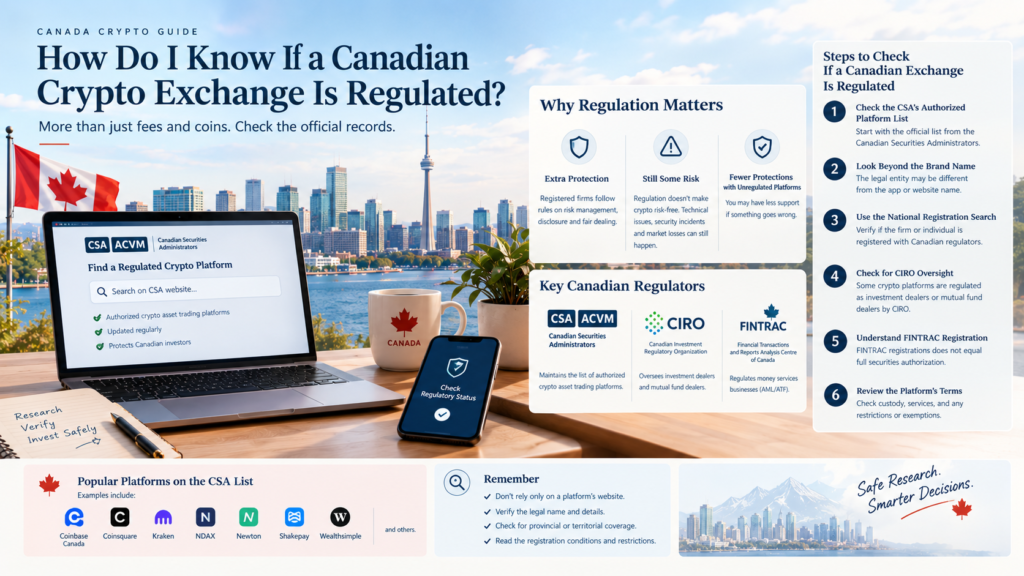
Choosing a crypto exchange in Canada involves more than comparing fees and supported coins.
You also need to know whether the platform is authorized to serve Canadian clients.
This matters because Canadian crypto regulation has become more structured. The Canadian Securities Administrators (CSA) maintains a list of crypto asset trading platforms that are authorized to do business with Canadians.
So, how do you know if a Canadian crypto exchange is regulated?
The safest approach is simple. Check the platform against official Canadian regulatory records before depositing your money.
Why Regulation Matters in Canada
Crypto regulation can give investors an extra layer of protection.
Registered firms must follow certain requirements around risk management, disclosure, and fair dealing. However, regulation does not make crypto risk-free.
This distinction is important.
A regulated exchange can still experience technical problems, security incidents, or market losses.
However, an unregulated platform may leave you with fewer protections if something goes wrong.
Therefore, checking regulatory status should be one of your first steps before opening an account.
Check the CSA’s Authorized Platform List
The Canadian Securities Administrators provides an official list of crypto platforms authorized to do business with Canadians.
This should be your starting point.
The list includes platforms such as Coinbase Canada, Coinsquare, Kraken, NDAX, Newton, Shakepay, Wealthsimple, and others. The CSA updates the list as regulatory decisions change.
Do not rely only on a platform’s website.
A company may describe itself as compliant or regulated without giving you the full picture.
Instead, search for the company on the official CSA website.
Make sure the legal entity name matches the platform you plan to use.
Look Beyond the Exchange’s Brand Name
A crypto platform can operate under a different legal entity.
For example, the name shown in an app may not match the registered company name.
This matters when you check regulatory records.
Look for information such as:
- Legal company name
- Regulatory status
- Province or territory covered
- Type of authorization
- Registration conditions
- Any restrictions or exemptions
The CSA list shows that some platforms have specific terms or geographic limitations.
Therefore, do not stop after finding a familiar brand name.
Check the details as well.
Check the National Registration Search
The CSA also provides the National Registration Search.
This tool helps Canadians check whether a firm or individual is registered with Canadian securities regulators.
This can be useful when an exchange uses a less familiar legal entity.
Search the company name carefully.
Then compare the result with the information shown on the exchange’s website.
If the names do not match, investigate further before depositing funds.
What Does CIRO Have to Do With Crypto?
The Canadian Investment Regulatory Organization, or CIRO, also plays a role in Canada’s financial regulatory system.
CIRO oversees investment dealers and mutual fund dealers across Canada. Some crypto platforms operate through entities that fall under CIRO oversight.
For example, CIRO’s dealer information includes crypto-related firms such as Coinsquare Capital Markets, NDAX Canada, Shakepay, Newton, and Webull Canada Crypto.
However, do not assume that every crypto platform needs the exact same type of registration.
The regulatory category depends on the services and structure of the business.
Therefore, check the specific platform rather than relying on a general label.
What About FINTRAC Registration?
You may also see crypto platforms mention FINTRAC.
FINTRAC regulates money services businesses under Canada’s anti-money laundering and terrorist financing framework.
However, FINTRAC registration alone does not mean that an exchange has full securities regulatory authorization.
This is an important distinction.
A platform can have obligations under Canada’s anti-money laundering framework without having the same status as a registered crypto asset trading platform.
Therefore, do not treat a FINTRAC registration number as the only proof that an exchange is regulated.
Check the relevant securities regulator as well.
What Is an Unregulated Crypto Exchange?
An unregulated exchange may operate without the authorization required to serve Canadian clients.
Some platforms may still appear professional.
They may have a polished website, many cryptocurrencies, and attractive trading fees.
However, those features do not prove regulatory status.
Some platforms may also use terms such as “licensed,” “compliant,” or “registered” without clearly explaining what those terms mean.
Therefore, verify the claim independently.
If you cannot confirm the platform’s status through an official Canadian regulatory source, be cautious.
Watch for Regulatory Restrictions
Finding a platform on a regulatory list is only the first step.
You should also check its current conditions.
Some platforms have specific provincial or territorial restrictions.
Others may operate under specific terms while their full registration process continues.
The CSA’s current list shows that regulatory decisions can include amendments, conditions, and geographic limitations.
This means you should check the latest information before opening an account.
Do not rely on an old article or social media post.
What Is a Pre-Registration Undertaking?
You may also encounter the term “pre-registration undertaking.”
Some crypto asset trading platforms have used these undertakings while regulators review their registration applications.
However, a pre-registration undertaking does not mean that the platform has received full registration.
The CSA specifically warns investors about this distinction.
Therefore, read the regulator’s description carefully.
Do not treat an undertaking as the same thing as full authorization.
How Can You Spot a Suspicious Crypto Exchange?
Regulatory status is not the only warning sign.
You should also watch for unusual promises.
Be cautious if an exchange:
- Guarantees high returns
- Pressures you to deposit quickly
- Promises risk-free trading
- Offers unusually high rewards
- Makes withdrawals difficult
- Asks you to pay unexpected fees before releasing funds
- Uses unclear company information
- Cannot explain its Canadian regulatory status
A legitimate-looking website does not guarantee that a platform is safe.
Therefore, verify the company before sending crypto or Canadian dollars.
Should Canadian Investors Use a Regulated Exchange?
For many Canadian investors, using a platform with verified regulatory status can provide an additional layer of protection.
It can also make it easier to understand which rules apply to the service.
However, regulation does not guarantee profits.
It does not protect you from market volatility.
It also does not mean every crypto asset available on the platform is safe.
The CSA reminds Canadians that crypto assets remain risky and that regulatory oversight cannot eliminate all investment risks.
Therefore, regulation should be one part of your decision.
You should also review security, custody, fees, withdrawals, and supported assets.
Check the Exchange Before You Deposit
Before sending money to a Canadian crypto exchange, take a few minutes to verify the platform.
First, find the legal company name.
Next, check the CSA’s authorized platform list.
Then, review the National Registration Search when relevant.
After that, check whether the platform has provincial or territorial restrictions.
Finally, read the platform’s custody and withdrawal terms.
This process may seem slow.
However, it can help you avoid a much bigger problem later.
What About Self-Custody?
Even when you use a regulated exchange, you do not have to keep all your crypto there.
Some Canadian investors use exchanges for trading and self-custody wallets for long-term holdings.
This approach can reduce dependence on one platform.
However, self-custody comes with its own risks.
You control the private keys, so you also control the responsibility for protecting them.
If you lose your recovery phrase, you may lose access to your assets.
Therefore, learn how self-custody works before moving significant funds.
A Hardware Wallet Can Add Another Layer of Control
If you decide to hold long-term crypto outside an exchange, a hardware wallet can be an option.
It keeps private keys separate from many everyday online activities.
However, buying a hardware wallet does not remove every security risk.
You still need to protect your recovery phrase.
You should also buy hardware wallets from trusted sources and check the package when it arrives.
🇨🇦 OneKey Shipping Offer for Canadian Buyers
If you are in Canada and considering a hardware wallet, OneKey currently offers free standard shipping on eligible orders of US$89 or more in regions that are not subject to its listed shipping exceptions.
However, OneKey’s current shipping policy lists selected Canadian areas with a fixed US$28 shipping fee. Therefore, Canadian buyers should check the shipping charge shown at checkout for their delivery location before ordering.
That makes it worth checking your eligibility before you place an order.
Canadian Crypto Regulation Is Still Evolving
Canada’s crypto regulatory framework continues to develop.
The CSA regularly updates its information about authorized crypto platforms and regulatory decisions.
The current list includes multiple platforms with decisions or amendments made during 2026. For example, the CSA lists updated decisions for Netcoins, Newton, Satstreet, Webull Canada Crypto, and other platforms.
Therefore, always check the latest regulatory information.
A platform that was available last year may have different conditions today.
Likewise, a company that was previously unregistered may later receive authorization.
A Simple Checklist for Canadian Crypto Investors
Before using a crypto exchange in Canada, check these points:
1. Find the legal company name.
Do not rely only on the brand name.
2. Search the CSA’s authorized platform list.
Confirm that the platform can legally serve Canadian clients.
3. Check the National Registration Search.
Use it when you need to verify a firm’s registration details.
4. Review provincial restrictions.
Make sure the authorization applies to your location.
5. Check the platform’s terms.
Look at custody, withdrawals, fees, and supported assets.
6. Check for warning signs.
Avoid platforms that promise guaranteed returns or pressure you to deposit.
7. Consider self-custody for long-term holdings.
A personal wallet can give you more control over your private keys.
8. Keep your security information private.
Never share your recovery phrase with anyone.
Final Thoughts
So, how do you know if a Canadian crypto exchange is regulated?
Start with the official sources.
Check the exchange on the CSA’s list of platforms authorized to do business with Canadians. Then verify the legal entity and review any conditions or restrictions.
You can also use the National Registration Search when you need more information about a firm’s registration.
Most importantly, do not confuse a professional-looking website with regulatory approval.
For Canadian crypto investors, regulation can provide an additional layer of protection. However, it does not remove market risk, custody risk, or security risk.
Therefore, take time to verify the platform before depositing your money.
And if you plan to move long-term holdings into self-custody, consider a secure hardware wallet and check OneKey’s current shipping terms for your Canadian delivery area.
💸 GET PAID GLOBALLY WITH KOLAN
USD, GBP, EUR & AED accounts
Sign up: https://forms.gle/QVri289ukKMFR6Qn8

🔐 SECURE YOUR CRYPTO WITH ONEKEY OR ELLIPAL
Free delivery over US$99 + up to 5 USDT cashback
OneKey: https://onekey.so/r/TRC
Ellipal: https://www.ellipal.com/?rfsn=9305287.28d2ea6

🌍 GO GLOBAL WITH MYPAL
https://h5.mypal.pro/pm/vhcn?code=27090432

🔗 CONNECT WITH CRYPTOMARTSITE
https://msha.ke/cryptomart.site

Leave a Reply