What Happens to My Crypto If an Exchange Goes Bankrupt?
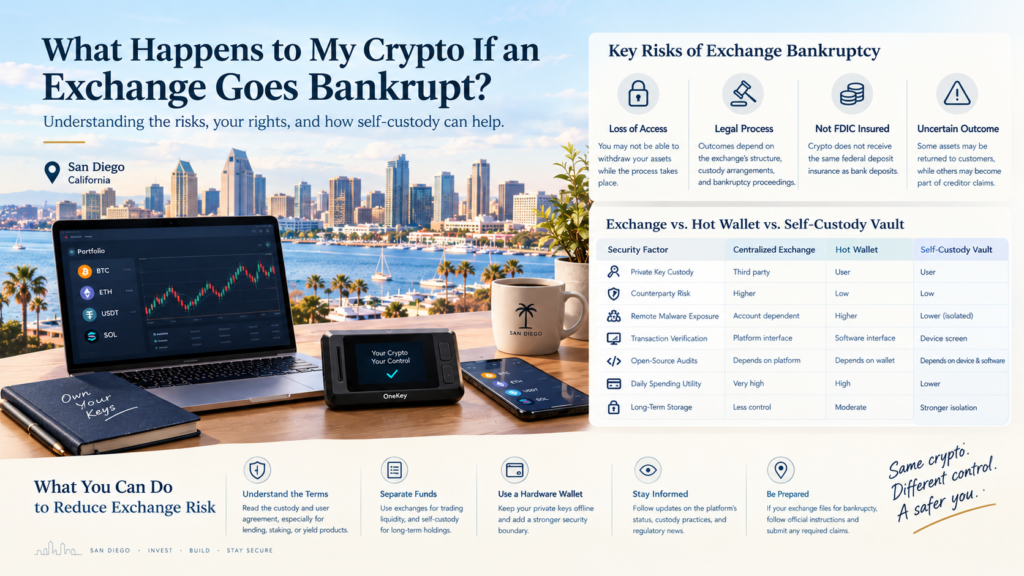
For crypto investors in San Diego, keeping assets on an exchange can make trading simple. However, it also creates a risk that many investors overlook.
What happens if the exchange cannot pay its debts?
Your crypto may not disappear immediately. However, you could lose access to your assets while the bankruptcy process takes place.
The outcome depends on the exchange’s legal structure, custody arrangements, user agreement, and bankruptcy proceedings.
Therefore, investors should understand these risks before leaving large amounts of crypto on an exchange.
Why Exchange Bankruptcy Matters
When you hold crypto on an exchange, you may not control the private keys.
The exchange usually manages the wallets that hold customer assets. You access your balance through your account.
This setup can make trading convenient.
However, it also creates counterparty risk.
If the exchange fails, you may need to wait for the company, courts, or bankruptcy administrator to determine how customer assets will be handled.
That process can take time.
You may also face restrictions on withdrawals while the company resolves its financial problems.
Does Bankruptcy Mean You Lose Your Crypto?
Not necessarily.
Bankruptcy does not automatically mean that every customer loses all their crypto.
The result depends on how the exchange held customer assets and how the bankruptcy case treats those assets.
Some assets may remain available to customers. Other assets may become part of a dispute over ownership or creditor claims.
Therefore, you should not assume that your exchange balance has the same legal protection as money in a bank account.
Crypto does not receive the same federal deposit insurance that protects eligible bank deposits.
What Happens When an Exchange Files for Bankruptcy?
An exchange may restrict withdrawals before or after filing for bankruptcy.
The company may also stop normal operations.
At that point, customers may need to follow instructions from the bankruptcy process.
The court may appoint a trustee or other administrator to manage the company’s assets and claims.
Customers may then need to submit information or claims to recover their assets.
The exact process depends on the bankruptcy case.
For that reason, two failed crypto exchanges can produce very different outcomes.
Customer Crypto vs Company Assets
One of the most important questions involves ownership.
Did the exchange hold customer crypto separately from its own corporate assets?
Or did the company use customer assets in ways that create additional risk?
The answer can affect what happens during bankruptcy.
Clear custody records can help establish which assets belong to customers.
However, complicated arrangements can create disputes.
This is one reason investors should read an exchange’s custody terms before transferring a large amount of crypto.
Why the Exchange Terms Matter
Many users accept an exchange’s terms without reading them.
That can become a problem during bankruptcy.
The terms may explain how the platform holds customer assets. They may also describe lending, staking, rehypothecation, or other services.
These details matter.
For example, an exchange may offer yield products that involve additional risks.
A simple trading account and a crypto lending product may not have the same legal treatment.
Therefore, read the custody and user agreement before using advanced services.
What Happens to Bitcoin on an Exchange?
Bitcoin held through an exchange does not work like Bitcoin held in a personal wallet.
With a personal wallet, you control the private keys.
With an exchange account, the platform controls the underlying wallet infrastructure.
Your account shows a balance, but you may not personally control the keys behind that balance.
If the exchange remains operational, this arrangement can feel invisible.
However, bankruptcy can expose the difference.
You may have to wait for the platform or bankruptcy process to determine how you can access the assets.
What About Stablecoins and Other Crypto?
The same basic risk can apply to other digital assets.
Bitcoin, Ether, stablecoins, and other tokens can all face access or custody issues when an exchange fails.
However, the legal and operational treatment can differ between assets.
The exchange may also have different arrangements for different products.
Therefore, do not assume that every asset in your account receives identical treatment.
Check the platform’s current terms and custody information.
Why Self-Custody Can Reduce Exchange Risk
Self-custody changes the relationship between you and the crypto network.
When you control the private keys, you do not depend on an exchange to provide access to your assets.
That can reduce counterparty risk.
However, self-custody creates another responsibility.
You become responsible for protecting your private keys and recovery phrase.
If you lose the recovery phrase, you may lose access to your crypto.
If someone obtains it, they may control your funds.
Therefore, self-custody does not remove risk.
It changes the type of risk you manage.
Should San Diego Investors Move Everything to a Wallet?
Not necessarily.
An exchange can still make sense for active trading.
You may need quick access to trading pairs, liquidity, and other exchange services.
A personal wallet may make more sense for long-term holdings.
Because of this, some investors use both options.
For example, you could keep a limited trading balance on an exchange. You could then move long-term holdings to a hardware wallet.
This approach can reduce your exposure to a single platform.
It also keeps your trading funds separate from your long-term holdings.
How Much Crypto Should You Keep on an Exchange?
There is no universal percentage that works for everyone.
Instead, think about what you actually need for trading.
If you trade frequently, you may need more funds available on an exchange.
If you rarely trade, you may not need to keep a large balance there.
The important point is concentration risk.
Keeping your entire portfolio on one platform creates a single point of failure.
Spreading your assets across appropriate storage methods can reduce that risk.
What Should You Check Before Choosing an Exchange?
San Diego investors can review several factors before depositing significant funds.
1. Custody Structure
Find out who controls the private keys.
Also, check whether the exchange separates customer assets from company assets.
2. User Agreement
Read the terms that explain how the platform handles customer crypto.
Pay special attention to lending, staking, and yield products.
3. Withdrawal Rules
Check withdrawal limits and restrictions.
Make sure you understand how long withdrawals may take.
4. Security Practices
Review the platform’s security controls.
Look for strong account protection, withdrawal controls, and other security features.
5. Regulatory Status
Check which entity operates the platform and which rules apply to your account.
Do not assume that an exchange available in California has the same legal structure everywhere.
What Can You Do If an Exchange Shows Signs of Trouble?
Pay attention to warning signs.
For example, unusual withdrawal delays may deserve attention.
So can sudden changes to withdrawal rules, service interruptions, or major financial problems reported by the company.
If you become concerned, review your account and transaction records.
Make sure you can access your transaction history.
If the platform allows withdrawals and you have decided to reduce your exposure, consider moving appropriate long-term holdings to a secure personal wallet.
Do not make rushed decisions based on social media rumours.
Verify important information through official company announcements and reliable sources.
Keep Your Crypto Records
Good records can help if an exchange experiences financial problems.
Save your:
- Exchange transaction history
- Deposit records
- Withdrawal records
- Wallet addresses
- Transaction IDs
- Purchase information
- Tax documents
- Account statements
These records can help prove your transaction history.
They can also support your tax reporting.
Therefore, do not rely entirely on an exchange to preserve your records forever.
Download important account information while you still have access.
What About Taxes If an Exchange Goes Bankrupt?
Bankruptcy does not automatically erase your tax responsibilities.
Your tax treatment depends on what happened to your crypto.
For example, a withdrawal, sale, loss, or other disposition can have different tax consequences.
The IRS requires U.S. taxpayers to report applicable digital asset transactions. It also expects taxpayers to maintain records that support their calculations. (irs.gov)
If an exchange failure causes a significant financial loss, do not automatically assume that you can deduct the entire loss.
The tax treatment can depend on the facts of the case.
Therefore, speak with a qualified tax professional if a bankruptcy affects a significant part of your portfolio.
What Can San Diego Investors Learn From Exchange Failures?
Past exchange failures have shown why custody matters.
They also showed how difficult recovery can become when customer assets and company operations become connected.
The main lesson is simple.
Do not treat an exchange account exactly like a personal bank account.
An exchange provides useful services, but it also introduces counterparty risk.
Therefore, understand the risks before keeping a large balance there.
Exchange vs Self-Custody
The choice comes down to control and convenience.
An exchange gives you easier access to trading.
Self-custody gives you direct control over private keys.
However, each option creates different responsibilities.
| Storage method | Main benefit | Main risk |
|---|---|---|
| Exchange | Easy trading and access | Exchange failure or account restrictions |
| Hardware wallet | Greater control over private keys | Loss or theft of recovery information |
| Software wallet | Convenient self-custody | Online security threats |
| Combination | Balances access and control | Requires careful management |
There is no perfect storage method.
The right choice depends on how you use crypto and how well you can manage the risks.
Final Thoughts
So, what happens to your crypto if an exchange goes bankrupt?
You may not lose everything, but you could face withdrawal restrictions, delays, legal claims, or uncertainty over asset ownership.
The outcome depends on the exchange, its custody structure, and the bankruptcy process.
For San Diego investors, the best approach is to understand these risks before putting a large amount of crypto on one platform.
Keep detailed records.
Read the exchange’s terms.
Use strong account security.
Also, consider keeping long-term holdings in a wallet where you control the private keys.
Most importantly, do not assume that an exchange balance has the same protection as money held in a traditional bank account.
Understanding custody can help you make better decisions before a financial problem occurs.
💸 GET PAID GLOBALLY WITH KOLAN
USD, GBP, EUR & AED accounts
Sign up: https://forms.gle/QVri289ukKMFR6Qn8

🔐 SECURE YOUR CRYPTO WITH ONEKEY OR ELLIPAL
Free delivery over US$99 + up to 5 USDT cashback
OneKey: https://onekey.so/r/TRC
Ellipal: https://www.ellipal.com/?rfsn=9305287.28d2ea6

🌍 GO GLOBAL WITH MYPAL
https://h5.mypal.pro/pm/vhcn?code=27090432

🔗 CONNECT WITH CRYPTOMARTSITE
https://msha.ke/cryptomart.site

Leave a Reply