UK and US Clash Over the Future of Blockchain-Based Financial Markets
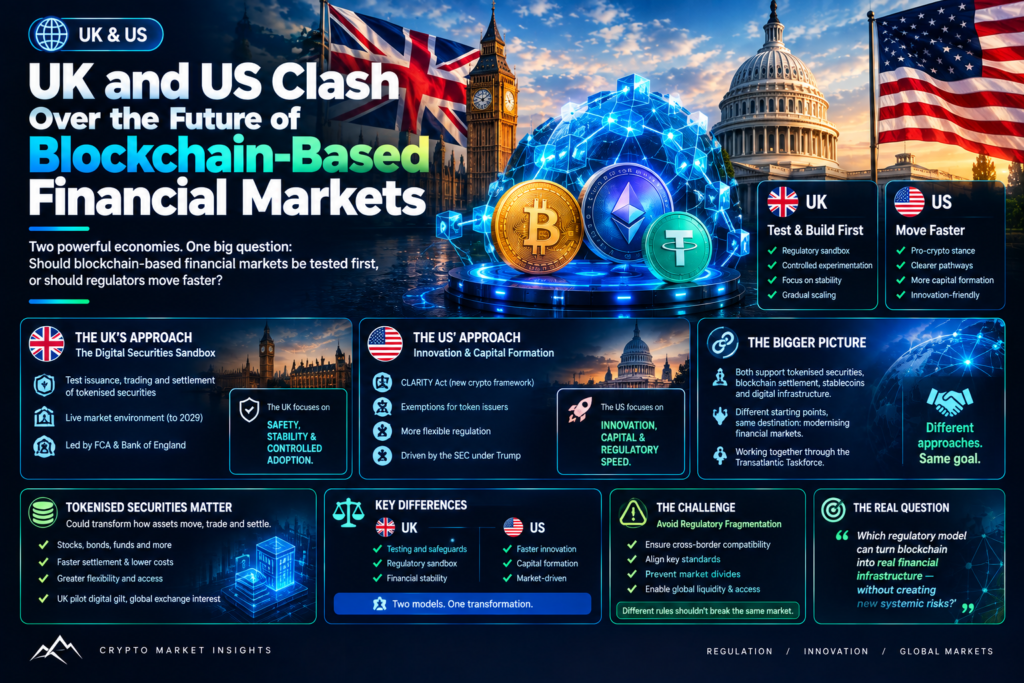
The UK and the United States agree that blockchain could reshape financial markets.
But they do not necessarily agree on how quickly that transformation should happen.
Both countries are now exploring tokenised securities, blockchain-based settlement, stablecoins and digital financial infrastructure. Yet their regulatory instincts are noticeably different.
The UK has generally leaned toward controlled experimentation, using regulatory sandboxes to test new technology before allowing it to scale across mainstream financial markets.
The US, meanwhile, is moving with a much more aggressive pro-crypto tone under President Donald Trump, with the Securities and Exchange Commission (SEC) pushing for clearer and more flexible pathways for crypto businesses and token issuers.
That creates an interesting question:
Should blockchain-based financial markets be tested carefully first, or should regulators move faster and let the market discover what works?
The UK Wants to Test Blockchain Before Scaling It
The UK’s approach is built heavily around experimentation.
The Financial Conduct Authority (FCA) and Bank of England launched the Digital Securities Sandbox (DSS), giving firms a regulated environment where they can test the issuance, trading and settlement of tokenised securities.
The idea is relatively simple: instead of rewriting financial-market rules overnight, regulators can observe how blockchain-based markets actually behave in real-world conditions.
The sandbox is not just a theoretical experiment.
The Bank of England says the DSS allows live UK trading venues and settlement systems for tokenised securities, with 16 firms preparing to launch. The programme is scheduled to run until January 2029.
That reflects a distinctly British regulatory mindset.
The technology is promising.
But before it becomes part of the financial system at scale, regulators want to understand the risks around settlement, custody, liquidity, investor protection and financial stability.
The UK Isn’t Anti-Blockchain
That caution should not be mistaken for resistance.
In May 2026, the FCA and Bank of England published a shared vision for tokenisation in UK wholesale markets, saying blockchain and distributed ledger technology could make financial markets faster, more efficient and potentially less costly.
They are now looking at areas including tokenised collateral, settlement instruments and prudential treatment.
The FCA has also received 123 responses from industry and other stakeholders as part of its work on the future of tokenisation.
Its next step is to develop a joint tokenisation roadmap with the Bank of England later in 2026.
So the UK’s position is not:
“Don’t use blockchain.”
It is closer to:
“Let’s prove it works before we rebuild the market around it.”
America Is Taking a More Aggressive Route
The US is moving in a different direction.
Under the Trump administration, the SEC has adopted a significantly more crypto-friendly tone.
In August 2026, the SEC proposed a new framework designed specifically for crypto assets, including exemptions that could make it easier for certain crypto companies to raise capital and issue tokens.
The proposal includes a potential one-time exemption allowing certain crypto companies to issue up to $5 million in tokens over four years, alongside a separate pathway for offerings of up to $75 million per year with reporting requirements.
The SEC also proposed a safe harbor that could prevent certain crypto assets from being treated as investment contracts if specific conditions are met.
That is a very different regulatory signal.
Rather than simply asking how blockchain should fit into existing financial infrastructure, the US is increasingly asking:
“How can the regulatory system make room for blockchain-based markets to grow?”
This Is Where the Two Approaches Start to Diverge
The difference is subtle, but important.
The UK’s model puts significant emphasis on controlled testing, market infrastructure and financial stability.
The US approach under the current SEC leadership is placing greater emphasis on clearer pathways for capital formation and innovation.
Neither approach is necessarily wrong.
The UK has good reasons to be cautious.
Financial markets are interconnected systems. A problem involving tokenised securities is not necessarily limited to the blockchain itself. It can affect custody, collateral, settlement, liquidity and potentially wider financial stability.
The US has a different concern.
Move too slowly, and innovation may simply move somewhere else.
If companies believe the regulatory environment is too restrictive, they can build their infrastructure in other jurisdictions and potentially take investment, talent and market activity with them.
That creates a competition between regulatory certainty and regulatory speed.
And Yet, the UK and US Are Trying to Work Together
Here’s where the story gets more interesting.
Despite these differences, the UK and US are not walking away from each other.
In July 2026, HM Treasury and the US Treasury published the first recommendations from the Transatlantic Taskforce for Markets of the Future.
Among the recommendations was the idea of creating an industry-led group to test cross-border use cases for tokenised assets.
The two sides also called for US financial agencies and the Bank of England to identify common approaches to the regulatory treatment of tokenised assets.
That means the disagreement is less about whether blockchain belongs in financial markets and more about how the transition should happen.
The two countries are effectively trying to build bridges while experimenting with different regulatory philosophies.
The Sandbox Could Become the Middle Ground
This is where the UK’s Digital Securities Sandbox becomes particularly important.
The sandbox gives regulators and financial institutions a place to experiment without immediately committing the entire market to a new system.
It also creates something that could eventually make cross-border cooperation easier.
If regulators in London and Washington can compare data from real-world blockchain experiments, they can begin identifying which risks are genuinely different and which ones can be addressed with common standards.
That could eventually make it easier for a tokenised security created or traded in one jurisdiction to interact with infrastructure in the other.
The US-UK Financial Regulatory Working Group has already discussed opportunities for cross-border innovation involving the UK’s Digital Securities Sandbox.
Why Tokenised Securities Matter So Much
This debate is bigger than crypto trading.
Tokenisation could eventually change how traditional financial assets themselves move through the financial system.
Stocks, bonds, funds and other assets can be represented digitally on distributed ledgers.
In theory, that could reduce settlement friction, automate parts of financial transactions and allow markets to operate with greater flexibility.
The Bank of England is already exploring tokenised securities alongside tokenised deposits and stablecoins, while the UK is preparing a pilot digital gilt instrument.
At the same time, US and global exchanges are increasingly exploring tokenised equities and blockchain-based market infrastructure.
So the real competition may not be between Bitcoin and traditional finance.
It could be between different versions of traditional finance running on blockchain infrastructure.
The Biggest Risk Is Regulatory Fragmentation
There is one major problem both countries need to avoid.
Fragmentation.
Imagine a company developing a tokenised bond that can operate under UK rules but not US rules.
Or a stablecoin that can be used as settlement infrastructure in one market but faces restrictions in another.
Or a blockchain-based trading platform that has to build two completely different compliance systems just to operate across the Atlantic.
That would undermine one of the biggest potential benefits of tokenisation: creating financial infrastructure that can move more efficiently across borders.
This is why the UK-US cooperation effort matters.
The goal is not necessarily to create identical regulations.
It is to make sure that different regulatory systems can still talk to each other.
The Bigger Question: Who Will Set the Standard?
This could eventually become a competition over global financial standards.
The US has enormous capital markets and a rapidly changing crypto policy environment.
The UK has one of the world’s most important financial centres and is already building infrastructure specifically designed for tokenised securities.
If either country succeeds in creating a scalable model for blockchain-based capital markets, other jurisdictions may follow.
That makes today’s experiments much more important than they appear.
The rules being tested today could influence how securities are issued, traded and settled globally in the next decade.
So, Are the UK and US Really Clashing?
Not exactly.
They are actually moving toward greater cooperation.
But they are approaching the same technological shift from different starting points.
The UK is emphasizing testing, safeguards and controlled adoption.
The US is increasingly emphasizing innovation, capital formation and faster regulatory accommodation.
And that difference could become one of the most important debates in the next phase of blockchain adoption.
Because the future of financial markets may not be about whether blockchain wins.
It may be about which regulatory model is capable of turning blockchain into real financial infrastructure without creating new systemic risks.
The UK wants to test the future.
The US wants to accelerate it.
And somewhere between those two approaches, the next generation of global financial markets could be built.
Need to Receive International Payments?
Open your USD, GBP & EUR account with Kolan.
Fill out the form and book your free consultation.
Secure Your Crypto With OneKey
Looking for a safer way to store your crypto?
Shop OneKey hardware wallets and protect your digital assets with a dedicated hardware wallet.
Join the CryptoMartLive Community
Stay connected with the latest crypto news, market developments, and opportunities.
WhatsApp: CryptoMartLive WhatsApp Group
Telegram Group: CryptoMartLive Telegram Group
Telegram: @sungazerlive
Instagram: @cryptomartlive
Crypto moves fast. Stay informed. Stay ahead.
Tinggalkan Balasan