Stablecoin Settlement: Lloyds and Visa Test Cross-Border Payments
September 30, 2026 · Plaza Cripto
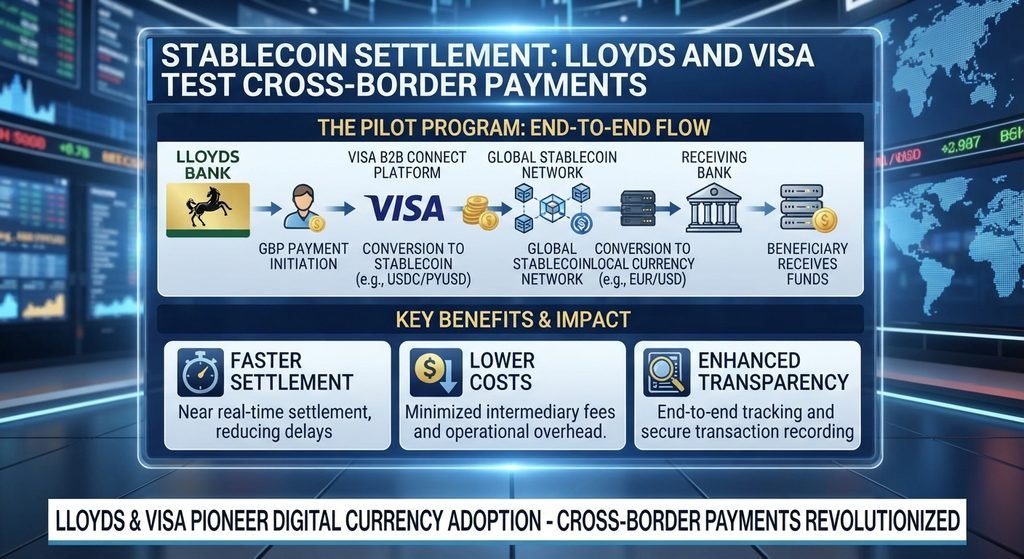
Stablecoin settlement is moving into a real-world institutional testing phase as Lloyds Banking Group and Visa completed a seven-day live pilot for cross-border payment obligations. During the trial, Lloyds used USDC to settle US$750,000 of obligations with Visa, with funds reaching Visa in less than an hour, including during the weekend. The pilot also tested settlement across private and public blockchain environments.
Stablecoin Settlement Enters Institutional Testing
The stablecoin settlement pilot represents an exploration of how digital money could support faster and more flexible movement of funds between financial institutions.
Lloyds Banking Group and Visa announced on September 30, 2026, that they had completed the seven-day live pilot after conducting real-world settlement transactions.
The initiative focused specifically on the settlement process rather than the way payments themselves are initiated. Settlement is the process through which financial institutions exchange and reconcile funds after payment activity.
According to Lloyds, the pilot was designed to examine speed, transparency and operational flexibility in cross-border settlement.
Lloyds and Visa Complete a US$750,000 Pilot
During the seven-day trial, Lloyds used stablecoins to settle U.S.-dollar payment obligations totaling US$750,000 with Visa.
Lloyds used USDC purchased through Archax, a UK-regulated digital asset exchange. The settlement volume was booked through Lloyds’ Corporate Markets branch in Jersey before being transferred to Visa in the United States.
The transaction provides a real-world example of how a bank can use a stablecoin as part of an institutional settlement process rather than simply testing the technology in a simulated environment.
Funds Reached Visa in Less Than One Hour
One of the key results highlighted by Lloyds was the speed of settlement.
During the pilot, funds reached Visa in less than one hour, including transactions completed over the weekend.
Traditional cross-border settlement processes can be affected by banking hours, meaning transactions initiated outside operating windows may take longer to complete.
The pilot demonstrated how stablecoin-based settlement could potentially operate continuously rather than being limited to conventional banking schedules.
24/7 Settlement and Liquidity Management
The ability to settle transactions around the clock can have implications for institutional liquidity management.
Businesses and financial institutions operate across different time zones and may need to move funds outside traditional banking hours.
According to Lloyds, round-the-clock settlement could provide greater visibility over when funds arrive and reduce the amount of liquidity tied up while transactions wait for settlement.
This could be particularly relevant during weekends and holidays, when traditional banking infrastructure can introduce additional delays.
Why Settlement Speed Matters
Settlement speed affects how businesses manage financial obligations.
When institutions know more precisely when funds will arrive, treasury teams can coordinate liquidity, meet payment obligations and plan cash positions with greater certainty.
The Lloyds-Visa pilot therefore focused not only on transaction speed but also on the operational implications of faster settlement.
Private and Public Blockchain Settlement
Another important element of the pilot was the use of both private and public blockchain environments.
Lloyds used its own node on Canton, a network that provides configurable privacy capabilities.
Visa, meanwhile, supported settlement on a separate public blockchain.
The test therefore explored how institutional stablecoin settlement could work across different blockchain environments rather than relying on a single network.
Blockchain Interoperability Becomes a Key Issue
The use of multiple blockchain environments highlights the importance of interoperability.
As digital asset activity expands across different blockchain networks, institutions may need infrastructure capable of connecting separate environments.
The Lloyds and Visa pilot explored this concept by using a private blockchain environment on one side and a public blockchain environment on the other.
According to Lloyds, interoperability could give institutions greater flexibility as liquidity and activity develop across a multi-chain ecosystem.
USDC as the Settlement Asset
The pilot used USDC as the stablecoin for the tested settlement obligations.
USDC is designed to maintain a value linked to the U.S. dollar, making it suitable for experiments involving dollar-denominated settlement.
Lloyds obtained the USDC through Archax, a UK-regulated digital asset exchange, before using the asset in the settlement process with Visa.
The use of an existing regulated digital asset venue also illustrates how traditional financial institutions can interact with digital asset infrastructure within a regulated environment.
Settlement Rather Than Payment Initiation
The distinction between payment and settlement is important in understanding the pilot.
Lloyds and Visa were not primarily testing how consumers or businesses initiate payments.
Instead, the pilot examined the behind-the-scenes settlement process through which financial institutions exchange funds and reconcile payment activity.
This means the experiment was focused on the infrastructure supporting financial transactions rather than replacing existing payment interfaces.
Digital Money and Institutional Finance
The pilot forms part of Lloyds’ broader exploration of how digital assets and tokenised forms of money could support the movement of value between businesses and financial institutions.
Stablecoins are one form of digital money that institutions can potentially use to move value across blockchain networks.
The trial therefore provides an example of how traditional banking infrastructure and blockchain-based settlement can be tested alongside each other.
The objective is not necessarily to replace existing systems immediately, but to examine where digital money could offer additional speed, flexibility and visibility.
Traditional Banking Hours vs. Continuous Settlement
Traditional financial infrastructure often operates according to established banking schedules.
Cross-border transactions can consequently be affected by weekends, holidays and differences between market operating hours.
Stablecoin settlement introduces a different model because blockchain networks can process transactions outside conventional banking windows.
The Lloyds-Visa pilot demonstrated this potential by completing settlement in less than one hour, including during the weekend.
Implications for Corporate Treasury
Corporate treasury teams continuously manage cash positions, payment obligations and liquidity requirements.
Faster settlement could potentially change how treasury departments plan these activities.
If funds can be received and confirmed outside traditional banking hours, companies may have greater visibility over their available liquidity.
The Lloyds pilot therefore provides an institutional case study for examining how stablecoins could interact with treasury and settlement operations.
Stablecoin Settlement and Cross-Border Finance
Cross-border transactions often involve multiple currencies, financial institutions and settlement infrastructures.
Each additional layer can create operational complexity and affect the time required for funds to reach the receiving institution.
Stablecoin settlement provides an alternative infrastructure in which digital representations of value can move across blockchain networks.
The Lloyds and Visa pilot tested whether this model could operate in a real-world institutional environment while maintaining the requirements of financial settlement.
A Step Toward Multi-Chain Digital Money
The pilot’s combination of private and public blockchain environments is particularly relevant to the development of institutional digital money.
Financial institutions may have different requirements around privacy, transparency, interoperability and access depending on the type of transaction.
Testing settlement across different blockchain environments can help identify how these requirements might be addressed within a broader digital financial ecosystem.
Lloyds described the trial as part of its wider work exploring how digital assets and tokenised forms of money could enhance the movement of value between businesses and financial institutions.
What the Pilot Demonstrates
The seven-day trial provides several concrete data points:
- US$750,000 in payment obligations were settled.
- The pilot lasted seven days.
- Funds reached Visa in less than one hour.
- Settlement was demonstrated during the weekend.
- USDC was used as the settlement asset.
- The trial covered both private and public blockchain environments.
- Lloyds used a node on Canton, while Visa supported settlement on a separate public blockchain.
These results illustrate how stablecoins can be tested in institutional settlement without requiring the entire payment system to be rebuilt.
Looking Ahead
The Lloyds and Visa pilot adds another example of financial institutions exploring blockchain-based settlement in a live environment.
The focus on stablecoin settlement, interoperability and round-the-clock processing reflects broader experimentation with digital money and tokenised financial infrastructure.
For banks and businesses, the potential benefits being examined include faster settlement, greater visibility over funds and more flexible liquidity management.
However, the seven-day pilot represents a test of these capabilities rather than evidence that stablecoins will replace traditional settlement systems. The next stage will depend on further institutional testing, infrastructure development and the regulatory frameworks governing digital money.
👉 Open Your Account: : https://forms.gle/QVri289ukKMFR6Qn
🔐 Buy OneKey and Get Up to 5 USDT Cashback: https://onekey.so/r/ERC
💳 Discover MyPal: https://h5.mypal.pro/pm/vhcn?code=27090432
Leave a Reply