Which Crypto Exchanges Are Regulated in the UK? What Customers Need to Know
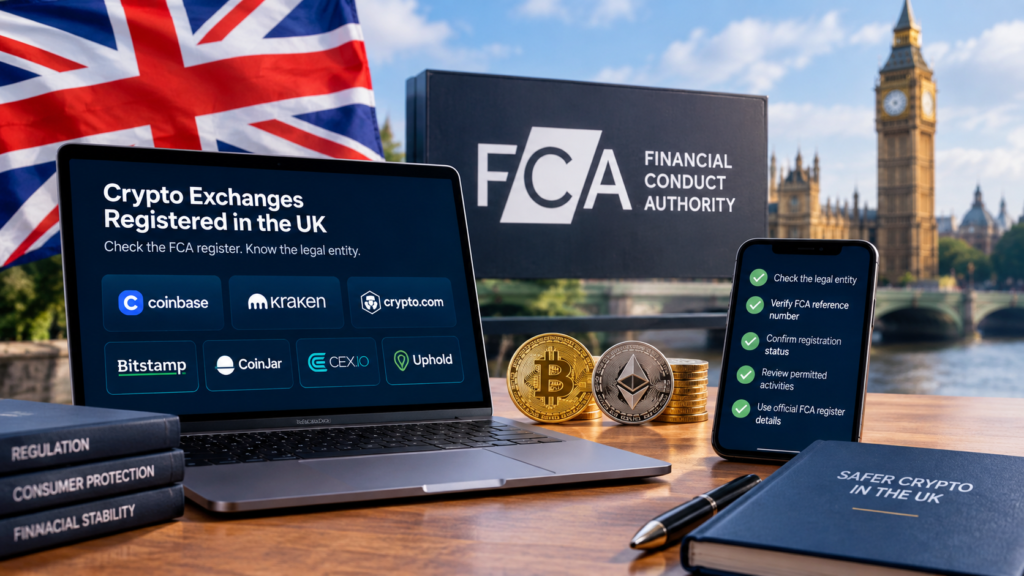
If you are looking for a crypto exchange in the UK, one question matters before you deposit your money: is the platform actually regulated or registered in the UK?
The answer is not always as simple as seeing the FCA logo on an exchange’s website.
The Financial Conduct Authority (FCA) currently registers certain cryptoasset businesses under the UK’s anti-money laundering rules. However, this registration is different from full authorisation under the UK’s upcoming cryptoasset regime.
That distinction matters for anyone trying to find a legitimate crypto exchange.
[IMAGE]
Several major exchanges operate in the UK through entities that are registered with the FCA. But registration does not mean that every crypto service offered by a company is fully regulated, or that customers have the same protections they would get from traditional financial products.
What Does “Regulated” Mean for Crypto Exchanges in the UK?
The word regulated can be confusing in the crypto market.
Since January 2020, UK cryptoasset businesses carrying out certain activities have needed to register with the FCA under the Money Laundering, Terrorist Financing and Transfer of Funds Regulations. The FCA supervises these firms for anti-money laundering and counter-terrorist financing requirements.
This is not the same as full financial services authorisation.
The FCA itself says that its current cryptoasset registration regime is separate from the new regulatory framework that will begin on 25 October 2027.
So when checking an exchange today, customers should look at the exact FCA status of the UK entity providing the service.
Which Crypto Exchanges Are Registered in the UK?
The FCA’s cryptoasset register includes a number of firms operating in the UK market.
Among the major platforms, Coinbase, Kraken and Crypto.com have UK entities with FCA cryptoasset registration.
Other firms on the FCA’s cryptoasset register include Bitstamp UK, CoinJar UK, CEX.IO Markets UK and Uphold Europe. The FCA register covers more than just trading exchanges, so customers should check exactly what services a particular firm is permitted or registered to provide.
Coinbase
Coinbase operates in the UK through CB Payments Limited, which is registered with the FCA for certain cryptoasset activities under the UK’s Money Laundering Regulations.
The company also holds FCA authorisation for electronic money services. Coinbase’s UK agreement states that CB Payments is registered for specific cryptoasset activities and authorised for electronic money services.
However, this does not mean every Coinbase product is regulated in the same way.
The FCA’s register and Coinbase’s own terms should be checked when determining which entity provides a particular service.
Kraken
In the UK, Payward Limited operates Kraken and has held FCA registration as a cryptoasset business since November 2021.
Separately, Payward Services Limited operates under FCA authorisation for electronic money activities.
This is another example of why the legal entity matters.
An exchange may use different companies within the same group for crypto trading, custody, payments or other services.
Crypto.com
Crypto.com operates in the UK through Foris DAX UK Limited.
The FCA has identified Foris DAX UK Limited as an FCA-authorised firm in its consumer warning database, with firm reference number 941745.
Again, customers should check the specific service and legal entity rather than assuming that every product offered by a global crypto brand has identical regulatory status.
Does FCA Registration Mean an Exchange Is Safe?
Not necessarily.
This is one of the most important points for UK crypto customers.
FCA registration means the firm has been registered for the activities covered by the applicable regulatory framework. It does not mean the FCA recommends the exchange or guarantees that customers will not lose money.
The FCA warns that cryptoassets can involve significant risks. It also makes clear that protection depends on the product, service and permissions involved.
For example, customers should not assume that crypto holdings are protected by the Financial Services Compensation Scheme (FSCS) simply because an exchange appears on an FCA register.
Kraken, for example, states that its UK crypto services are not covered by the FSCS or Financial Ombudsman Service in the way customers might expect for traditional regulated financial products.
So registered does not automatically mean risk-free.
How Can You Check If a Crypto Exchange Is Legitimate?
The FCA provides a useful starting point.
Before opening an account, search for the company’s legal entity on the FCA Financial Services Register.
Do not rely only on the brand name.
A global crypto company can operate through several different companies. One entity might handle crypto services, while another handles electronic money or payments.
Check:
- The company’s legal name
- Its FCA reference number
- Its current registration or authorisation status
- The activities covered by that status
- The website listed on the FCA Register
- Whether the details match the exchange you are using
The FCA also warns about clone firms that copy the names and details of genuine authorised businesses. Customers should use the contact details shown on the official register rather than details supplied by an unexpected caller or message.
What About Binance in the UK?
Binance is an important example of why customers should not assume that a major global exchange is automatically FCA regulated.
The FCA has previously stated that Binance Markets Limited was not permitted to conduct regulated activities in the UK without the FCA’s written consent. The FCA also said in 2023 that Binance Markets Limited had cancelled its FCA permissions and that no other entity in the Binance Group held UK authorisation or registration to conduct regulated activity at that time.
This is why checking the current FCA Register is more useful than relying on an old article, social media post or an exchange’s global reputation.
Regulatory status can change.
What About Other Crypto Exchanges?
The UK market includes many international crypto platforms, but their regulatory position is not identical.
The FCA’s research shows that centralised exchanges remain the most common way UK consumers obtain cryptoassets. In its 2025 research, 73% of crypto users said they used a centralised exchange, including platforms such as Coinbase, Binance and Kraken.
But popularity and regulation are two different things.
An exchange can be widely used by UK consumers without being registered with the FCA for the same services as another platform.
That is why customers should check regulatory status separately from reviews, trading volume or brand recognition.
What Is Changing for UK Crypto Exchanges?
The UK’s crypto regulatory framework is changing significantly.
Parliament made the Financial Services and Markets Act 2000 (Cryptoassets) Regulations 2026 in February 2026. The new framework is scheduled to come fully into force on 25 October 2027.
Under the new regime, activities such as operating a qualifying cryptoasset trading platform, safeguarding certain cryptoassets and dealing or arranging deals in qualifying cryptoassets will fall within the FCA’s financial services regulatory perimeter.
Firms will need FCA authorisation to conduct activities covered by the new regime, unless a relevant exemption or transitional arrangement applies.
The FCA’s application window for firms preparing for the new regime opens on 30 September 2026 and runs until 28 February 2027.
This creates an important transition period.
An exchange that is registered under the current MLR framework is not necessarily already authorised under the future FSMA crypto regime.
What Does This Mean for UK Customers?
For customers, the regulatory transition means old exchange lists can quickly become outdated.
Instead of asking only, “Is this exchange regulated?”, it is better to ask:
Which UK entity am I dealing with?
What is that entity registered or authorised to do?
Is its status current on the FCA Register?
What protections apply to the particular service I am using?
These questions provide a clearer picture than a simple regulated/not-regulated label.
Does FCA Registration Protect Your Crypto?
No regulatory registration removes the underlying risks of cryptoassets.
The FCA warns that consumers can lose all the money they invest in cryptoassets. Crypto holdings can also be exposed to market volatility, fraud, cyber risks and problems involving the platform or custody arrangements.
Registration can provide regulatory oversight within a defined framework, but it should not be interpreted as a guarantee that an exchange will not fail or that customers cannot lose money.
The type of service also matters.
For example, electronic money held through an authorised payment or e-money firm can be subject to safeguarding requirements, while cryptoassets themselves generally do not receive FSCS protection simply because they are held through an FCA-registered crypto business. Kraken makes this distinction clear in its UK disclosures.
What Should You Look For in a UK Crypto Exchange?
There is no single factor that determines whether an exchange is suitable for every customer.
Instead, compare the information that matters to you.
FCA Status
Start with the FCA Register.
Make sure you are checking the correct legal entity rather than just searching for the brand name.
Security
Look at how the exchange protects customer accounts and assets.
Two-factor authentication, withdrawal controls, custody arrangements and security policies can all matter.
Fees
Check trading fees, spreads, deposit fees and withdrawal costs.
A platform with a low advertised trading fee may still have other costs.
Available Assets
Different exchanges support different cryptocurrencies.
If you plan to trade a specific token, check whether it is actually available to UK customers.
Withdrawals
Understand how crypto withdrawals work before depositing a significant amount.
Check withdrawal limits, fees and any restrictions that apply to UK customers.
Customer Support
It is also worth checking how customers can contact the exchange if something goes wrong.
A clear complaints process and identifiable UK entity can make a difference when dealing with a problem.
The Bottom Line
So, which crypto exchanges are regulated in the UK?
Several major platforms operate through FCA-registered UK entities, including Coinbase, Kraken and Crypto.com, alongside other firms listed on the FCA’s cryptoasset register.
But the word “regulated” needs context.
The FCA’s current crypto registration regime mainly covers anti-money laundering supervision. The UK’s broader financial services regime for cryptoassets is scheduled to begin on 25 October 2027.
For UK customers, the practical step is simple: check the FCA Register, verify the exact legal entity, look at the permissions or registration that apply to the service, and understand what protections do and do not cover your crypto.
A familiar brand name is not a substitute for checking the regulatory details.
Frequently Asked Questions
Which crypto exchanges are FCA registered in the UK?
Major platforms operating through FCA-registered UK entities include Coinbase, Kraken and Crypto.com. Other crypto businesses are also listed on the FCA’s cryptoasset register, so customers should check the current register before opening an account.
Is FCA registration the same as full crypto regulation?
No. The current FCA cryptoasset registration regime operates mainly under the UK’s Money Laundering Regulations. A broader financial services regime for cryptoassets is scheduled to begin on 25 October 2027.
Does FCA registration mean my crypto is protected?
No. FCA registration does not automatically provide FSCS protection for cryptoassets. Protection depends on the product, service and relevant permissions.
Is Binance FCA regulated in the UK?
The FCA has stated that Binance Markets Limited cancelled its UK permissions in 2023 and that no other entity in the Binance Group held UK authorisation or registration to conduct regulated activity at that time. Customers should check the current FCA Register for the latest position.
How do I check whether a crypto exchange is legitimate?
Search the exchange’s legal entity on the FCA Financial Services Register. Check that the firm’s details, website and regulatory status match the platform you intend to use.
Are crypto exchanges safe in the UK?
FCA registration can provide regulatory oversight for activities covered by the applicable rules, but it does not guarantee that a platform is risk-free or that customers cannot lose money. Cryptoassets remain high-risk investments.
💸 GET PAID GLOBALLY WITH KOLAN
Need to receive international payments? Open your USD, GBP, EUR & AED accounts with Kolan and make international payments easier.
Fill out the form and book your free consultation:
https://forms.gle/QVri289ukKMFR6Qn8
🔐 SECURE YOUR CRYPTO WITH ONEKEY OR ELLIPAL
Get free delivery on orders over US$99 + up to 5 USDT cashback.
OneKey: https://onekey.so/r/TRC
Ellipal: https://www.ellipal.com/?rfsn=9305287.28d2ea6
🌍 GO GLOBAL WITH MYPAL
https://h5.mypal.pro/pm/vhcn?code=27090432
🔗 CONNECT WITH CRYPTOMARTSITE
https://msha.ke/cryptomart.site
Leave a Reply