Which Crypto Exchanges Are Regulated in the UK? What UK Investors Need to Know
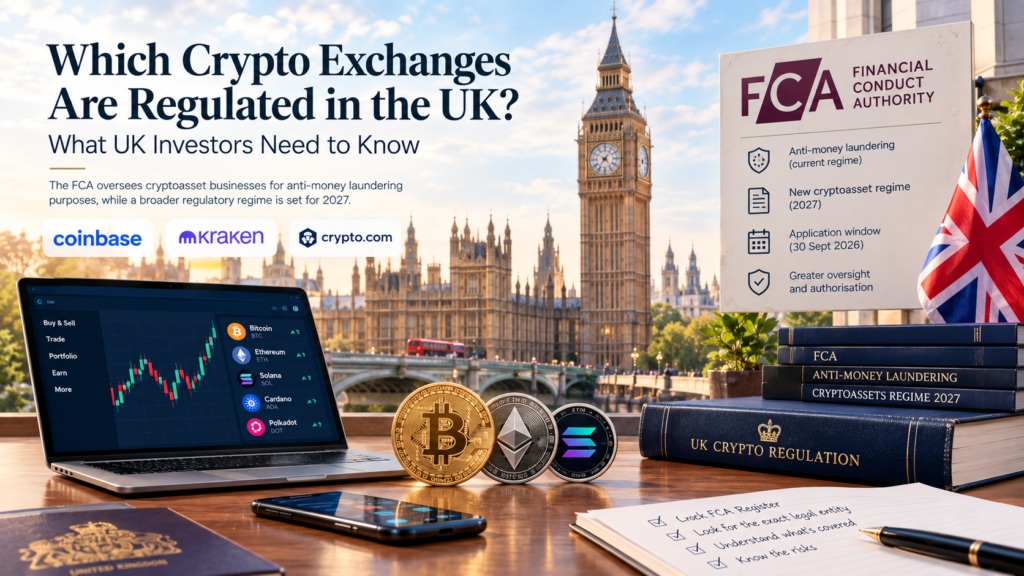
Choosing a crypto exchange in the UK is about more than comparing trading fees, available coins, or app features. For many customers, the bigger question is whether a platform is legitimate and operates within the UK’s regulatory framework.
The Financial Conduct Authority (FCA) currently supervises cryptoasset businesses for anti-money laundering purposes. The UK is preparing to introduce a broader cryptoasset regulatory regime in October 2027. That means the word “regulated” can mean different things depending on the service an exchange provides.
So, which crypto exchanges are registered in the UK, and what does that status actually mean for customers?
![Image: Crypto exchange regulation in the UK]
What Does “Regulated” Mean for Crypto in the UK?
The FCA currently requires certain cryptoasset businesses carrying out in-scope activities in the UK to register under the Money Laundering, Terrorist Financing and Transfer of Funds Regulations 2017.
This includes businesses providing certain cryptoasset exchange services and other activities covered by the current rules.
However, FCA registration should not be confused with a general endorsement of an exchange.
The FCA says that registration under the current Money Laundering Regulations is a legal requirement for firms carrying out relevant cryptoasset services in the UK. It is not a recommendation or endorsement of the business.
This distinction matters because cryptoassets themselves do not currently receive the same regulatory protections as many traditional financial products.
Which Crypto Exchanges Are Registered in the UK?
Several major crypto platforms operate in the UK under the FCA’s current regulatory framework. But customers should check the specific UK entity and the services covered by its registration rather than assuming that every product offered by a global exchange has the same regulatory status.
Coinbase
Coinbase operates in the UK through UK-regulated entities. Its UK customer agreement states that CB Payments Ltd is authorised by the FCA as an electronic money institution and is also registered under the Money Laundering Regulations for specific cryptoasset activities.
Coinbase also provides FCA-regulated investment services through its UK entity for certain financial instruments. However, Coinbase makes clear that its digital asset services are not covered by the Financial Services Compensation Scheme (FSCS).
The platform also applies UK-specific requirements to crypto customers, including client categorisation, an appropriateness assessment and a 24-hour cooling-off period for new users before they can trade cryptoassets.
The important point is that Coinbase’s different services can have different regulatory treatment.
Kraken
Kraken operates in the UK through several entities.
According to Kraken, Payward Limited is registered with the FCA as a cryptoasset firm under the Money Laundering Regulations. Payward Services Limited is also authorised by the FCA as an electronic money institution, while Crypto Facilities Limited holds FCA authorisation as an investment firm for certain services.
This is another example of why customers should look at the exact legal entity and service involved rather than treating an exchange’s entire product range as having one blanket regulatory status.
Crypto.com
Crypto.com also has an FCA-registered UK entity.
Foris DAX UK Limited, which operates the Crypto.com App in the UK, is registered with the FCA under the Money Laundering Regulations to provide cryptoasset services. Crypto.com says the entity has FCA registration number 941745.
Crypto.com also received FCA authorisation as an electronic money institution in 2023. However, the company’s UK disclosures make clear that cryptoassets themselves are not covered by the FSCS or the Financial Ombudsman Service.
Again, the distinction between the regulated payment or e-money service and the cryptoasset activity is important.
Does FCA Registration Mean an Exchange Is “Safe”?
Not necessarily.
FCA registration can be an important part of checking whether a crypto business is operating within the UK’s current regulatory framework. But it does not mean the FCA recommends a particular exchange or guarantees that customers will not lose money.
The FCA explicitly states that registration under the current cryptoasset regime is not an endorsement or recommendation. It also says that crypto customers do not receive Financial Ombudsman Service or FSCS protection simply because a cryptoasset business is registered.
Cryptoassets remain high-risk investments, and their prices can move sharply. Customers can also face risks linked to fraud, hacking, operational failures and the failure of a service provider.
That makes regulatory status one part of the due diligence process, rather than a guarantee of safety.
How Can You Check If a Crypto Exchange Is Legitimate?
Before opening an account, UK customers can check the FCA’s Financial Services Register.
The key is to search for the exact legal entity, not just the exchange’s brand name.
Customers should check:
- Whether the firm appears on the FCA register
- The firm’s exact legal name
- Its FCA reference number
- What activities it is authorised or registered to perform
- Whether those activities match the service being offered
- Whether the firm’s UK status has changed
- Whether the website or app being used matches the details on the register
This matters because large crypto companies often operate through multiple subsidiaries. One entity may provide cryptoasset services, while another provides payment, e-money or investment services.
The FCA’s register is therefore more useful than simply relying on an exchange’s marketing claim that it is “regulated”.
What About Binance and Other Global Exchanges?
Being popular among UK crypto users does not automatically mean an exchange has the same regulatory status as an FCA-registered cryptoasset business.
The FCA’s consumer research shows that platforms such as Coinbase, Binance, Crypto.com, Bybit and Kraken are among the exchanges used by UK consumers.
But usage and regulatory status are two different things.
This is particularly important when comparing global exchanges because a platform may operate through an overseas entity while targeting customers in the UK.
The FCA says that cryptoasset businesses marketing to UK consumers are subject to the UK’s financial promotions regime, regardless of where the business is based.
So, UK customers should check the firm’s current status and the specific entity providing the service rather than relying on the exchange’s global reputation.
What Is Changing for UK Crypto Exchanges?
The UK’s crypto rules are moving towards a broader regulatory framework.
Parliament made the Financial Services and Markets Act 2000 (Cryptoassets) Regulations 2026 in February 2026. The FCA expects the new cryptoasset regime to come into force on 25 October 2027.
Under the new framework, firms carrying out certain regulated cryptoasset activities will need FCA authorisation under the Financial Services and Markets Act.
This will cover activities such as operating a cryptoasset trading platform, safeguarding cryptoassets and arranging certain cryptoasset transactions.
The FCA’s application window for firms seeking authorisation opens on 30 September 2026, ahead of the new regime’s expected start in October 2027.
That means the regulatory status of crypto exchanges in the UK is likely to become increasingly important as the transition progresses.
What Does This Mean for UK Crypto Customers?
For customers, the main takeaway is simple: don’t judge an exchange by its brand name alone.
An exchange can be widely used and still have different regulatory treatment for different products. Similarly, an FCA registration does not mean your crypto investment is protected from losses.
A better approach is to check the exact UK entity, verify its status on the FCA register and understand which services are actually covered.
It is also worth remembering that crypto regulation is changing. A platform’s status today may not tell you exactly how its services will be regulated once the new UK regime comes into force in 2027.
The Bottom Line
There are major crypto exchanges operating within the UK’s regulatory framework, including Coinbase, Kraken and Crypto.com. But “regulated” is not a blanket label covering every product, service or cryptoasset offered by an exchange.
For UK customers, the FCA Register is one of the most useful places to start when checking whether a platform is registered or authorised and what it is permitted to do.
Most importantly, FCA registration should not be treated as a guarantee against investment losses or as confirmation that an exchange is completely risk-free.
As the UK prepares for its wider cryptoasset regime in 2027, understanding the difference between registration, authorisation and consumer protection will become increasingly important for anyone using a crypto exchange in Britain.
💸 GET PAID GLOBALLY WITH KOLAN
Need to receive international payments? Open your USD, GBP, EUR & AED accounts with Kolan and make international payments easier.
Fill out the form and book your free consultation:
https://forms.gle/QVri289ukKMFR6Qn8
🔐 SECURE YOUR CRYPTO WITH ONEKEY OR ELLIPAL
Get free delivery on orders over US$99 + up to 5 USDT cashback.
OneKey: https://onekey.so/r/TRC
Ellipal: https://www.ellipal.com/?rfsn=9305287.28d2ea6
🌍 GO GLOBAL WITH MYPAL
https://h5.mypal.pro/pm/vhcn?code=27090432
Leave a Reply