Who Actually Regulates Cryptocurrency in the USA? Understanding the SEC, CFTC and Other Agencies
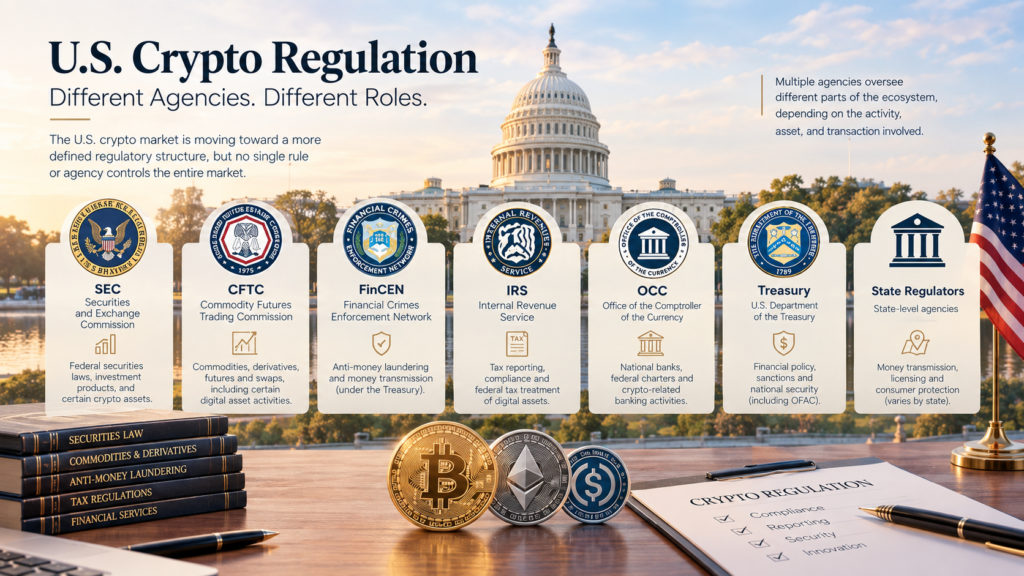
If you buy Bitcoin in the United States, who exactly is watching?
The answer is not as simple as naming one regulator. The U.S. crypto market is overseen by several federal agencies, and their roles can change depending on the asset, transaction, and financial activity involved.
That is why understanding US crypto regulation can feel confusing, especially as regulators continue to define where their authority begins and ends.
In 2026, that picture has continued to evolve. The Securities and Exchange Commission (SEC) and Commodity Futures Trading Commission (CFTC) have taken steps to clarify their respective roles, while agencies such as FinCEN, the IRS, and the Office of the Comptroller of the Currency (OCC) oversee specific parts of the digital asset ecosystem.
So, who actually regulates cryptocurrency in the USA?
Why Is US Crypto Regulation So Complicated?
Cryptocurrency does not fit neatly into one traditional financial category.
One digital asset can be used as an investment, traded on an exchange, used for payments, or incorporated into another financial product. Different activities can therefore trigger different regulatory requirements.
Several agencies can have authority over different parts of the crypto market.
The SEC generally focuses on federal securities laws, while the CFTC oversees commodities and derivatives within its jurisdiction.FinCEN handles anti-money laundering requirements under the Bank Secrecy Act, while the IRS deals with federal tax treatment.
State regulators can also impose their own requirements in areas covered by state law.
This means the answer to “Who regulates crypto?” often starts with another question: What type of crypto activity are we talking about?
SEC: When Crypto Falls Under Securities Laws
The SEC is one of the most important agencies in the US crypto regulatory landscape.
Its role comes into play when crypto assets or transactions fall within the federal securities laws.
In March 2026, the SEC issued an interpretation explaining how federal securities laws apply to certain crypto assets and transactions. The interpretation also covers airdrops, protocol mining, staking, and wrapped crypto assets that do not qualify as securities.
The CFTC also issued guidance on how it and its staff would administer the Commodity Exchange Act consistently with the SEC’s interpretation.
On September 25, 2026, the SEC issued staff FAQs with additional explanations about the classification of certain crypto assets. The SEC stated that its Division of Corporation Finance staff provided these views and that the FAQs do not have the force of law.
For crypto businesses and investors, these developments matter because the classification of an asset or transaction can affect which securities rules apply.
CFTC: Where Commodities and Derivatives Come In
The CFTC has a different role.
The agency oversees derivatives markets, including futures and swaps involving commodities. Its authority also extends to certain digital asset activities within the Commodity Exchange Act.
In March 2026, the SEC and CFTC announced a memorandum of understanding designed to improve coordination between the two agencies. The agreement covers areas such as product definitions, registration, examinations, market surveillance, and enforcement.
The CFTC also issued FAQs on March 20, 2026, addressing activities involving crypto assets and blockchain technologies by registrants and registered entities.
For the crypto industry, the SEC-CFTC relationship is important because digital assets do not always fit neatly into a single regulatory category.
FinCEN: The Anti-Money Laundering Layer
Then there is the Financial Crimes Enforcement Network, or FinCEN.
FinCEN operates under the U.S. Department of the Treasury and administers the Bank Secrecy Act.
Its crypto-related role is primarily connected to anti-money laundering and money transmission requirements.
FinCEN has previously clarified that certain businesses exchanging or transmitting convertible virtual currency can fall under the definition of a money transmitter and may therefore have obligations under its regulations.
That makes FinCEN particularly relevant to crypto businesses that move or exchange value rather than simply holding digital assets.
In other words, FinCEN is not the agency deciding whether every cryptocurrency is a security or commodity. Its focus is different: financial crime compliance and the movement of money and value.
IRS: Crypto Regulation Also Means Taxes
The Internal Revenue Service has another piece of the puzzle: taxation.
For U.S. federal tax purposes, the IRS generally treats digital assets as property rather than currency.
That means crypto transactions can create tax reporting obligations.
Selling digital assets for U.S. dollars, exchanging one digital asset for another, or using digital assets to pay for goods and services can have tax consequences depending on the circumstances.
The IRS has also introduced digital asset reporting requirements for certain brokers. Beginning with transactions on or after January 1, 2025, brokers are required to report gross proceeds in certain transactions, while basis reporting applies to certain transactions beginning in 2026.
For U.S. crypto users, this means regulation is not limited to exchanges and token issuers. Tax rules can affect individual investors as well.
OCC and Stablecoin Regulation
Stablecoins add another layer to the regulatory picture.
The 2025 GENIUS Act established a federal framework for payment stablecoins in the United States. In 2026, federal agencies have been working on the rules needed to implement that framework.
The OCC, for example, proposed regulations covering payment stablecoin issuers and related activities involving entities under its jurisdiction.
Treasury has also proposed rules related to the implementation of the GENIUS Act, including requirements involving payment stablecoin issuance and state-level regulatory regimes.
This matters because stablecoins are not simply another category of cryptocurrency. Their use as payment instruments brings them into areas involving banking, payments, anti-money laundering, and financial stability.
As a result, stablecoin regulation can involve multiple agencies and regulatory frameworks.
What About State Regulators?
The federal government is not the only level of regulation in the United States.
Individual states can have their own laws and licensing requirements for financial businesses, including certain crypto-related activities.
This can create another layer of compliance for companies operating across the country.
A crypto business may therefore need to consider both federal requirements and the rules of the states in which it operates.
The exact requirements can depend on the company’s activities, customers, products, and legal structure.
So, Who Actually Regulates Cryptocurrency in the USA?
There is no single agency responsible for every part of cryptocurrency in America.
Instead, US crypto regulation is divided according to the type of asset, activity, and law involved.
The SEC can become relevant when securities laws apply. The CFTC has authority over commodities and derivatives within its jurisdiction. FinCEN focuses on anti-money laundering and money transmission requirements, while the IRS handles federal tax treatment.
The OCC and other banking regulators can become involved in activities involving regulated financial institutions and payment stablecoins. State regulators can also impose requirements under state law.
That division explains why two crypto companies can face very different regulatory obligations even if both operate in the same industry.
What Is Changing in 2026?
The regulatory landscape is still developing.
In March 2026, the SEC and CFTC took steps toward greater coordination and issued an interpretation clarifying aspects of their respective approaches to crypto assets.
In August, the SEC proposed its Regulation Crypto Assets framework. The proposal would create tailored exemptions for certain crypto-related investment contracts and includes a proposed conditional safe harbor related to the definition of an investment contract.
The SEC’s public comment period for the proposal is scheduled to remain open until October 20, 2026.
Meanwhile, regulators continue implementing the GENIUS Act framework for payment stablecoins.
These developments show why crypto regulation in the United States should not be viewed as a finished rulebook. The agencies are still refining how existing laws and new frameworks apply to a rapidly changing market.
What Does This Mean for Crypto Users?
For everyday crypto users, the most important point is that regulation depends on what you do with digital assets.
Buying and holding Bitcoin is different from operating a crypto exchange. Issuing a stablecoin is different from trading a crypto derivative. Receiving crypto as income is different from simply holding an asset.
Each activity can raise different legal, compliance, or tax questions.
That is also why users should be careful when reading claims that one U.S. agency “regulates crypto.” In practice, the regulatory answer is usually more specific.
The Bigger Picture
The U.S. crypto market is moving toward a more defined regulatory structure, but no single rule or agency controls the entire market.
Different agencies can oversee different activities. The SEC, CFTC, FinCEN, IRS, OCC, Treasury, and state regulators each have roles that depend on the activity involved.
For businesses, understanding those boundaries can be essential for compliance. For investors and users, knowing which rules apply can make it easier to understand the risks and responsibilities associated with digital assets.
As regulators continue issuing rules, interpretations, and guidance, the most useful question may no longer be simply “Is crypto regulated?”
Instead, it is:
“Which crypto activity are we talking about, and which rules apply to it?”
💸 GET PAID GLOBALLY WITH KOLAN
Need to receive international payments? Open your USD, GBP, EUR & AED accounts with Kolan and make international payments easier.
Fill out the form and book your free consultation:
https://forms.gle/QVri289ukKMFR6Qn8
🔐 SECURE YOUR CRYPTO WITH ONEKEY OR ELLIPAL
Get free delivery on orders over US$99 + up to 5 USDT cashback.
OneKey: https://onekey.so/r/TRC
Ellipal: https://www.ellipal.com/?rfsn=9305287.28d2ea6
🌍 GO GLOBAL WITH MYPAL
https://h5.mypal.pro/pm/vhcn?code=27090432
Leave a Reply