Best Crypto Exchanges for UK Customers: How to Find Legitimate Platforms
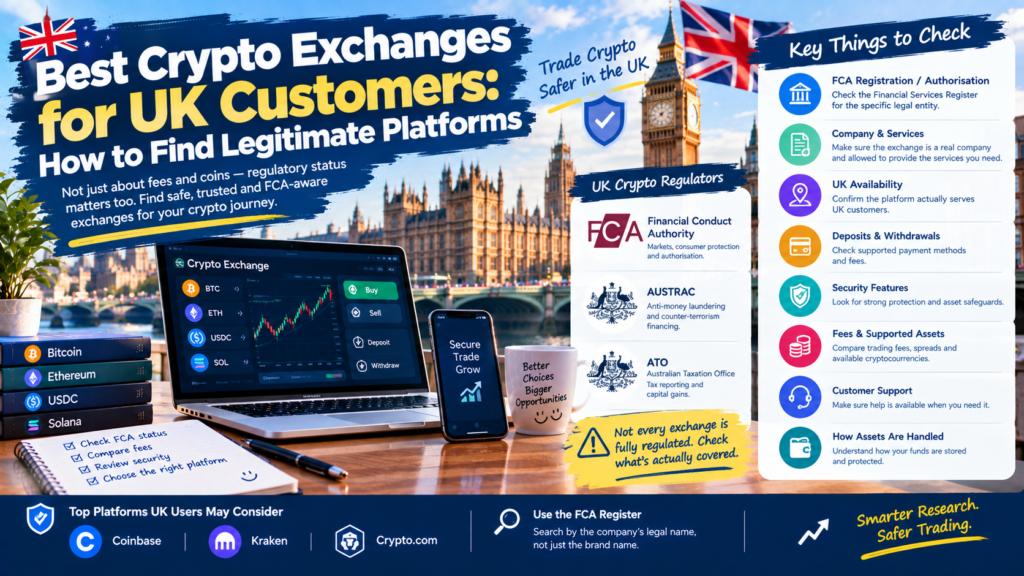
Finding the best crypto exchanges for UK customers is not simply about comparing trading fees or counting the number of coins available.
For UK users, regulatory status matters too.
A crypto exchange can offer Bitcoin, Ethereum, stablecoins and hundreds of other assets, but that does not automatically mean every service it provides is regulated in the UK.
That distinction is becoming even more important in 2026.
The UK is preparing a new cryptoasset regulatory regime that will bring more crypto activities into the Financial Conduct Authority’s (FCA) regulatory perimeter from 25 October 2027. Firms can begin applying for authorisation from 30 September 2026, with the application window running until 28 February 2027.
So, how should UK customers evaluate a crypto exchange?
What Makes a Crypto Exchange Legitimate in the UK?
A legitimate crypto exchange should be more than a professional-looking website.
UK customers should check several factors before depositing money.
These include:
- FCA registration or authorisation where applicable
- The company’s legal entity
- The services it is permitted to provide
- UK availability
- Deposit and withdrawal options
- Security features
- Fees and spreads
- Supported cryptocurrencies
- Customer support
- How customer assets are handled
Most importantly, check the regulatory status yourself.
The FCA’s Financial Services Register is a public record of firms and individuals authorised or registered by the regulator. The FCA also warns consumers to check whether a firm’s permissions actually cover the activities it offers.
A company appearing on a regulatory register does not automatically mean every crypto product it offers is protected or regulated.
Does FCA Registration Mean an Exchange Is Fully Regulated?
Not necessarily.
This is one of the most important points for UK crypto users.
At present, certain crypto businesses must register with the FCA under the UK’s anti-money laundering rules.
The FCA says businesses providing certain in-scope cryptoasset services in the UK must register before starting those activities. This includes cryptoasset exchange services such as exchanging cryptoassets for money or money for cryptoassets.
However, the FCA also makes clear that the current registration framework is not the same as full regulation of all crypto activities.
The new cryptoasset regime is scheduled to change this position.
From 25 October 2027, firms carrying out newly regulated cryptoasset activities will generally need FCA authorisation unless an exemption or transitional arrangement applies.
Therefore, UK customers should always check what a firm’s registration actually covers.
Crypto Exchanges UK Customers May Encounter
The UK market includes several well-known international crypto platforms.
However, their regulatory status can differ by legal entity and service.
That means customers should not rely solely on the exchange’s global reputation.
Instead, search for the specific UK company or entity on the FCA’s register.
The FCA itself advises consumers to check a firm’s name, permissions and contact details before using a crypto service.
Coinbase
Coinbase is one of the largest global crypto platforms and is available to UK customers.
When evaluating Coinbase in the UK, users should check the specific Coinbase entity and the services available to UK customers.
The same principle applies to any international exchange.
A global brand name does not tell you exactly which UK regulatory permissions apply to your account.
Kraken
Kraken is another major international crypto exchange used by customers in different markets.
UK customers should again check the relevant Kraken entity and its current regulatory permissions before using a particular service.
This is particularly important as the UK’s regulatory framework changes.
Crypto.com
Crypto.com is another international crypto platform with a presence in the UK.
As with other exchanges, users should check the specific entity serving UK customers and verify its current status through official regulatory information.
The key question is not simply whether an exchange operates in Britain.
The better question is which legal entity provides the service and what permissions apply.
How to Check an Exchange on the FCA Register
Checking an exchange does not have to be complicated.
Start with the FCA Financial Services Register.
Search for the company’s legal name rather than relying only on its brand name.
Then check:
1. The exact company name
Make sure the legal entity matches the company you are dealing with.
2. Its status
Look at whether the firm is authorised or registered.
3. Its permissions
A firm can have specific permissions rather than blanket approval for every financial activity.
4. Its contact details
The FCA recommends checking that the contact details shown on the register match the details provided by the company.
5. Warning information
The FCA Register can also identify unauthorised firms and other regulatory information.
This simple process can help reduce the risk of dealing with an impersonator or unauthorised business.
Why the UK Crypto Rules Are Changing
The UK’s crypto market is moving toward a more comprehensive regulatory framework.
Under the current system, certain crypto businesses register with the FCA primarily for anti-money laundering supervision.
However, the FCA’s new framework will bring additional crypto activities into its regulatory perimeter.
The final guidance published in September 2026 covers activities including safeguarding cryptoassets, operating trading platforms, arranging deals and staking.
The new regime is scheduled to begin on 25 October 2027.
For customers, this means the regulatory environment should become more structured over time.
For exchanges, it means additional compliance and authorisation requirements.
What About Crypto Trading Platforms?
Trading platforms are an important part of the upcoming framework.
The FCA’s final perimeter guidance specifically identifies operating a cryptoasset trading platform as an activity that can require FCA authorisation under the new regime.
That matters because an exchange is not simply a website where users buy Bitcoin.
A platform can perform several different functions, including:
- Executing trades
- Holding customer crypto
- Arranging transactions
- Providing staking services
- Offering transfers
- Supporting stablecoins
- Providing other cryptoasset services
Each activity can have different regulatory implications.
As a result, customers should look beyond the exchange’s homepage and understand what services they are actually using.
What Should UK Customers Compare?
Regulation is important, but it is not the only factor.
Once you have established that an exchange is legitimate and available to UK customers, compare the practical features.
Trading Fees
Check the difference between advertised trading fees and the actual cost of buying or selling.
Some platforms use maker and taker fees.
Others may make money through spreads.
A low headline fee does not always mean the lowest overall transaction cost.
GBP Support
For UK customers, GBP support can make deposits and withdrawals easier.
Check whether the exchange supports GBP deposits, withdrawals and the payment method you intend to use.
Available Cryptocurrencies
Different exchanges support different assets.
A beginner may only need Bitcoin and Ethereum.
More experienced users may want access to additional tokens.
However, a larger asset selection also means more assets to research.
Security
Look for security features such as:
- Two-factor authentication
- Withdrawal controls
- Device management
- Address whitelisting
- Passkeys or other account protection
- Cold-storage practices where applicable
No exchange can eliminate every security risk.
Your own account security also matters.
Customer Support
Consider how easy it is to contact the exchange when something goes wrong.
This becomes especially important if a deposit is delayed or a withdrawal is temporarily restricted.
Are UK Crypto Exchanges Covered by the FSCS?
This is where crypto users need to be particularly careful.
Cryptoassets are generally not covered by the Financial Services Compensation Scheme simply because they are held through a registered crypto business.
The FCA states that most crypto-related activities are not currently regulated and that consumers generally do not have access to FSCS protection for those activities.
A regulated payment service connected to a crypto business can have different protections from the cryptoasset itself.
The FCA’s 2026 information about Gemini’s UK exit provides an example of this distinction: its e-money and payment activities had different regulatory treatment from its cryptoasset activities.
Therefore, never assume that an FCA-related registration means your crypto holdings have bank-style protection.
How to Avoid Fake Crypto Exchanges
Scammers can copy the names, websites and branding of legitimate companies.
The FCA warns that fake investment websites can look professional and may use social media or search engines to attract victims.
Before sending money, check:
The URL. Make sure you are using the exchange’s official website.
The legal entity. Match it against the FCA Register where applicable.
The contact details. Check whether they match the regulator’s information.
The promises. Be suspicious of guaranteed returns or pressure to deposit immediately.
The payment instructions. Be particularly careful if someone asks you to send crypto to a personal wallet to “activate” your account.
The FCA specifically warns consumers about unsolicited investment approaches, pressure to invest quickly and unrealistic returns.
Should Beginners Choose the Exchange With the Lowest Fees?
Not necessarily.
Fees matter, but they should be considered alongside regulation, security, liquidity, payment methods and customer support.
For example, an exchange with slightly higher trading fees may still be easier for a UK beginner if it provides convenient GBP deposits and clear transaction information.
Another user may care more about advanced trading tools.
The right comparison depends on how you plan to use the platform.
What About Staking on UK Exchanges?
Staking is another area where users should pay attention to the regulatory changes.
The FCA’s September 2026 perimeter guidance specifically discusses staking as one of the cryptoasset activities affected by the new regulatory framework.
That does not mean every staking product has exactly the same regulatory treatment.
The structure of the service matters.
Therefore, check the specific product terms rather than assuming that staking is automatically covered by the same rules as ordinary crypto trading.
What Is Changing From September 2026?
The UK’s transition is particularly relevant for exchanges right now.
The FCA says the application window for the new cryptoasset regime opens on 30 September 2026 and closes on 28 February 2027.
Firms that want to carry out newly regulated activities under the upcoming framework will need to prepare applications or variations of permission.
Existing FCA registrations do not automatically convert into full authorisation under the new regime.
For UK customers, this means an exchange’s regulatory status can change as the transition progresses.
Checking the FCA Register should therefore be treated as an ongoing step rather than a one-time check.
A Simple Checklist for UK Crypto Exchange Users
Before opening an account, ask:
Is the company listed on the FCA Register where required?
Does its legal entity match the business I am dealing with?
What activities does its permission or registration cover?
Does it support GBP deposits and withdrawals?
What are the trading fees and spreads?
Which cryptocurrencies can I trade?
How does the platform protect accounts?
What are the withdrawal rules?
Does the service provide staking or other additional products?
Am I receiving any promises that sound too good to be true?
If something does not look right, stop before depositing money.
Best Crypto Exchanges for UK Customers: What Should You Look For?
There is no single exchange that is automatically the right choice for every UK customer.
Instead, legitimate platforms should be evaluated through a combination of regulatory status, available services, fees, GBP support, security and user needs.
Coinbase, Kraken, Crypto.com and other major platforms may appear in the UK market, but customers should verify the specific legal entity and current regulatory position rather than relying on brand recognition alone.
The FCA provides the Financial Services Register specifically so consumers can check firms and their permissions.
That check is more important than a “top exchange” list.
The UK crypto market is also entering a significant regulatory transition.
With the new regime scheduled for October 2027 and applications opening in September 2026, exchanges will increasingly need to demonstrate how they fit within the FCA’s regulatory framework.
For UK customers, the practical takeaway is simple: look beyond fees and coin selection. Verify the platform, understand what is actually regulated, secure your account and keep track of the rules affecting the services you use.
💸 GET PAID GLOBALLY WITH KOLAN
Need to receive international payments? Open your USD, GBP, EUR & AED accounts with Kolan and make international payments easier.
Fill out the form and book your free consultation:
🔐 SECURE YOUR CRYPTO WITH ONEKEY OR ELLIPAL
Get free delivery on orders over US$99 and enjoy up to 5 USDT cashback on eligible purchases.
🌍 GO GLOBAL WITH MYPAL
🌐 CONNECT WITH CRYPTOMARTSITE
Want to join the community, contact us, or find all our social channels?
Leave a Reply