Argentina Crypto Market: Bitcoin Rebounds Above $84K
September 24, 2026 · Plaza Cripto
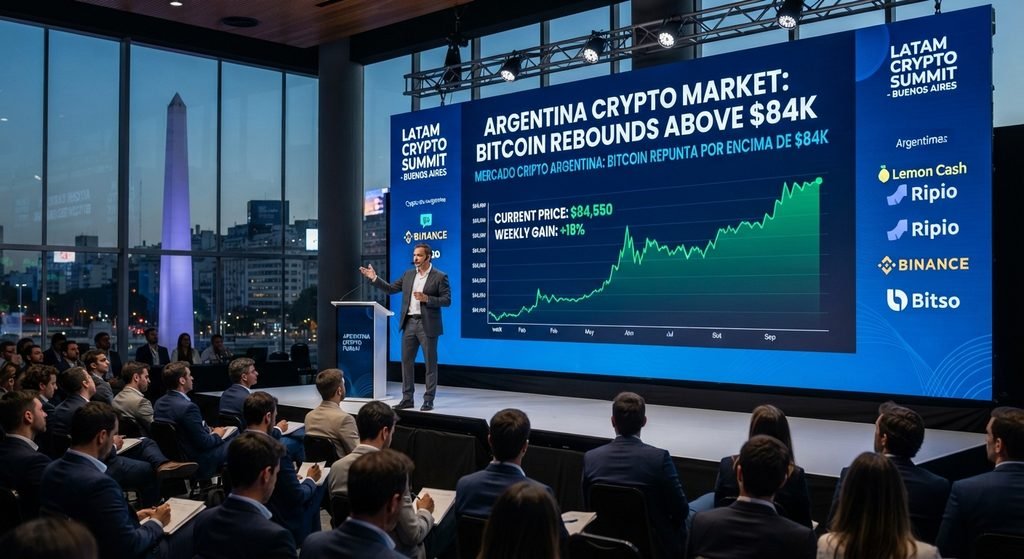
Argentina’s crypto market is following a broader recovery in digital asset prices as Bitcoin rises above US$84,000 and major cryptocurrencies record gains. The move comes as digital assets continue to attract attention across Argentina, where crypto trading, stablecoins and digital financial services have become increasingly connected with everyday financial activity. Kolan, OneKey and MyPal offer complementary solutions across international payments, digital asset security and emerging digital payment infrastructure.
ARGENTINA — September 24, 2026
Argentina’s crypto market is experiencing renewed activity as Bitcoin and other major digital assets move higher on September 24, 2026.
According to data reported by LA NACION, Bitcoin was trading at approximately US$84,154, equivalent to around ARS 136.75 million, representing a 3.14% increase over 24 hours and a 10.52% increase compared with the previous week. Ethereum was trading around US$2,680.52, while other major cryptocurrencies including BNB, Cardano and Solana also recorded daily gains.
The movement reflects a broader recovery across the global cryptocurrency market.
However, price movements are only one part of Argentina’s developing digital asset ecosystem.
For individuals, freelancers, businesses and international users, cryptocurrencies are increasingly connected with questions around security, payments, foreign currencies and access to digital financial infrastructure.
Bitcoin’s Recovery Reaches the Argentine Market
Bitcoin remains the largest digital asset by market capitalization and continues to influence sentiment across the wider crypto market.
On September 24, the asset was trading above US$84,000, with its weekly performance showing a stronger move than the previous day’s increase. LA NACION reported Bitcoin’s market capitalization at approximately US$1.69 trillion at the time of its update.
Other major cryptocurrencies were also moving higher.
Ethereum gained 3.35% over 24 hours, while BNB, Cardano and Solana recorded gains of approximately 3.24%, 7.22% and 3.65%, respectively, according to the same market update.
The simultaneous movement across major digital assets illustrates how closely connected Argentina’s crypto market is with global cryptocurrency markets.
Argentine users can therefore experience local currency changes and international crypto-market movements at the same time.
Crypto and Argentina’s Digital Financial Environment
Argentina has developed a significant relationship with digital assets as users seek different ways to manage payments, savings and international financial activity.
Cryptocurrencies can provide access to global digital markets without relying exclusively on traditional financial infrastructure.
Stablecoins are particularly relevant because they are designed to maintain a value linked to another asset, such as the US dollar.
For users operating in an environment where currency management is an important consideration, dollar-linked digital assets can become part of a broader financial strategy.
At the same time, Bitcoin and other volatile cryptocurrencies serve different purposes and involve different levels of market risk.
The distinction between cryptocurrencies, stablecoins and payment infrastructure therefore remains important.
Stablecoins Add Another Layer to Argentina’s Crypto Economy
The Argentine digital asset ecosystem extends beyond Bitcoin.
Stablecoins such as USDT and USDC have become important tools for digital transfers, international payments and other blockchain-based transactions.
Their value proposition differs from Bitcoin because stablecoins are generally designed to track the value of an underlying currency or asset rather than fluctuate according to market demand alone.
Argentina’s crypto market has also seen the emergence of locally connected digital representations of the peso.
This demonstrates how blockchain technology can be used not only for speculative assets but also for digital representations of traditional currencies.
As blockchain networks become more accessible, the boundary between cryptocurrency, payments and digital finance continues to evolve.
Security Becomes More Important as Digital Asset Use Expands
Increasing crypto activity also creates greater demand for security.
Users who hold Bitcoin or other cryptocurrencies must consider how their private keys are stored and how transactions are authorised.
Unlike traditional bank accounts, blockchain assets are generally controlled through cryptographic keys.
Losing access to those keys can result in the loss of access to the corresponding assets.
This makes self-custody an important consideration for users who want direct control over their cryptocurrency holdings.
OneKey: Supporting Digital Asset Self-Custody
OneKey provides hardware wallets designed to help users store and manage digital assets while maintaining control over their private keys.
Hardware wallets provide a dedicated environment for interacting with cryptocurrencies.
For Argentine users holding Bitcoin, Ethereum and other digital assets, self-custody can provide an additional layer of control over how assets are accessed.
The broader development of the crypto market therefore involves more than price movements.
As adoption expands, infrastructure for securely managing digital assets becomes increasingly relevant.
From Crypto Markets to International Payments
Argentina’s digital economy is also increasingly connected to international financial activity.
Freelancers may work with clients abroad.
E-commerce businesses may receive payments from international customers.
Remote professionals may be paid in foreign currencies.
Export-oriented companies may need to manage transactions across several markets.
These activities create financial requirements that extend beyond domestic banking.
The growth of digital assets is therefore taking place alongside the broader development of international payment infrastructure.
Kolan: Supporting Multi-Currency Financial Activity
Kolan provides access to accounts in currencies including USD, GBP and EUR, supporting users involved in international payments.
For freelancers, remote professionals and businesses working across borders, access to multiple currencies can help organise international financial activity.
Digital assets and multi-currency accounts serve different functions.
Crypto wallets allow users to interact with blockchain-based assets, while international financial accounts can support traditional currency transactions.
Together, these technologies reflect a broader transformation in how people participate in the global digital economy.
MyPal: Connecting Digital Payments With Web3
The development of digital assets is also closely connected to the evolution of digital payments.
Blockchain networks can support transfers and transactions across borders, while emerging payment platforms explore ways to connect digital finance with everyday commerce.
MyPal operates within this broader digital payment environment.
For users participating in both online commerce and Web3, payment infrastructure can provide a bridge between digital assets, financial services and everyday transactions.
As the digital economy develops, the distinction between payment technology and blockchain infrastructure is becoming increasingly interconnected.
Argentina’s Crypto Market Is More Than Bitcoin
Bitcoin’s move above US$84,000 provides an important snapshot of Argentina’s crypto market, but the broader ecosystem includes multiple categories of digital financial activity.
These include:
- Bitcoin and other cryptocurrencies — digital assets traded across global markets.
- Stablecoins — blockchain-based assets designed to track relatively stable values.
- Self-custody — direct management of private keys and digital assets.
- International payments — financial infrastructure for cross-border transactions.
- Digital payments — emerging systems connecting online commerce and Web3.
Different users require different tools.
A Bitcoin holder may prioritise security.
A freelancer may require international payment infrastructure.
An e-commerce seller may need multi-currency financial tools.
A Web3 user may explore blockchain-based payment applications.
A More Connected Digital Financial Ecosystem
The latest Bitcoin movement demonstrates how Argentina remains connected to the global cryptocurrency market.
At the same time, the country’s digital financial ecosystem continues to develop across multiple layers.
Market infrastructure determines how digital assets are traded.
Wallet technology determines how users manage their assets.
Payment infrastructure determines how money moves across borders.
And blockchain applications continue to introduce new possibilities for digital commerce.
These developments are not necessarily interchangeable.
Instead, they form different components of an increasingly connected digital financial environment.
Security, Payments and Digital Assets
The continued development of Argentina’s crypto market highlights three areas that remain relevant for users: market access, security and financial connectivity.
Bitcoin and other cryptocurrencies provide access to global digital asset markets.
Hardware wallets can help users maintain control over their private keys.
Multi-currency financial infrastructure can support international payments.
Digital payment platforms can explore connections between Web3 and everyday commerce.
The result is a digital financial ecosystem that extends beyond cryptocurrency trading alone.
Building Argentina’s Digital Financial Ecosystem
Bitcoin’s recovery above US$84,000 demonstrates the continued importance of digital assets within Argentina’s financial landscape.
But the broader transformation is not limited to price movements.
Users increasingly interact with cryptocurrencies, stablecoins, international payments and digital financial platforms as part of a wider digital economy.
OneKey addresses digital asset security and self-custody.
Kolan supports international payments and multi-currency financial activity.
MyPal explores digital payment solutions connected with emerging financial technologies.
Together, these solutions form part of an evolving ecosystem connecting cryptocurrency, international payments, digital security and Web3.
Explore the Digital Financial Ecosystem
Whether you are a crypto user, freelancer, remote professional, entrepreneur, e-commerce seller or international business in Argentina, explore solutions designed to support different aspects of the modern digital economy.
👉 Open Your Account: https://forms.gle/QVri289ukKMFR6Qn8
🔐 Buy OneKey and Get Up to 5 USDT Cashback: https://onekey.so/r/ERC
💳 Discover MyPal: https://h5.mypal.pro/pm/vhcn?code=27090432
About Kolan, OneKey and MyPal
Kolan provides solutions designed to support international payments and access to currencies such as USD, GBP and EUR.
OneKey develops hardware wallets and digital asset security solutions designed to help users store and manage cryptocurrencies while maintaining control over their private keys.
MyPal develops solutions focused on digital payments and emerging financial use cases involving digital assets.
Together, these solutions form part of an evolving digital financial ecosystem connecting international payments, cryptocurrency, blockchain and Web3.
Leave a Reply