What’s the Best Cryptocurrency to Use in Africa Right Now?
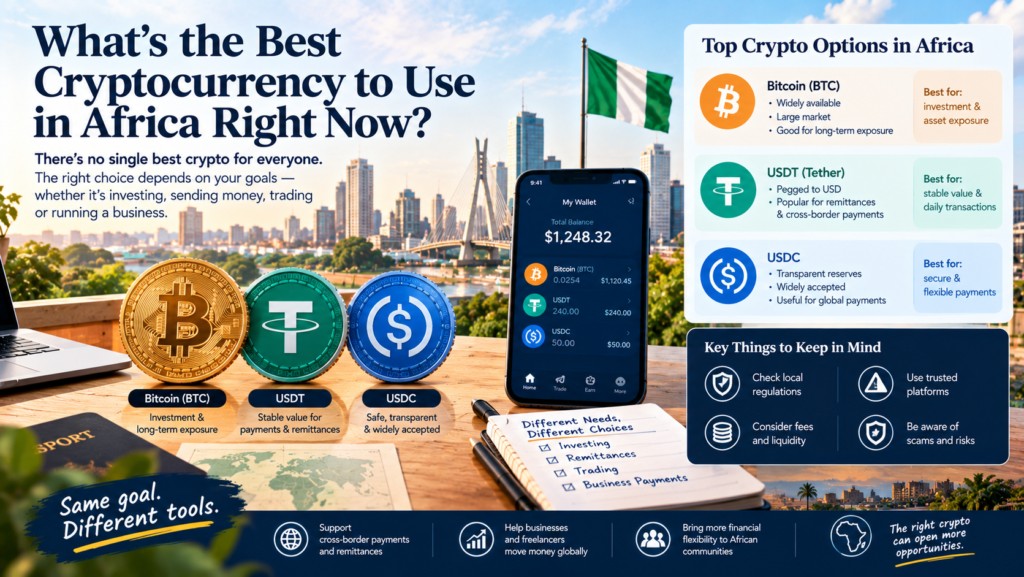
There is no single cryptocurrency that works best for everyone in Africa.
Freelancers choose financial tools based on their needs, while Nigerian traders choose tools that fit their market.Dollar payments from overseas clients can matter to freelancers, while Nigerian traders may focus on other needs.Businesses that pay overseas suppliers may prioritize other features, while families may simply need an easy way to send money.
That is why the more useful question is not “Which cryptocurrency is the best?”
It is “Which crypto asset makes the most sense for the way you want to use it?”
Across Africa, that question is becoming increasingly relevant. Sub-Saharan Africa received more than $205 billion in on-chain crypto value between July 2024 and June 2025, up roughly 52% from the previous year, according to Chainalysis. Nigeria and South Africa remain two of the region’s largest crypto markets.
Stablecoins are also becoming increasingly important, particularly for cross-border payments, while Bitcoin remains a major crypto asset across several African markets.
So, if you’re in Africa and considering crypto in 2026, which assets should you actually understand?
Bitcoin: A Major Choice for Crypto Exposure
Bitcoin remains one of the most recognized cryptocurrencies in Africa.
Its appeal is relatively straightforward. Bitcoin is widely available across global crypto platforms, has a large market, and does not depend on a single company or government to issue it.
In Sub-Saharan Africa, Bitcoin has historically played an important role. Chainalysis found that Bitcoin accounted for a large share of fiat purchases in Nigeria and South Africa, representing 89% and 74% respectively in its analysis of centralized-exchange activity.
For someone who wants exposure to crypto as an asset rather than simply a payment tool, Bitcoin may therefore be one of the first assets to research.
However, there is an important trade-off.
Bitcoin’s price can move significantly.
A digital pound differs from a dollar-pegged stablecoin. Someone who receives Bitcoin today could see the value of those holdings change substantially before spending them later.
So while Bitcoin can be relevant for investment or long-term crypto exposure, it may not be the most convenient option when the primary goal is keeping a payment close to a specific fiat value.
USDT: A Practical Option for Dollar-Based Transfers
For many African users, the appeal of USDT comes from its connection to the U.S. dollar.
USDT is a stablecoin designed to maintain a value around one U.S. dollar. Unlike Bitcoin, it is not intended to gain value through market price appreciation.
That makes stablecoins particularly relevant in situations involving international payments, remittances, and dollar-denominated transactions.
Nigeria provides a useful example.
The IMF reported in 2026 that stablecoins had become a meaningful cross-border payment channel in Nigeria. More than 65% of Nigeria’s cross-border crypto inflows in 2024 were stablecoins, with USDT and USDC dominating the market.
USDT can serve people who receive money from abroad, pay international suppliers, or hold dollar-denominated digital assets. Bitcoin serves a different purpose for these users.
But “stable” does not mean risk-free.
Users still need to consider the issuer, platform, blockchain network, transaction fees, local regulations, liquidity, and the possibility of scams or mistakes when sending funds.
USDC: Another Major Stablecoin to Consider
USDC is another dollar-pegged stablecoin that has become important in the global digital-asset market.
Like USDT, its main attraction is not price speculation.
Instead, users may choose it when they want a digital asset designed to track the U.S. dollar.
That can make USDC relevant for international payments, digital commerce, crypto trading, and businesses operating across borders.
The choice between USDT and USDC should not simply come down to which ticker appears first on an exchange.
Users should look at liquidity on the platform they intend to use, available blockchain networks, transaction fees, local access, withdrawal options, and the regulatory environment where they live.
In other words, the “best” stablecoin can depend heavily on the infrastructure available to you.
Stablecoins May Be More Practical for Payments
This is where the African crypto market becomes particularly interesting.
Crypto adoption in the region is not only about speculation.
Chainalysis has identified stablecoins as an important part of Sub-Saharan Africa’s crypto economy, with stablecoins used for cross-border payments, trade, remittances, and other financial activity.
The IMF has also highlighted stablecoins as a growing cross-border payment channel in Nigeria. The attraction comes partly from the ability to transfer dollar-denominated value quickly while reducing some of the friction associated with traditional international payment systems.
That matters because many African users have a practical reason to look at dollar-based digital assets.
People may use dollar-denominated stablecoins when they receive international payments, send money across borders, or face volatility in their local currency. These stablecoins can address different needs from volatile cryptocurrencies.
What About Ethereum?
Ethereum is another major cryptocurrency worth understanding.
Unlike Bitcoin, Ethereum is closely connected to a broader blockchain ecosystem that supports decentralized applications, smart contracts, tokenized assets, stablecoins, and decentralized finance.
That makes ETH useful for people who actively participate in the Ethereum ecosystem.
For example, someone using decentralized applications may need ETH to pay network fees.
However, someone who simply wants to receive a dollar-denominated payment may have little reason to hold ETH instead of a stablecoin.
The right choice therefore depends on the purpose.
What About XRP and Other Cryptocurrencies?
African crypto markets are not limited to Bitcoin and stablecoins.
Other assets, including XRP and Ethereum, are also used across the region.
Chainalysis found that South Africa had a larger share of XRP and ETH purchases than Nigeria. Digital asset users in major African markets may follow different patterns.
This is a useful reminder that Africa should not be treated as one single crypto market.
Nigeria, South Africa, Kenya, Ghana, Ethiopia, and other African markets each have their own currencies, regulations, financial systems, and user behavior.
What works well for a South African trader may not necessarily be the most practical option for someone receiving remittances in Kenya.
Which Crypto Is Best for Different Situations?
Instead of choosing one universal winner, consider the use case.
| Your Goal | Crypto Type to Research | Why |
|---|---|---|
| Long-term crypto exposure | Bitcoin | Large and established crypto asset |
| International payments | USDT / USDC | Dollar-denominated stablecoins |
| Remittances | USDT / USDC | Designed to maintain a stable dollar value |
| Using Ethereum applications | ETH | Used within the Ethereum ecosystem |
| Trading | BTC, ETH, stablecoins and others | Depends on liquidity and strategy |
| Holding dollar exposure digitally | USDT / USDC | Tracks the U.S. dollar rather than a local currency |
| Diversified crypto exposure | BTC, ETH, stablecoins and others | Different assets serve different roles |
This table is not a recommendation to buy any particular asset.
It simply shows why the practical answer depends on what you are trying to accomplish.
Why Stablecoins Are Getting So Much Attention in Africa
There is a broader economic story behind stablecoin adoption.
In some African economies, consumers and businesses face currency volatility, limited access to foreign currency, or expensive cross-border payment systems.
Stablecoins can provide a digital way to move dollar-denominated value.
The IMF’s research on Nigeria describes stablecoins as a growing cross-border channel that can reduce some payment frictions while also creating new policy and regulatory challenges.
That combination is important.
Stablecoins can make certain transactions more convenient, but they also introduce questions around regulation, monetary policy, consumer protection, and financial stability.
As a result, users should not view stablecoins simply as “digital dollars with no risks.”
Bitcoin Still Has a Different Role
Stablecoin growth does not mean Bitcoin has become irrelevant.
Bitcoin serves a different purpose.
Its fixed maximum supply and decentralized network have made it attractive to people looking for an alternative digital asset and a potential store of value.
In Nigeria and South Africa, Bitcoin remains a significant part of crypto purchasing activity.
The distinction is therefore useful:
Bitcoin is primarily a volatile crypto asset.
Stablecoins are primarily designed to maintain a stable value.
Ethereum combines an asset with a broader programmable blockchain ecosystem.
Those differences matter more than simply asking which coin ranks first.
What Should African Crypto Users Check Before Choosing?
The asset itself is only one part of the decision.
Before using any cryptocurrency, check the platform you are using, the network supporting the transaction, and the rules that apply in your country.
1. Check Local Regulations
Crypto regulations differ across African countries.
South Africa, Nigeria, Kenya, Ghana, and other markets are developing their own approaches to digital assets.
Cryptocurrencies may operate globally, but local rules can differ for exchanges, custody, payments, and financial promotions.
2. Check Transaction Fees
A cheap-looking crypto transaction can become expensive if the network fee or withdrawal charge is high.
Always check the total cost before sending money.
3. Check Liquidity
Liquidity matters when buying, selling, or converting crypto.
A widely used asset may provide more trading options, but availability still depends on the exchange and market you are using.
4. Check the Blockchain Network
USDT and USDC can exist across multiple blockchain networks.
Sending a token through the wrong network can create serious problems.
Always confirm that the sender and recipient support the same network before completing a transfer.
5. Check the Platform
Do not assume that every exchange, wallet, or crypto app is equally trustworthy.
Look for information about licensing, security practices, custody arrangements, fees, and customer support.
Don’t Forget the Local Currency
Another important consideration is the conversion between crypto and your local currency.
A stablecoin may track the U.S. dollar, but you may eventually need to convert it into naira, rand, shilling, cedi, birr, or another local currency.
That means the practical usefulness of crypto depends partly on the local cash-out infrastructure.
A user may have an easy way to receive USDT but a much more complicated process for converting it into local money.
Before using crypto for payments, understand the entire journey:
Local currency → Crypto → Transfer → Crypto → Local currency
Every step can involve fees, exchange-rate differences, verification requirements, or regulatory restrictions.
What About Safety?
Crypto transactions are generally irreversible once confirmed on a blockchain.
That makes basic security extremely important.
Never share your wallet’s private keys or recovery phrase.
Be careful with links sent through WhatsApp, Telegram, Instagram, or social media.
And never send crypto simply because someone promises guaranteed profits, investment returns, or a job opportunity.
A familiar crypto asset does not automatically make a transaction safe.
The wallet, exchange, counterparty, and transaction details all matter.
Africa Is Not One Crypto Market
Perhaps the biggest mistake is treating Africa as one homogeneous market.
Crypto use differs significantly from one country to another.
Nigeria has become a major stablecoin and crypto market, while South Africa has developed a more institutionalized regulatory environment. Other countries have their own adoption patterns and regulatory frameworks.
Currency conditions also matter.
Currency volatility can influence why people use stablecoins. Stablecoin use can vary between countries with unstable currencies and countries with more stable currencies.
The same is true for remittances.
People who receive money from family overseas have different needs from traders seeking market exposure.
So, What’s the Best Cryptocurrency for Africa?
There is no single answer.
Someone looking for established crypto exposure may want to understand Bitcoin as one of the major assets in the market.
Stablecoins such as USDT and USDC may be more relevant for international payments and dollar-denominated transfers.
Meanwhile, Ethereum and ETH can serve a different purpose when interacting with decentralized applications.
The practical choice depends on what you need the asset to do.
That is especially important in Africa, where crypto adoption is increasingly connected to real-world financial needs rather than speculation alone.
Cross-border payments, remittances, business transactions, currency protection, and access to digital financial services are all contributing to the region’s growing crypto activity.
The Bigger Picture
Africa’s crypto story is becoming less about finding one “best” cryptocurrency and more about finding useful financial tools for specific problems.
Bitcoin can provide exposure to a decentralized digital asset.
Stablecoins can provide a digital representation of dollar value.
Ethereum can provide access to a programmable blockchain ecosystem.
Different tools can therefore coexist.
As stablecoins, tokenised money, and digital payment infrastructure continue developing across the continent, the most important skill for users may not be picking the most popular coin.
It may be understanding why you are using crypto in the first place.
Once that is clear, choosing the right type of asset becomes much easier.
Need to Receive International Payments?
Open your USD, GBP, EUR & AED account with Kolan.
Fill out the form and book your free consultation.
Secure Your Crypto & Get Cashback!
Get free delivery on orders over US$99 and enjoy up to 5 USDT cashback on eligible OneKey purchases.
Go Global with MyPal.
CONNECT WITH CRYPTOMARTSITE
Join the community, contact us, or find all our social channels in one place:
Leave a Reply