What Is the Digital Pound and How Does It Affect Me?
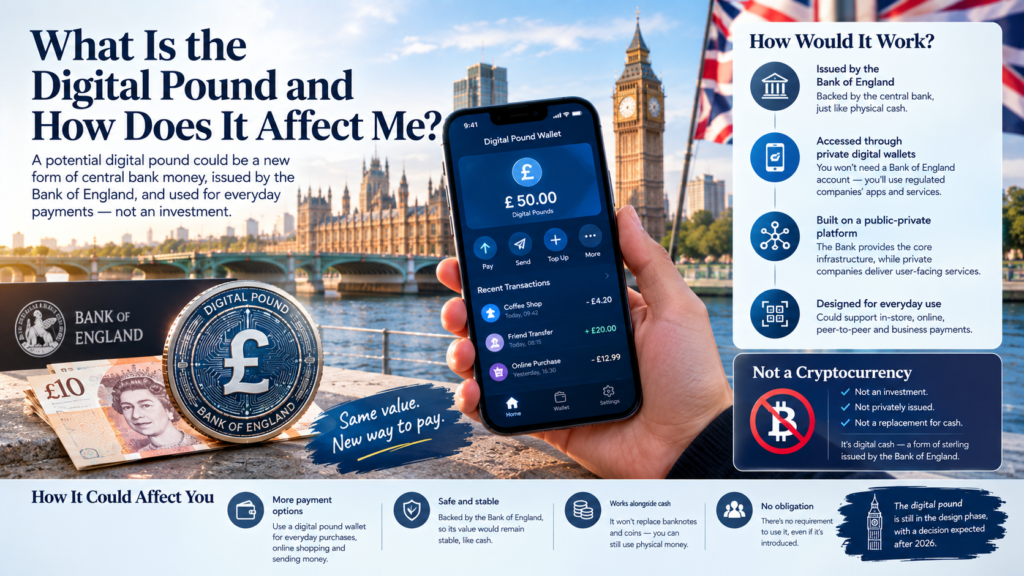
Imagine opening your phone and seeing a new kind of pound sitting alongside the money in your bank account.
It is not Bitcoin. It is not a stablecoin. And it would not simply be another banking app.
Instead, the UK is exploring a digital pound, a potential central bank digital currency (CBDC) issued by the Bank of England.
The idea is still being designed. As of 2026, the Bank of England and HM Treasury have not decided whether to introduce it. The current design phase is expected to conclude in 2026, after which the government and the Bank will assess whether the project should move forward.
So, what exactly is a digital pound, and how could it change the way you manage money in everyday life?
What Is the Digital Pound?
The simplest way to understand the digital pound is to think of it as digital cash.
The Bank of England would issue a potential digital pound directly, with its value denominated in sterling. Like physical banknotes, its value would remain stable. £10 in digital pounds would be worth the same as a £10 banknote.
However, the Bank of England would not necessarily provide your digital pound account directly.
Under the model currently being explored, people would access digital pounds through digital wallets provided by private companies. These companies would handle the customer-facing side of the service, while the Bank of England would operate the core ledger infrastructure.
That difference sets the proposed system apart from simply moving money through an existing bank account.
Is the Digital Pound a Cryptocurrency?
No.
This is one of the most important distinctions.
Cryptocurrencies such as Bitcoin are privately issued digital assets that operate differently from central bank money. A digital pound, by contrast, would be issued by the Bank of England and would represent sterling.
The Bank of England describes it as a digital form of cash rather than a cryptoasset.
That means the digital pound would not be designed as an investment whose price moves up and down like Bitcoin.
Instead, its primary purpose would be payments.
Why Is the UK Exploring a CBDC?
The way people pay is changing.
Cash remains available, but digital payments have become increasingly important. At the same time, new forms of digital money, including stablecoins and tokenised assets, are developing.
The Bank of England sees a potential digital pound as part of a broader “multi-money” system. In this system, people could use different forms of sterling while keeping the same underlying value.
There is also a question of how public money fits into an increasingly digital economy.
Today, the central bank issues physical banknotes as a form of money. If everyday payments become increasingly digital, policymakers are examining whether people should also have access to a digital form of central bank money.
The digital pound is one possible answer.
How Would the Digital Pound Work?
The current proposal involves a public-private platform.
The Bank of England would provide the core infrastructure, while regulated private companies could provide wallets and other user-facing services.
In practical terms, that could mean you interact with the digital pound through an app or wallet provided by a private payment company rather than logging into a Bank of England account.
The design work is also looking at features that could make digital payments more flexible.
For example, experiments through the Digital Pound Lab have explored point-of-sale payments, QR codes, cashback, transport payments, business-to-business transactions and other potential use cases.
These are experiments, not promises that all of these features will eventually become part of the final product.
So, How Could It Affect You?
For most people, the biggest potential change would be another way to pay.
You could potentially use a digital pound wallet for everyday purchases, online payments, or payments between individuals.
Imagine paying for a coffee, sending money to a friend, or purchasing something online using a digital wallet containing digital pounds.
The experience could feel similar to other digital payment methods.
The key difference comes from the type of money used for the payment.
Instead of commercial bank money, you would be using a form of central bank money designed specifically for a digital environment.
Would You Have to Use It?
No decision has been made to introduce the digital pound, so there is currently no requirement for anyone to use one.
Even if it were introduced, the Bank of England has stated that it would not replace cash.
The proposed digital pound would exist alongside banknotes, giving people another payment option rather than eliminating physical money.
That distinction matters because the digital pound project goes beyond putting notes and coins into an app.
It is about considering what public money could look like in a more digital economy.
What About Privacy?
Privacy is one of the biggest questions surrounding any CBDC.
The Bank of England says that any future laws for a digital pound would guarantee users’ privacy and that neither the Bank nor the government would be able to control how people spend their money.
At the same time, the proposed system would involve private companies providing user-facing services.
That means the exact rules around data, privacy, identity, wallet providers and payment information will matter significantly.
The Bank is still developing these details.
For example, its design work has examined an alias service that could potentially allow digital pound accounts to be identified through aliases rather than simply exposing account details. The Bank has stressed that these design notes are exploratory and do not represent final policy.
When discussing digital pound privacy today, separate the proposed design principles from the final rules.
Would the Digital Pound Replace Your Bank Account?
Not necessarily.
People would not open ordinary deposit accounts directly with the Bank of England under the current model.
Instead, digital pound wallets would be provided by private companies.
You could therefore have your existing bank account, cards, cash and potentially a digital pound wallet at the same time.
The idea is more about expanding payment choices than forcing everyone into a single system.
What About Interest?
The digital pound is being considered primarily as a payment instrument rather than a savings product.
That means it should not be thought of as a digital version of a traditional savings account.
The broader question is how much digital money people should hold and how it should interact with existing bank deposits.
This is one reason the design includes consideration of limits and other features intended to manage potential impacts on the financial system.
The exact final arrangements, however, have not yet been decided.
Could It Make Payments Faster?
Potentially, yes.
The Bank of England has been exploring how a digital pound could support more efficient and innovative payment services.
Experiments have included point-of-sale transactions, cashback, transport payments and business-to-business payments.
There is also a wider UK effort to modernise retail payments infrastructure.
In June 2026, the Retail Payments Infrastructure Board launched a consultation on next-generation UK retail payment infrastructure, including support for new payment methods and enhanced cross-border payments. Importantly, this broader infrastructure project is separate from a final decision on whether to introduce the digital pound.
Could Businesses Benefit?
Businesses could potentially gain another way to accept and send payments.
For merchants, digital money could create opportunities for new payment services and automated processes.
The Digital Pound Lab has already tested potential business use cases, including conditional business-to-business payments and payment services for transport operators.
However, the real-world benefits would depend on adoption.
A payment system only becomes useful at scale when enough consumers, merchants and financial service providers actually use it.
What Is Happening With the Digital Pound in 2026?
This is where the story currently stands.
The Bank of England and HM Treasury are completing the design phase during 2026.
This work includes a detailed blueprint, technological experiments, stakeholder engagement, and an assessment of the potential benefits, costs, and risks.
Later in 2026, the Bank expects to publish the assessment and blueprint, alongside its decision on the next steps.
That means the UK is not at the stage where people can simply download an official digital pound wallet and start spending digital pounds.
The project remains under development.
What Happens If the UK Decides to Build It?
Even a decision to proceed would not mean an immediate launch.
The Bank of England has said that if the UK decides to build a digital pound, it would only be introduced after Parliament passed the necessary primary legislation.
The Bank also says the earliest possible issuance would be in the second half of this decade.
So there are several stages between the current design work and actually using a digital pound in everyday life.
Digital Pound vs Bank Money vs Crypto
The differences become easier to understand when placed side by side.
| Type of money | Who issues it? | Main use | Value |
|---|---|---|---|
| Cash | Bank of England | Everyday payments | £1 = £1 |
| Bank deposit | Commercial bank | Payments and savings | Denominated in GBP |
| Digital pound | Potentially Bank of England | Digital payments | £1 digital pound = £1 |
| Stablecoin | Private issuer | Digital payments / crypto ecosystem | Depends on its design and backing |
| Bitcoin | Decentralised network | Digital asset / payments | Market-based |
The digital pound would therefore sit somewhere between today’s physical cash and the rapidly expanding world of digital money.
But it would remain fundamentally different from a cryptocurrency.
What Does This Mean for Crypto?
The digital pound is not a cryptocurrency, but it is part of a much bigger shift in how money is being represented digitally.
The Bank of England describes the future payments environment as increasingly diverse. Public money, commercial bank deposits, stablecoins, and tokenised assets could all become part of that environment.
That could create more interaction between traditional finance and digital assets.
Stablecoins, for example, already serve as payment instruments in different markets. A CBDC could offer another form of digital money with its own issuer, structure, and regulatory framework.
For crypto users, the important development is therefore not simply whether Britain launches a digital pound.
It is the fact that governments and financial institutions are actively redesigning the infrastructure behind digital payments.
What Should UK Consumers Watch Next?
There are several developments worth following through the rest of 2026.
First, watch for the Bank of England and HM Treasury’s final assessment of the digital pound.
Next, pay attention to the proposed blueprint, because it should provide more detail about how the system could operate.
Privacy, wallet providers, user protections, payment limits and interoperability will all be important.
Finally, watch what happens across the broader UK payments ecosystem.
A digital pound would represent just one part of a much broader transformation in how consumers and businesses could move money.
The Bigger Picture
The digital pound is still a proposal, not a new currency that UK consumers can use today.
Yet the project matters because it shows how quickly the definition of “digital money” is expanding.
Cash is becoming increasingly complemented by electronic payments. Banks are exploring tokenised finance. Stablecoins are gaining attention. Meanwhile, central banks are examining whether public money should have a native digital form.
For consumers, the most important question may not be whether the digital pound replaces the money they already use.
It is whether it gives them another trusted way to pay in a digital economy.
For now, that question remains open.
The UK is still designing the answer.
Need to Receive International Payments?
Open your USD, GBP & EUR account with Kolan.
Fill out the form and book your free consultation.
Secure Your Crypto & Get Cashback!
Free Delivery on Orders Over US$99!
Buy OneKey and Get 3–5 USDT Cashback!
Buy MyPal and Get Up to 5 USDT Cashback!
Leave a Reply