Is Cryptocurrency Legal in Nigeria? What You Need to Know
Nigeria has one of the world’s most active cryptocurrency markets.
From Bitcoin and stablecoins to crypto exchanges, peer-to-peer trading and blockchain businesses, digital assets have become an important part of the country’s financial technology landscape.
But there is still a question many Nigerians ask:
Is cryptocurrency actually legal in Nigeria?
The short answer is more complicated than simply saying yes or no.
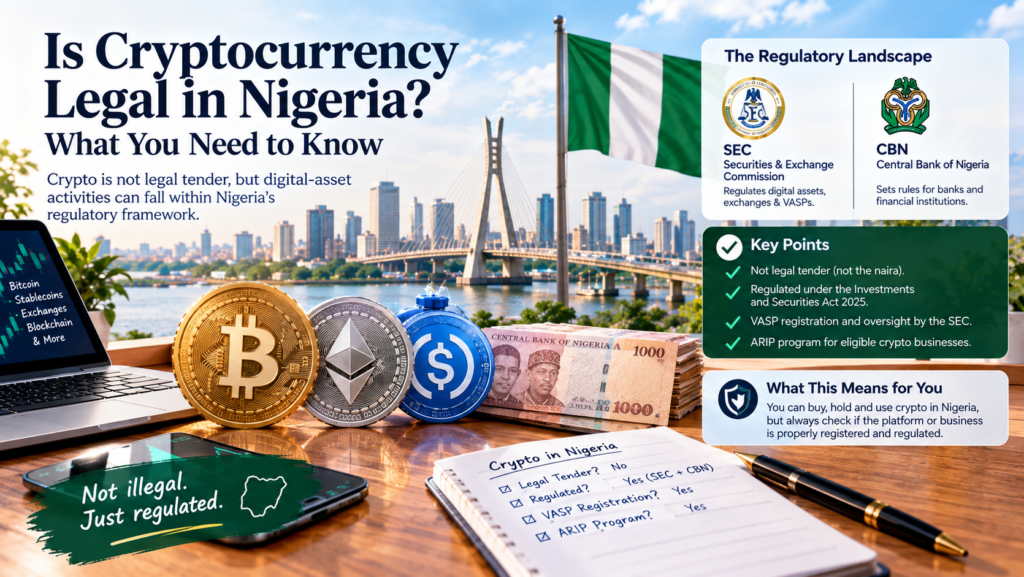
Nigeria does not treat cryptocurrency as legal tender like the naira. At the same time, the country has developed a regulatory framework for virtual assets, exchanges and other digital-asset businesses.
The Securities and Exchange Commission (SEC) is now playing a central role in regulating virtual asset service providers, while the Central Bank of Nigeria (CBN) has established rules governing how banks and other financial institutions interact with VASPs.
In 2026, the regulatory environment is becoming more structured, with the Investments and Securities Act 2025 explicitly giving the SEC powers over virtual and digital asset exchanges, VASPs and digital asset operators.
So, what does that actually mean for someone who owns or uses crypto in Nigeria?
Is Cryptocurrency Legal in Nigeria?
Crypto is not legal tender in Nigeria.
That means cryptocurrencies such as Bitcoin are not official Nigerian currency and are not issued or guaranteed by the Nigerian government.
However, that does not mean that cryptocurrency itself is simply prohibited.
Nigeria has moved toward regulating the digital asset industry rather than leaving it completely outside the financial system.
The SEC has established rules covering digital asset issuance, offering platforms, custody, virtual asset service providers and digital asset exchanges.
The country’s 2025 Investments and Securities Act goes further by explicitly giving the SEC authority to register and regulate virtual and digital asset exchanges, virtual asset service providers and digital asset operators.
So the key distinction is:
Crypto is not Nigerian legal tender, but digital-asset activities can fall within Nigeria’s regulatory framework.
What Does the SEC Have to Do With Crypto?
The Securities and Exchange Commission is the main regulator to understand if you want to know how crypto businesses are regulated in Nigeria.
The SEC has been developing its digital-asset framework for several years.
Its rules cover areas including:
- Digital asset issuance
- Digital asset offering platforms
- Digital asset custody
- Virtual Asset Service Providers
- Digital asset exchanges
- Certain investment-related activities involving digital assets
The SEC’s framework is designed around market integrity, investor protection and transparency while allowing digital-asset businesses to operate within a regulated environment.
This means a crypto exchange or digital-asset business operating in Nigeria cannot simply assume that being an online platform puts it outside financial regulation.
What Is a VASP?
You will often see the term VASP when reading about Nigerian crypto regulation.
VASP stands for Virtual Asset Service Provider.
Broadly, these are businesses providing services involving virtual assets.
Depending on the activity, this can include services connected to exchanging, transferring, safeguarding or facilitating transactions involving digital assets.
Nigeria’s SEC framework specifically provides for the registration and regulation of VASPs. The 2025 Investments and Securities Act also expressly includes VASPs within the SEC’s regulatory responsibilities.
For ordinary crypto users, this creates an important practical point.
Before using a platform that presents itself as a Nigerian crypto business, check its regulatory status rather than assuming that every exchange or investment platform is authorised.
Nigeria’s ARIP Program for Crypto Businesses
One of the most important developments in Nigeria’s crypto regulation is the Accelerated Regulatory Incubation Programme, commonly known as ARIP.
The SEC created ARIP as a controlled regulatory environment for Virtual Asset Service Providers and other digital investment businesses.
The programme allows the SEC to assess new business models and technologies while companies operate under defined conditions and supervision.
This is important because regulation does not necessarily mean shutting down innovation.
Instead, ARIP gives eligible businesses a pathway to operate within a controlled framework while the regulator evaluates their systems, governance, compliance and operational readiness.
However, there is an important distinction between Approval-in-Principle and a final licence.
The SEC made this clear in August 2026 when it announced three additional VASPs admitted to ARIP: Pisi Payments Solution Limited, BC Access (Nigeria) Limited and Yellow Card Financial Limited.
The SEC stated that their Approval-in-Principle allows them to operate within the defined scope of the programme and subject to its conditions, but it is not a final licence.
That distinction matters when checking whether a crypto platform is fully authorised.
What Changed With the Investments and Securities Act 2025?
Nigeria’s crypto regulatory framework also received a major legal foundation through the Investments and Securities Act 2025.
The Act gives the SEC authority to register and regulate virtual and digital asset exchanges, VASPs, digital asset operators and other relevant market participants.
This is significant because digital assets are no longer simply a technology issue.
Certain crypto-related businesses can now fall directly within Nigeria’s capital-market regulatory architecture.
The SEC’s revised capital requirements published in January 2026 also specifically include categories such as Digital Asset Exchanges, Digital Asset Custodians, Digital Asset Platform Operators, Digital Asset Intermediaries and other virtual-asset service providers.
For the industry, that means regulation increasingly involves more than simply registering a company.
Capital requirements, governance, operational controls and investor protection are becoming part of the regulatory conversation.
What Is the CBN’s Role?
The Central Bank of Nigeria is also relevant, but its role is different from that of the SEC.
In December 2023, the CBN issued guidelines covering the operation of bank accounts for Virtual Asset Service Providers.
The guidelines replaced earlier restrictions that had prevented banks and other financial institutions from operating accounts for cryptocurrency service providers.
Under the newer framework, banks and other regulated financial institutions can maintain banking relationships with VASPs subject to the CBN’s requirements.
However, the CBN also stated that banks and other financial institutions remain prohibited from holding, trading or transacting in virtual currencies on their own account.
That distinction is important.
It does not mean Nigerian banks are free to trade Bitcoin themselves.
Instead, the rules provide a framework for their banking relationships with regulated virtual-asset businesses.
Can Nigerians Own and Trade Crypto?
The regulatory framework is not the same as declaring crypto to be Nigerian legal tender.
Bitcoin and other cryptoassets remain different from the naira.
At the same time, Nigeria’s regulatory framework recognises digital assets and establishes rules for businesses operating in the sector.
The SEC’s digital-asset framework has covered crypto-related services for several years, while the 2025 Investments and Securities Act strengthened the Commission’s statutory role over virtual and digital asset businesses.
For users, the practical issue is therefore less about whether a cryptocurrency has become official money and more about which activity you are conducting and whether the service provider is properly regulated.
What About Crypto Exchanges?
Crypto exchanges deserve particular attention.
An exchange may provide services that fall within the SEC’s regulatory framework, depending on its activities and structure.
Nigeria’s SEC rules include requirements relating to Digital Asset Exchanges, while the 2026 revised minimum-capital framework sets specific capital requirements for regulated digital-asset entities.
For example, the SEC’s January 2026 circular lists a revised minimum capital of ₦2 billion for Digital Asset Exchanges and ₦2 billion for Digital Asset Custodians.
These requirements are aimed at strengthening the financial resilience of regulated market participants.
However, investors should not assume that every platform operating online is automatically regulated simply because it offers crypto services to Nigerians.
Checking the provider’s status remains important.
How Can Nigerians Check a Crypto Platform?
This is one of the most useful things a crypto user can do before depositing money.
The SEC has specifically warned Nigerians about unregistered online investment schemes.
In May 2026, the Commission said it had seen increasing promotion of unregistered investment schemes across platforms including WhatsApp, Instagram, Telegram, Facebook and TikTok.
The SEC advised the public to verify the registration status of investment platforms and companies through its official channels before investing.
That means you should not rely only on:
- Social media followers
- Influencer endorsements
- Telegram groups
- WhatsApp messages
- Screenshots of profits
- Celebrity promotions
- Testimonials
- Promises of guaranteed returns
A professional-looking website does not automatically prove regulatory approval.
What About Platforms Promising Guaranteed Returns?
This is another major warning sign.
The SEC has specifically advised Nigerians to avoid unregistered online investment schemes promising unrealistic or guaranteed returns.
Crypto prices can move significantly in either direction.
Therefore, anyone claiming that you can earn a guaranteed daily, weekly or monthly return from crypto should be treated with caution.
Be especially careful when the platform asks you to:
Deposit more money before withdrawing.
Pay a fee to unlock profits.
Send crypto to a personal wallet.
Recruit other investors to increase your returns.
Move the conversation to a private messaging app.
These features do not automatically prove fraud individually, but together they can indicate a serious risk.
Does Regulation Mean Crypto Is Safe?
No.
This is an important distinction.
Regulation can establish requirements for businesses, market operators and service providers.
It does not eliminate investment risk.
The SEC has repeatedly warned that cryptoasset investment can be extremely risky and may result in the loss of an investment.
Even when a platform is properly registered or operating within a regulatory programme, the value of the cryptocurrency itself can still rise or fall.
Regulation and investment performance are two different questions.
A regulated service provider does not mean that Bitcoin, Ether or another token is guaranteed to increase in value.
What Should Crypto Investors in Nigeria Look For?
Before using a crypto platform, consider several basic checks.
Check the company.
Find out who operates the platform and where the company is registered.
Check its regulatory status.
Look for relevant information from the SEC rather than relying on the platform’s own claims.
Understand the service.
An exchange, custodian, investment adviser and token issuer can have different regulatory requirements.
Read the terms.
Understand fees, withdrawal conditions and how your assets are held.
Avoid guaranteed returns.
Crypto investments remain exposed to market risk.
Protect your wallet.
Never give another person your private keys or recovery phrase.
Keep records.
Save transaction details, account statements and relevant communications.
These simple steps can reduce the risk of falling for an unregistered platform or fraudulent investment scheme.
What Does Nigeria’s Crypto Regulation Mean for the Industry?
Nigeria’s approach is becoming increasingly structured.
The country is not treating digital assets simply as an unregulated internet phenomenon.
Instead, regulators are building a framework that covers exchanges, custodians, VASPs, digital-asset platforms and other participants.
The ARIP programme is one example of how regulators are trying to accommodate new technology while maintaining oversight.
Meanwhile, the revised minimum-capital requirements show that regulatory expectations are becoming more demanding for businesses operating in the sector.
For legitimate crypto companies, this can mean higher compliance and operational costs.
For investors, it provides another reason to pay attention to whether a platform is operating within the relevant regulatory framework.
The Bigger Picture
So, is cryptocurrency legal in Nigeria?
The answer depends on what exactly you mean by “legal.”
Crypto is not Nigerian legal tender, and the naira remains the country’s official currency.
At the same time, Nigeria has established a regulatory framework for digital assets and businesses involved in the sector. The SEC has authority over VASPs, digital-asset exchanges and other digital-asset operators, while the CBN has rules governing banking relationships with VASPs.
The direction of travel is also becoming clearer in 2026.
Nigeria is moving toward a more formal digital-asset market, with regulatory programmes such as ARIP, updated capital requirements and the legal framework established under the Investments and Securities Act 2025.
For crypto users, that means legality should not be the only question.
A better question is:
Who regulates the platform, what service is it providing, and what protections and risks apply to the transaction?
As Nigeria’s crypto ecosystem continues to develop, understanding those distinctions can help users participate in the market with a clearer view of both the opportunities and the risks.
Need to Receive International Payments?
Open your USD, GBP & EUR account with Kolan.
Fill out the form and book your free consultation.
Secure Your Crypto & Get Cashback!
Free Delivery on Orders Over US$99!
Buy OneKey and Get 3–5 USDT Cashback!
Buy MyPal and Get Up to 5 USDT Cashback!
Leave a Reply