How to Spot Crypto Job Scams in Australia
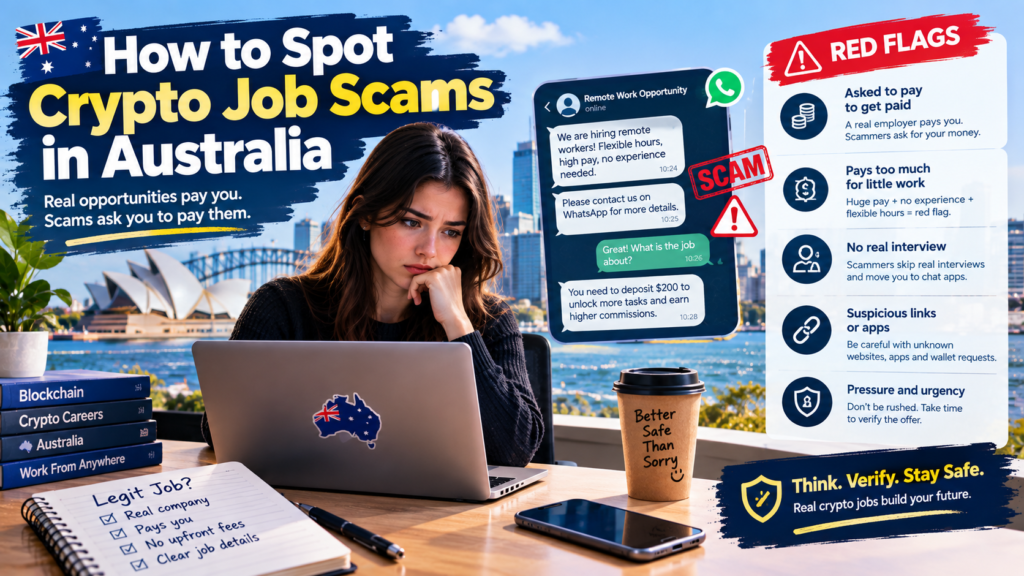
Finding a crypto job in Australia can be exciting.
The industry has created opportunities across blockchain development, marketing, compliance, customer support, research, business development and other areas. However, the same interest that attracts genuine employers also attracts scammers looking for people who want flexible work and quick income.
Australian authorities have repeatedly warned about employment scams that promise high-paying remote work while eventually asking victims to send money or cryptocurrency.
In May 2026, Scamwatch warned about recruitment scams impersonating well-known companies such as Amazon and YouTube. Victims were contacted about flexible, well-paid work, moved to encrypted messaging platforms such as WhatsApp and eventually told to use their own money or cryptocurrency to unlock tasks and commissions.
So how can Australian job seekers tell the difference between a genuine crypto career opportunity and a fake one?
What Is a Crypto Job Scam?
A crypto job scam is an employment fraud designed to make you believe you are being hired for a legitimate role.
Instead of paying you a salary, the scammer may try to make money from you.
The fake position could be advertised as a remote assistant, community manager, customer support representative, marketing specialist, e-commerce worker, finance agent or another simple online role.
Some scams are directly related to cryptocurrency. Others look like ordinary work-from-home jobs but eventually introduce crypto payments or a cryptocurrency wallet.
Scamwatch says common employment scams promise high income for little effort and may involve unexpected contact through text messages or encrypted messaging platforms such as WhatsApp, Signal or Telegram.
The important difference is simple:
A legitimate employer pays you to work. A job scam eventually finds a reason for you to pay them.
How Crypto Job Scams Usually Work
The first message can look surprisingly normal.
You might receive a message saying that a company is hiring remote workers. The recruiter may mention flexible hours, attractive pay and no previous experience required.
Sometimes the scammer uses the name and logo of a real company.
Other times, they create a completely fake crypto company with a professional-looking website, LinkedIn profile and job advertisement.
Once you respond, the conversation may quickly move to WhatsApp, Telegram or another messaging service.
The “recruiter” may then explain that your role involves completing simple tasks.
At first, everything can appear legitimate.
You may even receive a small payment.
That is where the scam can become more convincing.
The Small Payment Trick
Scammers sometimes pay victims a small amount at the beginning.
Scamwatch describes this as part of task-based job scams. After completing an initial set of tasks, victims may receive a small cryptocurrency payment to make the opportunity appear genuine.
Then the rules change.
You may be told that you need to:
- Deposit money to unlock more tasks
- Top up a cryptocurrency account
- Pay a fee before withdrawing your earnings
- Purchase a special package
- Deposit more money to access higher commissions
- Pay a “tax” or “verification fee”
- Recruit other people to increase your income
The website or app may even show your supposed earnings increasing.
But when you try to withdraw the money, another payment is required.
Then another.
Eventually, the scammer may disappear or stop allowing withdrawals.
Red Flag #1: You Are Asked to Pay to Get Paid
This is one of the clearest warning signs.
A genuine employer should not require you to send your own money or cryptocurrency to perform ordinary employment tasks.
Scamwatch specifically warns Australians not to enter job arrangements that require upfront payment through bank transfer, PayID or cryptocurrency.
Be particularly careful if someone says:
“Deposit $200 to unlock a $500 commission.”
Or:
“Top up your crypto balance before you can withdraw your salary.”
These are not normal employment conditions.
If you have to spend your own money to access your supposed wages, stop and verify the offer independently.
Red Flag #2: The Job Pays Too Much for Very Little Work
A job promising hundreds of dollars per hour for simple tasks may sound attractive.
That is exactly why scammers use it.
Scamwatch warns about employment offers promising high income while requiring little effort, little experience or no qualifications.
Be especially cautious when an advertisement combines:
High pay + no experience + flexible hours + work from home + immediate start.
Any one of these characteristics can appear in a legitimate job.
The combination, particularly when paired with pressure to send money, deserves much more scrutiny.
Red Flag #3: There Is No Real Interview
A genuine employer usually wants to understand whether you are suitable for the position.
Depending on the role, that could involve a phone call, video interview, technical assessment, portfolio review or discussion about your previous experience.
Scammers often skip this process.
Instead, they may hire you within minutes of contacting you.
Scamwatch identifies a very quick hiring process, with no interview or discussion of qualifications, experience or references, as a warning sign.
If someone claims to have hired you without asking anything about your skills, take a step back.
Red Flag #4: The “Recruiter” Contacts You Unexpectedly
An unsolicited message does not automatically mean a job is fake.
However, it should make you verify the opportunity carefully.
Scamwatch’s 20 May 2026 alert specifically warned about scammers impersonating recruiters and contacting people through SMS before moving them to encrypted messaging platforms.
You might receive a message such as:
“Hi, we found your profile and have a remote crypto opportunity for you.”
The message may then ask you to continue the conversation on WhatsApp.
Instead of following the link or phone number provided by the recruiter, find the company’s official website yourself.
Then contact the company through information published on that website.
Red Flag #5: The Company Exists, But the Job Does Not
This is one of the more difficult scams to identify.
A scammer may impersonate a real company.
They could copy its logo, use the name of an actual employee and reproduce details from a legitimate job advertisement.
That does not make the offer genuine.
Scamwatch specifically warns that fake job advertisements can appear even on trusted platforms and websites.
So seeing a job on a familiar platform is not enough.
You still need to verify the employer.
How to Verify a Crypto Company in Australia
Before sharing personal information or accepting an offer, investigate the company independently.
Start with the official website.
Do not use the website link provided by the recruiter.
Instead, search for the company yourself.
Check whether:
- The company has a real website
- The domain matches its official branding
- The job appears on its careers page
- The recruiter actually works for the company
- The company’s contact details are consistent
- Employees have credible professional profiles
- The company has a genuine business presence
- The email address matches the company’s domain
If the recruiter claims to represent a major crypto company, contact that company using a phone number or email address you found independently.
Scamwatch recommends sourcing contact details yourself rather than relying on information supplied by the person who contacted you.
Legitimate vs Fake Crypto Jobs
Sometimes the easiest way to identify a scam is to compare the hiring process.
| Legitimate Crypto Job | Potential Crypto Job Scam |
|---|---|
| Detailed job description | Vague description |
| Real interview | Instant hiring |
| Skills and experience discussed | No qualifications required |
| Company-domain email | Random or free email address |
| Salary or compensation explained | Unrealistic income promises |
| Employer pays you | You must pay first |
| Normal recruitment process | Pressure to act immediately |
| Official careers page | Only advertised through messages |
| No need to deposit crypto | Asked to top up crypto |
| References or background checks may apply | Little or no verification |
Not every legitimate company will follow exactly the same recruitment process.
Likewise, one warning sign alone does not prove an offer is fraudulent.
The goal is to look at the entire picture.
Be Careful With Crypto Wallet Requests
A genuine crypto job may involve blockchain technology or even require you to use a crypto wallet for legitimate business purposes.
But there is a major difference between using crypto as part of your job and being asked to send your own crypto to an employer.
Never provide your private key or recovery phrase to a recruiter.
You should also question any request to connect your personal wallet to an unfamiliar website as part of a supposed recruitment process.
If the employer says you need to purchase cryptocurrency before starting work, stop and independently verify the company.
Protect Your Personal Information
Money is not the only thing scammers want.
A fake employer may ask for identity documents during the application process.
They could request your passport, driver’s licence, bank details, cryptocurrency account information or other personal information.
Some legitimate employers may need identification for employment or legal reasons.
The important question is who is requesting it and why.
Scamwatch advises job seekers to be careful about providing personal information and not to send identity documents unless they are confident the employer or recruitment firm is genuine.
If a stranger on WhatsApp asks for your passport before even conducting an interview, that should raise serious questions.
What About Crypto Jobs on LinkedIn?
LinkedIn can be useful for finding genuine crypto employment.
But a professional-looking profile does not guarantee that the person contacting you is legitimate.
Scammers can create convincing profiles, copy information from real employees and use company branding.
The same principle applies to other platforms.
A job posted on a trusted website can still be fake, according to Scamwatch.
Therefore, verify the opportunity through the company’s independent official channels before providing sensitive information or sending money.
What If the Recruiter Pressures You?
Pressure is another important warning sign.
A scammer may say:
“Only five positions are available.”
Or:
“You need to deposit the money today.”
Or:
“Your account will be closed if you don’t complete the task now.”
Scamwatch’s 2026 recruitment scam alert highlighted fake job offers that created urgency by claiming that only a limited number of positions were available.
A legitimate employer should give you reasonable time to consider an employment offer.
You do not need to make a rushed financial decision just because someone calls themselves a recruiter.
What Should You Do If You Think It Is a Scam?
Stop communicating with the person and do not send additional money.
If you have already transferred money, contact your bank or payment provider immediately.
If you provided personal information, consider taking steps to protect your identity.
Scamwatch recommends contacting IDCARE for support if you have shared identity information. It also recommends reporting scams through Scamwatch so authorities can identify patterns and help protect others.
Change passwords if you shared account information or believe your accounts may have been compromised.
If cryptocurrency was involved, preserve transaction records, wallet addresses, screenshots and messages. These details may be useful when reporting the incident.
What a Real Crypto Career Should Look Like
A genuine crypto job can still be remote.
It can still offer flexible working arrangements.
It can still pay well.
And it can still involve cryptocurrency.
The difference is the hiring process.
A legitimate employer should be interested in your skills and experience. You should be able to research the company independently. The compensation structure should be explained clearly, and you should not have to send your own money to unlock your salary.
Crypto companies also hire for many conventional professional roles.
You can find opportunities in:
- Software engineering
- Blockchain development
- Marketing
- Content
- Community management
- Compliance
- Legal
- Finance
- Customer support
- Product management
- Business development
- Research
- Data and analytics
You do not need to participate in a trading scheme to work in crypto.
The Bigger Picture
Crypto employment is becoming a broader career category.
As blockchain companies build exchanges, wallets, payment systems, stablecoins, infrastructure and financial products, they need people with skills far beyond programming.
That creates genuine opportunities for Australian workers.
At the same time, scammers understand that people are actively searching for remote jobs and additional income. Scamwatch’s latest recruitment warning shows how fraudsters can combine well-known company names, attractive salaries, flexible work and cryptocurrency payments to make fake opportunities look convincing.
The safest approach is not to avoid every crypto job.
It is to verify before you trust.
Check the company independently. Confirm the recruiter. Look for a real interview process. Understand how you will be paid. Never pay money to unlock your supposed salary. And never give your wallet recovery phrase to an employer.
A real crypto career should require your skills, not your savings.
Need to Receive International Payments?
Open your USD, GBP & EUR account with Kolan.
Fill out the form and book your free consultation.
Secure Your Crypto & Get Cashback!
Free Delivery on Orders Over US$99!
Buy OneKey and Get 3–5 USDT Cashback!
Buy MyPal and Get Up to 5 USDT Cashback!
Leave a Reply