Is Cryptocurrency Legal in the UK?
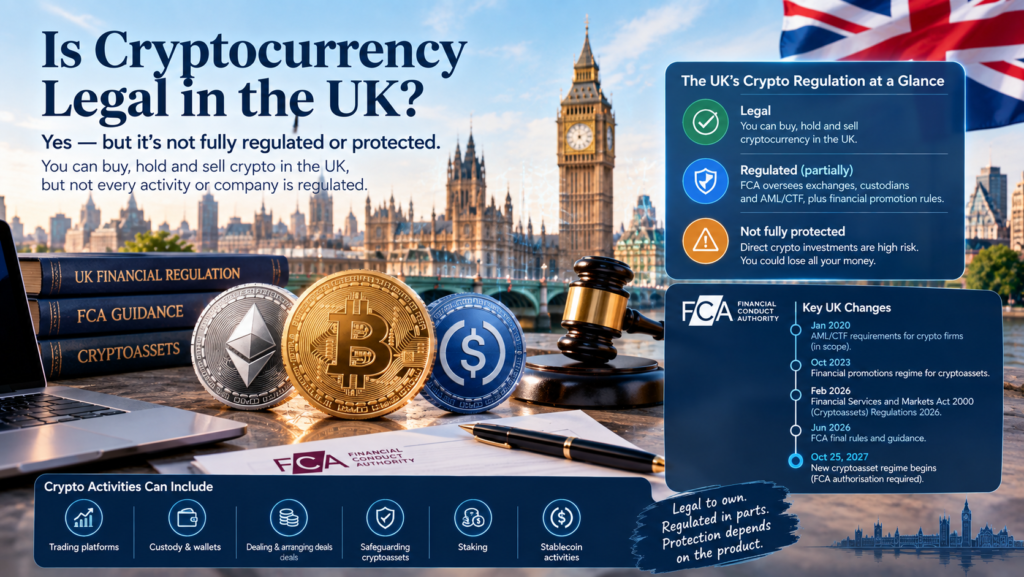
Can you legally buy Bitcoin in the United Kingdom?
Yes.
But that simple answer comes with an important qualification: the fact that cryptocurrency is legal does not mean that every crypto activity or crypto company is fully regulated in the UK.
The UK’s approach to digital assets has been evolving rapidly. Crypto businesses already face anti-money laundering and financial promotion requirements, while a much broader regulatory regime is being prepared for October 2027.
For anyone considering investing in cryptocurrency in the UK, understanding the difference between legal, regulated and protected is essential.
So, Is Cryptocurrency Legal in the UK?
Cryptocurrency itself is not generally prohibited in the UK.
The Financial Conduct Authority (FCA) recognises cryptoassets including Bitcoin and similar cryptocurrencies as a category of digital assets. The FCA has also stated that many cryptoassets, including Bitcoin and Litecoin, have historically fallen outside its broader financial services regulatory perimeter.
That means UK residents can buy, hold and sell cryptoassets.
However, investors should not automatically assume that buying cryptocurrency gives them the same protections available when investing in traditional regulated financial products.
The FCA specifically warns that direct investments in many cryptoassets are high risk and that consumers should be prepared to lose all the money they invest.
So, legal does not necessarily mean protected.
What Does the FCA Actually Regulate?
The FCA’s role in crypto has expanded over time.
Since January 2020, UK cryptoasset businesses such as exchange providers and custodian wallet providers have been subject to anti-money laundering and counter-terrorist financing requirements.
Crypto businesses within scope generally need to register with the FCA for money laundering supervision.
The UK also introduced a financial promotions regime for cryptoassets in October 2023.
Under the current framework, firms marketing qualifying cryptoassets to UK consumers must follow specific rules. The FCA identifies four legal routes through which cryptoasset promotions can be communicated to UK consumers, including communication by an authorised person or certain FCA-registered cryptoasset businesses.
This is an important distinction.
A company being allowed to advertise or operate under a particular regulatory framework does not automatically mean every cryptoasset it offers is itself a fully regulated investment.
Is Bitcoin Regulated in the UK?
Bitcoin occupies an unusual position under the UK’s existing framework.
The FCA describes Bitcoin, Litecoin and similar cryptocurrencies as examples of “unregulated tokens” where they do not fall into categories such as security tokens or e-money tokens.
However, that does not mean everything connected to Bitcoin is outside regulation.
For example, certain investment products that reference cryptoassets, such as derivatives, can fall within the FCA’s regulatory perimeter.
The activity surrounding a cryptoasset can therefore matter just as much as the asset itself.
What About Crypto Exchanges?
This is where investors need to pay attention.
Crypto exchange businesses operating in the UK can be subject to FCA requirements, particularly around anti-money laundering and financial promotions.
However, the current registration system should not be confused with the full regulatory regime that is coming.
The FCA explains that the UK’s new cryptoasset regime will introduce broader requirements for activities such as operating trading platforms, dealing and arranging deals, safeguarding cryptoassets, staking and certain stablecoin activities.
In other words, the regulatory status of a crypto company can depend on which rules currently apply and which activities the company performs.
The UK Is Building a Much Broader Crypto Framework
The UK’s crypto rules are now moving beyond the earlier focus on money laundering and financial promotions.
On 4 February 2026, Parliament made the Financial Services and Markets Act 2000 (Cryptoassets) Regulations 2026.
The legislation creates the foundation for a broader financial services regulatory framework covering cryptoassets.
The FCA subsequently published final rules and guidance on 30 June 2026.
These rules cover areas including regulated cryptoasset activities, stablecoin issuance, prudential requirements, market integrity and the application of FCA standards.
The full new regime is scheduled to commence on 25 October 2027.
What Changes in October 2027?
The upcoming regime is one of the biggest developments in the UK’s crypto market.
From 25 October 2027, firms carrying out regulated cryptoasset activities in the UK will generally need FCA authorisation unless a relevant exemption or transitional arrangement applies.
The activities covered include areas such as:
- Operating cryptoasset trading platforms
- Safeguarding cryptoassets
- Dealing in qualifying cryptoassets
- Arranging cryptoasset transactions
- Certain staking activities
- Issuing qualifying stablecoins
Regulatory treatment depends on the specific activity and type of cryptoasset involved.
Published in September 2026, the FCA’s final perimeter guidance is designed to help firms determine when authorisation will be required.
Can UK Investors Still Buy Crypto?
Yes.
The upcoming regulatory regime does not amount to a general ban on cryptocurrency ownership.
Instead, the regulatory focus is increasingly on how crypto businesses operate and what services they provide.
For investors, that means the important questions go beyond simply asking whether Bitcoin or another cryptocurrency is legal.
You should also consider:
Who is providing the service?
Is the company registered or authorised where required?
What type of cryptoasset are you buying?
What protections apply to the product?
How is the company allowed to market the investment to UK consumers?
These questions can help distinguish a legitimate crypto service from an unregulated or potentially fraudulent operation.
Legal Does Not Mean FSCS Protected
This is one of the most important points for UK investors.
Traditional financial products may come with protections under specific circumstances.
Direct crypto investments generally do not receive the same protection.
The FCA states that direct investments in cryptoassets are not protected by the Financial Services Compensation Scheme (FSCS), and consumers should be prepared to lose the money they invest.
Therefore, an investor should not interpret the legal status of cryptocurrency as a guarantee of financial protection.
The two concepts are completely different.
Legal means an activity is permitted under applicable law.
Regulated means a particular activity or firm falls within a regulatory framework.
Protected means specific investor or consumer protections apply.
A crypto product can be legal without providing the same protections as a traditional regulated investment.
What Should UK Investors Check Before Buying Crypto?
Before investing, it is worth checking the company behind the service.
The FCA maintains information about firms operating within its regulatory framework, and investors should be cautious about businesses that make unrealistic promises or use misleading promotional material.
The regulator also warns that scams are common in the crypto sector.
A particularly important warning sign is a promise of guaranteed or unusually high returns.
Crypto prices can be extremely volatile, and the FCA describes crypto investments as high risk and speculative.
Investors should therefore understand what they are buying rather than treating regulatory status as a substitute for research.
What About Overseas Crypto Companies Serving UK Customers?
UK rules can also apply to companies based outside the country when they market cryptoassets to UK consumers.
According to the FCA, its financial promotions regime covers firms promoting cryptoassets to UK consumers, regardless of where those firms are based.
Looking ahead, the regulatory framework also considers overseas firms that provide cryptoasset services to UK consumers.
This matters because a company having an international presence does not automatically mean it is authorised to provide every type of crypto service to UK customers.
Location, activity and regulatory status all matter.
The UK Crypto Rulebook Is Still Developing
Although the UK has already passed the legislation for its new regime, the regulatory transition is not finished.
The FCA published its final rules in June 2026 and its latest perimeter guidance in September 2026.
The FCA says the application window for firms using transitional arrangements opens on 30 September 2026 and closes on 28 February 2027.
Meanwhile, the government has also been making targeted amendments to the cryptoasset regulations, including changes relating to stablecoin payment services.
That means businesses and investors should pay attention to the rules in force at the time they act rather than relying on older information.
So, Can You Legally Invest in Cryptocurrency in the UK?
Yes.
Buying and holding cryptocurrency is not generally banned in the United Kingdom.
However, the UK’s approach is more nuanced than simply calling crypto “legal” or “illegal.”
Some cryptoassets and activities remain outside the FCA’s current broader regulatory perimeter, while other activities are already subject to specific requirements.
At the same time, the UK is building a much wider framework that will bring additional cryptoasset activities under FCA regulation from October 2027.
For investors, the key takeaway is simple:
Crypto can be legal without being fully regulated or protected.
Understanding that difference can help UK investors make more informed decisions before putting money into digital assets.
The Bigger Picture
The UK’s crypto market is entering a different phase.
A broader financial services regime is now taking shape, moving beyond the country’s earlier focus on anti-money laundering and financial promotions. The framework is expected to cover activities such as trading platforms, custody, dealing, staking, and stablecoins.
For investors, that means the regulatory environment will become increasingly important.
For crypto companies, it means compliance will become a much bigger part of doing business in the UK.
And for the wider industry, the question is no longer simply whether cryptocurrency is legal.
The bigger question is which crypto activities are regulated, who is authorised to provide them, and what protections consumers actually receive.
That distinction will become even more important as the UK’s new cryptoasset regime approaches its October 2027 start date.
💸 GET PAID GLOBALLY WITH KOLAN
Need to receive international payments? Open your USD, GBP, EUR & AED accounts with Kolan and make international payments easier.
Fill out the form and book your free consultation:
🔐 SECURE YOUR CRYPTO WITH ONEKEY OR ELLIPAL
Get free delivery on orders over US$99 + up to 5 USDT cashback.
Leave a Reply